
Since our first day in freshman year, we familiarized ourselves with the campus layout — navigating to classes, planning out the fastest routes and utilizing bikes and skateboards to help us hurry between buildings. As we trace our familiar routes to class each week, we might notice some hidden artworks around campus — statues in steel, bronze or aluminum, blending into the background, forming unique landscapes as the seasons change. These are our new old friends: the public art collection of Middlebury College.
The collection features around 30 artworks by nationally and internationally recognized artists. The artworks are installed, maintained and interpreted by the Committee on Art in Public Places (CAPP), composed of faculty, students, administrators and trustees. The Committee was established in the fall of 1994 after Middlebury’s Board of Trustees adopted a “One Percent for Art” policy to allocate funds for the purchase, construction and renovation of artworks.
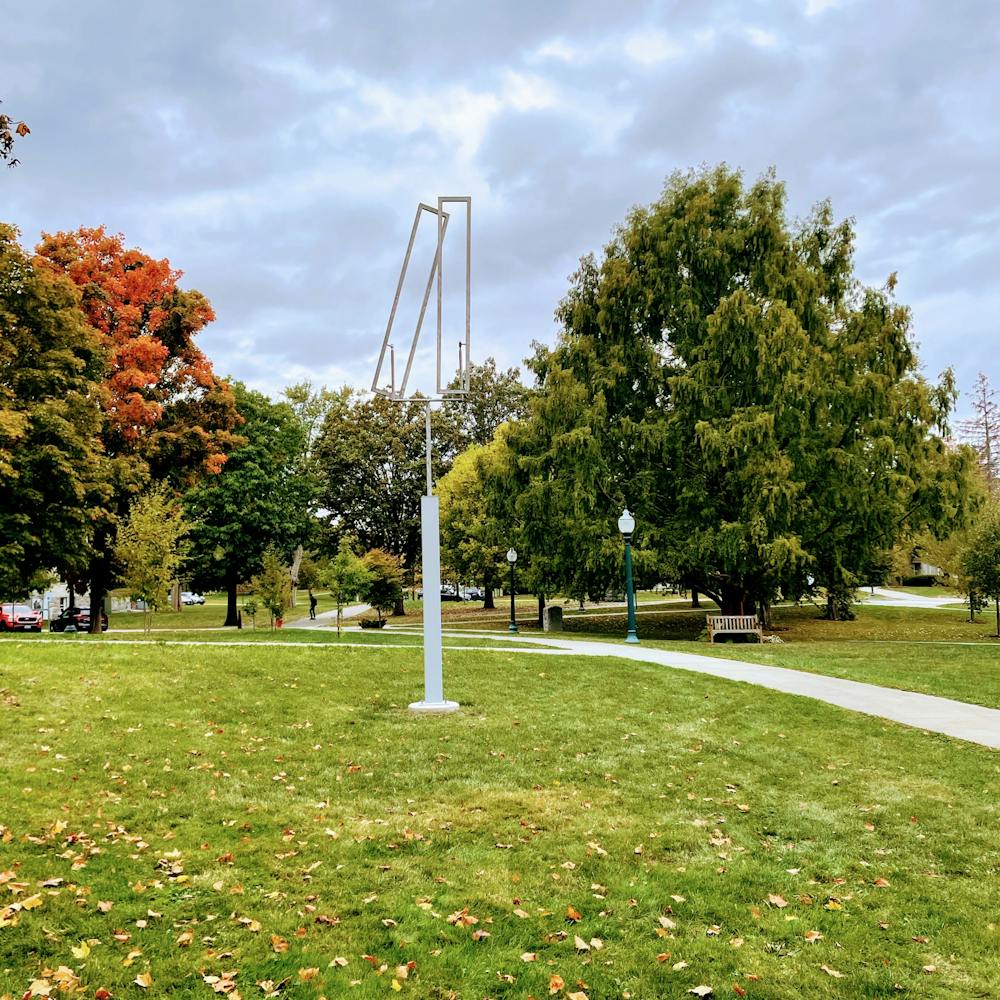
A week ago, on my way to the Davis Family Library, my attention was caught by the newly installed steel sculpture in front Warner Hall. The two rectangles moved slowly, cutting beams of sunlight in the process and fragmenting the blue sky in the backdrop into different geometric forms. There were moments I thought that the two were going to collide, but they simply slid past each other gracefully.
The “Two Open Rectangles” by George Rickey is a 12 × 3 × 3 feet stainless steel kinetic sculpture. It’s an old friend of the college, originally installed in front of the Johnson Memorial Building.
Douglas Perkins, associate director for operations and finance at the Museum of Art recounted its checkered history.
“The sculpture was stolen in the summer of 1976, replaced in 1977 with an alarm installed at its base to deter theft and finally removed in 2022 during the renovation of the Johnson Memorial Building,” Perkins wrote in an email to the Campus.
This piece does not depend on any mechanical devices to create movements; instead, it was designed–under the influence of Alexander Calder’s mobiles–to move freely in response to the surrounding air currents. This allows it to perform unprogrammed random movements that reflect the day’s condition. Some days it rests almost immobile, where we can barely detect its movement; other times it moves rapidly, waving its “arms” and taking up space around it. The invisible air guides its motion and breathes life into it. In return, the sculpture makes visible the subtle movements of air that usually go unnoticed.
Frederick C. Dirks Professor of International Economics William Pyle has his office situated on the third floor of Warner hall, his window facing the “Two Open Rectangles” and also admires the work.
“I could see it from my office every day, and I guess that’s why I’m mutually obsessed with it,” Pyle said. “It brightens my day. The rectangles are perfectly flat from my viewline because they align so precisely. When the wind picks up, the two rectangles collide through space in unpredictable ways, and I find it mesmerizing. Sometimes they form ‘X’s, sometimes ‘V’s, and there’s always a moment when you can see through them like a frame. It’s not just an artwork but also a frame for what’s beyond — especially as the seasons change.”
Each artwork in the collection embodies their own story. Some were directly purchased or commissioned, others were gifted to the college, and a few were added to complement specific construction projects. Tony Smith’s “Smog” was acquired as part of the construction of Bicentennial Hall, celebrating the intersection of science and livelihood. Composed of carefully arranged octahedrons, it offers different visual effects from each viewing angle, with the most ideal viewpoint from above.
These works often add moments of surprise to my daily life. The first time I saw the “Frisbee Dog” on Battle Beach from a distance, I mistook it for a real figure. Upon closer inspection, I was amused by its energy and how it captures motion so vividly through a stationary form. Perkins noted that it’s a good way to celebrate the invention of the frisbee — which, according to some Middlebury students, originated here in 1939.
Many of these artworks are old acquaintances of Middlebury College — most have been here longer than us. Unlike the exhibits in the museum, they integrate into our living and studying environment, fade into the backdrop of college buildings.
Sabarsky Graduate Fellow at the Museum of Art Eloise McFarlane ’24.5 and her team created maps of the public artworks to raise awareness of the collection. These maps are available in the Johnson Gallery, the Davis Family Library and other campus locations. A new guide on public sculptures will also launch in December, accessible on the mobile phone app “Bloomberg Connects.”
“When I was a student, I thought the public works weren’t appreciated, so I have the opportunity now at the museum to try and give them a little bit more love and recognition,” McFarlane said.
We are fortunate to have this collection of public artworks accompanying us, shaping our shared memories of Middlebury and adding moments of surprise to our daily lives. Next time you come across one of these new old friends, take a moment to pause and get to know it by name.
Yoyo Zhang '28 (she/her) is an arts & culture editor.
Yoyo is an Applied Math and History double major. She enjoys watching live theater and is also an actor herself. She has a wide interest including calligraphy, snowboarding, and painting.


