
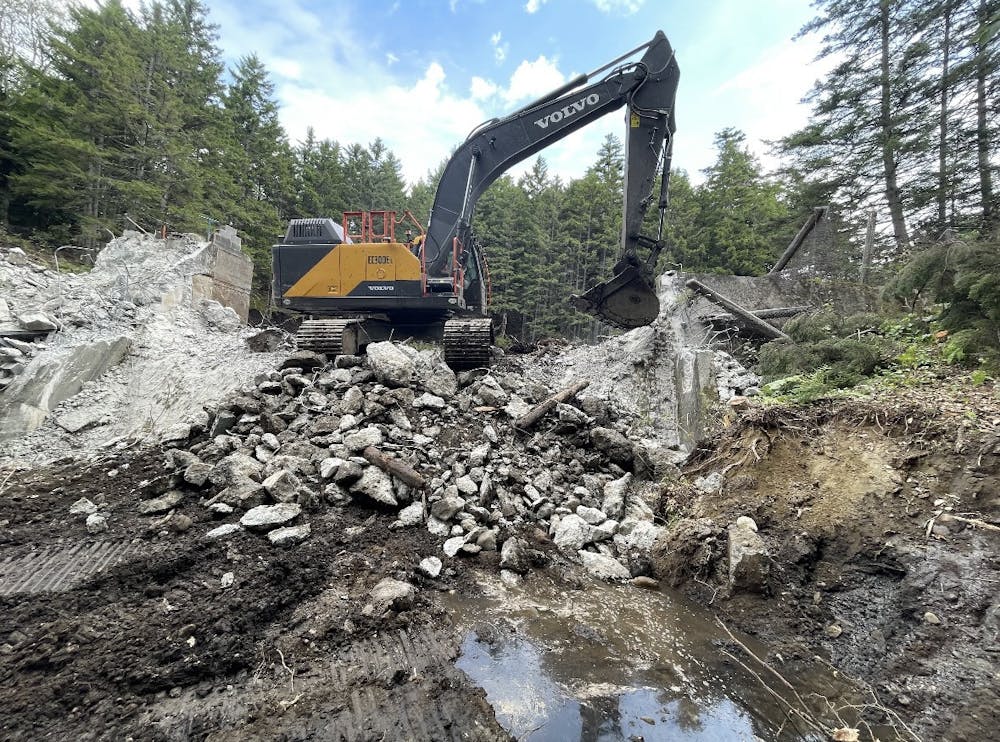
In a culmination of a years-long effort and collaboration between the college and the Vermont Natural Resources Council (VNRC), the Bread Loaf Dam on Brandy Brook in Ripton was completed on Aug. 27, restoring the stream and surrounding floodplain to its natural state.
An application to remove the dam was first submitted in 2021, according to Associate Laboratory Professor at Middlebury and College Lands Conservationist Marc Lapin and Science and Restoration Director at VNRC Karina Dailey. The century-old structure had accumulated excess sediment, suffered from poor maintenance and harmed wildlife while posing a flood risk to nearby areas. Its removal marked a major ecological restoration aimed at improving habitat health across the watershed.
The concrete dam, built by the college in 1937, is approximately 175 feet long and 25 feet high. Originally constructed to provide a drinking water supply to the Bread Loaf campus, it was later used as a snowmaking pond for the Rikert Nordic Center. Both purposes have since been replaced by more efficient systems, a well system for drinking water and an instream intake for snowmaking, rendering the dam obsolete, according to VRNC.
Lapin said the project involved numerous regulatory and organizational hurdles.
“Any sizable project must be reviewed under Act 250,” Lapin said, referring to Vermont’s land use and development law. “It made Vermont famous for being a green state. There are lots of layers in the application for permitting as well.”
Passed in 1970, Act 250 ensures that large-scale development complements Vermont’s landscape, economy and communities, according to the Vermont Land Use Review Board.
“Vermont conservation design [is] a statewide goal of connecting forest and riparian areas for wildlife corridors,” Dailey said. “Reconnecting this river and taking the barrier out is providing movement for future migration of aquatic organisms and wildlife up and down that portion of the river.”
Although administrative reviews delayed the project, the removal itself only took a few weeks. Engineers and Act 250 district commissioners ultimately approved the demolition of the historic structure. The focus now turns to replanting and stabilizing the site.
“The soil is reshaped, the stream is reshaped, and replanting the area in the fall is hard,” Lapin said. “The winter flows will change what decisions we will make in the spring for replanting.”
The site itself has already been seeded with a natural mix and mulched with straw preventing weeds from growing according to Lapin. She also noted that natural reseeding from spruce, birch and pine trees will also occur through seasonal foliage changes.
The college supported the removal by providing resources from Facilities and the Environmental Science Department. The Vermont Department of Fish and Wildlife also backed the project, citing benefits to native fish species such as Eastern brook trout.
The Vermont Dam Safety Division identified the dam as high-risk for flooding in the area, particularly to a critical road nearby. Restoring floodplain storage will help naturalize downstream movements of water and sediment, mitigating flood risks in the region. The removal will also improve water quality by increasing dissolved oxygen and reducing turbidity, according to Lapin and Dailey.
Dailey also emphasized the importance of local involvement in such restoration projects.
“The more people involved in the project, the stronger the project is,” Dailey said. “We start at the grassroots level within the community and then we move forward with providing funding support, the science, technical expertise and collaboration. The Breadloaf dam removal was a really sweet example of community partnership and collaboration.”
Editor’s Note: Managing Editor Mandy Berghela ’26 contributed in writing this article.


