
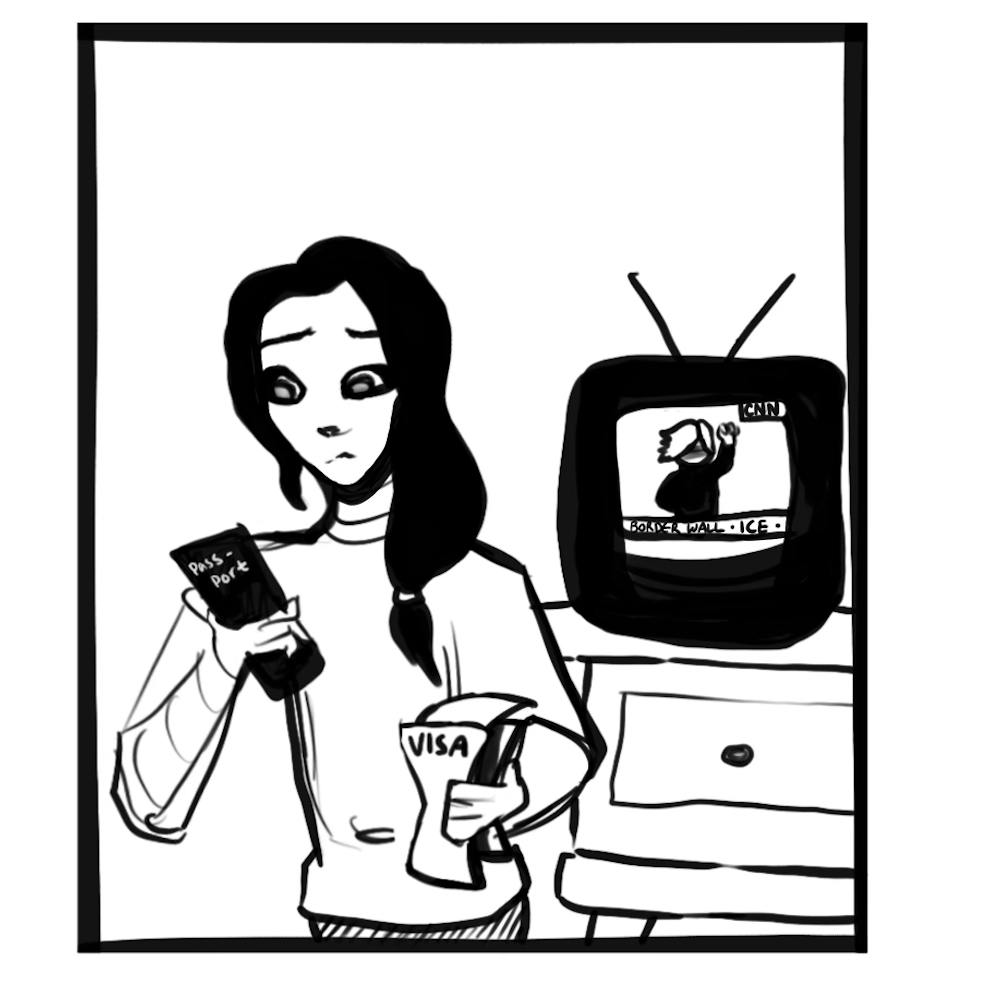
This fall, 292 international students from 75 countries are enrolled at Middlebury and all were able to obtain their proper documentation to return, according to Smita Ruzicka, Vice President for Student Affairs. But the process was not without challenges.
As a result of the Trump administration’s recent attacks on international students’ right to study in the U.S., travel bans imposed on some countries, pauses placed on new visa interviews and the introduction of social media screening requirements for visa applicants, Middlebury students experienced delays and anxieties over the summer when forming their plans for this year. Last spring, an international student at the college had their Student Exchange Visitor Information System (SEVIS) records revoked, ending their lawful status in the country.
Executive Director of International Student and Scholar Services (ISSS) Kathy Foley told The Campus that while nearly all visa delays were resolved in time, one student’s late appointment meant they had to arrive on campus after they had planned. Concerns amongst the international community at the college about studying and eventually remaining and working in the U.S have grown.
The students that spoke with The Campus for this story did so under the condition of anonymity due to fear of being targeted by the federal government, but editors have confirmed their identities.
Some students had to apply for a new F-1 visa over the summer, as the U.S. only issues one-year visas to students of certain nationalities. Among the first to undergo the new social media screening, they reported difficulties with the procedure and concerns over their privacy.
“During my interview, one of the first questions they asked was for my social media handles and whether the account I wrote down was public,” a student told The Campus. “Because my Instagram was private, they couldn’t monitor it, so my visa application would be on hold until I went back and made it public.”
In order to prevent having her application rejected, the student unfollowed some activist accounts, especially those that support Palestine in the context of the Israel-Palestine conflict.
“It felt like such a violation of my privacy and my rights,” she wrote. “But I needed my visa to be processed, so I really had no choice.”
She also said that this year, fewer visa interview slots were available compared to previous years, adding that she “barely managed to get the last one of the month.”
A student from Ukraine shared a similar story. After studying abroad last semester, they were required to renew their visa. When they went to schedule their interview in February, the earliest available appointment was in January 2026. After managing to secure a slot, their visa was placed on hold, which they suspect was due to the social media screening policy.
“The [U.S Consulate] officer explained that it’s not a rejection per se, but a special status my application was being put in because there is some kind of additional check they need to do, and the officer himself couldn’t do it on the spot,” the student wrote in an email to The Campus.
The student feared that the Trump administration’s view of Ukraine, as well as their posts in support of Palestine, might cause the visa to be rejected. Fortunately, the visa was approved after a week.
“Watching that Zelensky visit in the White House, I imagined that Ukrainians could be faced with travel bans as well,” the student wrote, referring to the Ukrainian president’s meeting with President Trump and Vice President JD Vance in February that was cut short by a heated argument in which Vance accused Zelensky of of being ungrateful for U.S. support. “I’m somewhat scared about the new policies in the US, in particular because of how unpredictable they are. It’s difficult to never know how things can evolve from here.”
One student said that precarious visa appointments and policies caused him and other international students he knows to worry in the months leading up to the semester and adjust their plans accordingly.
“The spotlight around this issue has discouraged many of us to attempt making any international travel plans for the summer, breaks, etc. due to the uncertainty and risk,” he wrote.
On Aug. 27, the Trump administration proposed a policy that would halt the open-ended ‘duration of status’ for foreign students, citing national security and visa abuse concerns. Under the new rule, international students would only be allowed to remain in the U.S. for the duration of the program they enroll in, with a cap of four years’ time.
This rule is now under the official rule-making process, which involves a comment period before the final rule will be implemented. If finalized, the flexibility for international students to pursue their studies in the U.S. will be reduced. The ISSS team is currently assessing the potential impacts of this proposed rule on the international community at Middlebury, Foley noted.
As listed on the Approach to National Events page, Middlebury’s administration has claimed commitment to monitoring federal policy changes and taking actions when appropriate. ISSS also closely reviews news and information that relates to immigration and issues that may affect Middlebury’s international community, according to Foley.
“We're going to continue monitoring SEVIS records like we started doing in the spring to make sure there were no revocations,” Ruzicka said to faculty at a meeting on the Bread Loaf Campus on Sept. 5.
Hugo Zhang '28 (he/him) is a News Editor.
Hugo previously served as an Online Editor. He intends to major in Economics and Geography. He enjoys cartography, traveling, and history. Last summer, he studied at Sciences Po Paris and traveled across Europe. He has also conducted research on ethnic minority policies, economic transformation, and urban planning in Northeastern China, also known as Manchuria.


