
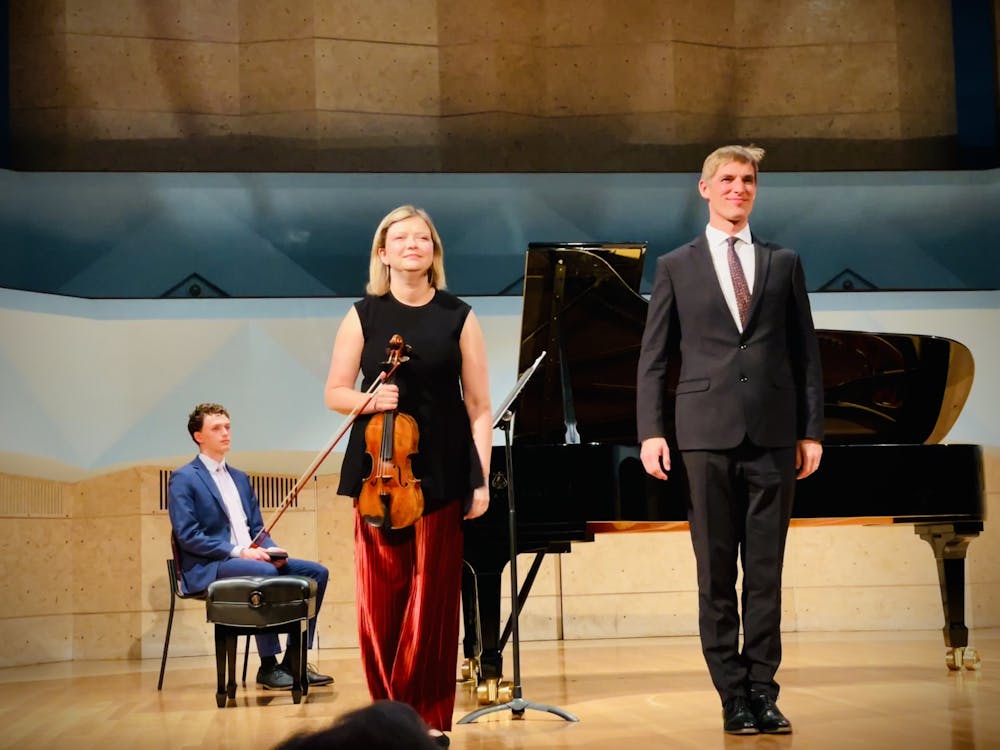
The sublime artistry of violinist Alina Ibragimova and pianist Cédric Tiberghien echoed in Robinson Concert Hall this past Sunday, as the pair delivered a performance that marked the end of Middlebury College’s 105th Performing Arts Series season. The duo program featured Janáček’s “Violin Sonata,” JW VII/7, Enescu’s “Violin Sonata No. 3 in A Minor,” Gerald Barry’s vivacious “Triorchic Blues” and Beethoven’s iconic “Kreutzer” Sonata.
Ibragimova and Tiberghien, both alumni of the BBC Radio 3 New Generation Artists program, have cultivated a remarkable musical partnership over 20 years. This event marked Tiberghien’s return to Middlebury and Ibragimova’s first visit. Their collaboration has been lauded by The Times of London, which observed that “Both of these players have the potential to conquer the world.”
The pair is currently on their North American tour, which includes a short visit to Vermont. They will also appear in a Music Theory course this week to share their insights and techniques as established musicians. The program features three sonatas in four pieces, with four composers from four different cultures: Czech, Romanian, Irish and German.
The first piece played was the “Violin Sonata,” JW VII/7, by Leoš Janáček (1854–1928). Unlike the traditional sonata forms of his predecessors, Janáček’s writing is raw, fragmented and highly expressive. His compositional style has heavily impacted many modern-day composers, including Billy Childs, whose composition was played by the Isidore Quartet as part of Middlebury’s Performing Arts Series earlier this year. The piece is marked by sharp contrasts: lyrical, folk-like melodies are suddenly interrupted by jagged rhythms and dissonant harmonies.
“A traditional fourth movement or a finale [of a sonata] would be another fast movement like the opening fast movement. But Janáček does something unusual. He uses adagio (slow tempo) at the end. He was a very non-traditional composer,” Professor Emeritus of Music Larry Hamberlin said in the pre-concert lecture.
The second piece played, “Violin Sonata No. 3 in A Minor, Op. 25” by George Enescu (1881-1955) is a celebration of Romanian folk music. Composed in 1926, the sonata bears the subtitle “dans le caractère populaire roumain” meaning “in the Romanian popular style. “Throughout its three movements, Enescu used chromatic modes to blur the traditional distinction between major and minor tonalities. The composer worked to make the piano sound like the Cobza, a short-necked lute traditional Romanian string instrument, and the Cimbalom, a trapezoidal instrument with many metal strings, similar to the inner part of a piano.
In this composition, the violin attempts to imitate the traditional Romanian wind instrument, which has a sweet, clear and slightly airy tone. While the violin score featured many detailed notations — leaving less room for improvisation — Ibragimova brought a fresh take to the piece (along with a few broken bow hairs).
The third piece, “Triorchic Blues” by Irish composer Gerald Barry, is an experimental work that has been performed as a piano solo, a violin solo, and even an aria in Barry’s opera “The Triumph of Beauty and Deceit.” Ibragimova and Tiberghien reworked this piece into a duo of piano and violin for this program — a compositional choice that delighted the audience.
The program closed with a classic of the Western tradition, Beethoven’s “The Kreutzer Sonata.”Originally composed for violinist George Bridgetower, this sonata was premiered by Bridgetower and Beethoven in 1803. However, after a personal falling out, Beethoven withdrew his dedication to Bridgetower and renamed the piece after French violinist Rodolphe Kreutzer, who never performed it. The sonata’s raw intensity has inspired many literary and artistic responses in the centuries since it was composed.
In Leo Tolstoy’s 1889 novel “The Kreutzer Sonata,” the piece symbolizes obsessive jealousy, exploring the destructive power of music and passion. The sonata explores similar themes; the violin and piano engage in a fierce dialogue in its first movement, a polite fight in the second and a playful conversation in the third.
While this concert marked the end of the 105th season of the Performing Arts Series, Ibragimova and Tiberghien’s performance reminded us of the endless possibilities of musical collaboration and the ability of great music to transcend time, culture and personal experiences.


