
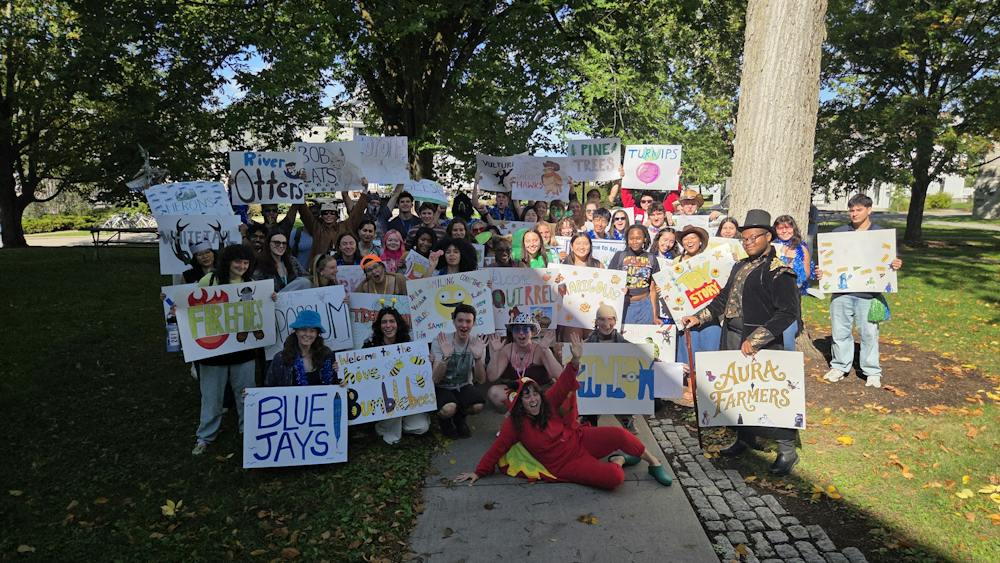
Upon their arrival on Sep. 9, a substantially re-worked orientation schedule awaited both domestic and international first years. Orientation week, compared with orientation last year, lasted for five days instead of seven, and international students arrived on the same day as their domestic peers. Following student feedback from last year, the Office for Student Engagement intended to bolster the structure of orientation week, creating a denser but more structured first week for incoming students.
The basic traditions of orientation remained the same: cheering orientation leaders and Residential Life staff welcomed students as they arrived on campus, first years were divided up into orientation groups, and cornerstone events such as the academic forum and the activities fair carried on from previous years. This year though, orientation groups only had one leader each.
“Since there’s only one group leader, the group leader can actually get a lot closer with their orientees,” Maddie Mitchell ’29, orientation leader for the “Tiger Moths,” said in an interview with The Campus.
All first years, domestic and international alike, followed a tight schedule. Following move-in, orientation groups met twice daily for around three hours total. Some events, unlike past orientation weeks, were mandatory for first years, and orientation leaders were tasked with bringing their students to those events — like an ice-cream social at President Baucom’s house. Mitchell estimated that first years only had about three hours of downtime every day.
“I understand why they would take [the downtime] away, because sometimes you don’t necessarily make a friend that has a car that you can go swimming with,” Mitchell said.
Alongside mandatory events, first years could choose among a plethora of optional activities: social, informative, athletic, or creative.
“This year also brought a new format of mixing mandatory programs with open sessions. Open Sessions were time blocks where multiple offerings were available and students could choose what they wanted to do (much like when attending a conference),” Valerie Netton, executive director of student engagement, wrote in an email to The Campus.
The week concluded with a first-years-only Lake Dunmore Event, complete with trips organized and led by Middlebury Mountain Club (MMC) guides, including canoeing, rock climbing, hiking and mountain biking.
“There were new optional events, so if you felt like you weren’t having enough downtime, there was always a block of two hours that you could choose not to do,” Teagan Archer ’29, orientation leader for the “Fireflies”, said in an interview with The Campus.
Following orientation week, leaders will meet with their groups every week throughout the month.
“It’s really just talking; it’s like a support group for our peers and I think it’s actually going to keep us closer,” Mitchell said. “It’s nice to have a reset, right before the week starts, with a group of people that feels like they’re supporting you.”
Both Archer and Mitchell emphasized that their orientation groups feel more tight-knit because of the changes to orientation structure this year.
For international students, orientation has shifted immensely over the past couple years. Two years ago, international students participated in a pre-orientation week, arriving days before domestic students and participating in activities organized and directed by international orientation leaders, also referred to as Program Arrival Leaders (PAL). International students had their own orientation groups — PAL groups — alongside their regular orientation groups.
“We [international students] all got here at the same time, and we had a couple of days of campus to ourselves, and we were able to get to know each other better. It was the best that happened to me, honestly. I was able to get to know a lot of the communities through that pre-orientation week, and a lot of my friends are through getting to know them through that week,” International Orientation Coordinator Munira Nurbhai ’28 said.
Last year, although the international pathway was preserved, international students arrived at the same time as domestic students. This year, international student pre-orientation was discontinued, and although PAL groups were still organized, fewer meetings were built into the orientation week schedule. PAL orientation coordinators were not informed about the change until this past August.
“It was a lot for us as coordinators to even figure out what to do because we were like, okay, what is going on? We had very limited communication with just every single department on campus,” Nurbhai said.
International students still scheduled events, like the talent show, but have had to rely on one another for legal help and advice adjusting to the new environment. International orientation coordinators put together packets of information for incoming students and did their best to schedule time to meet with their groups, but it was not built into the newly modified orientation schedule to the extent of past years.
“We got [the talent show], and we got like one or an hour in the whole week where it was like, okay, here is your part time with your groups, and we had to just make it work between all the gaps and open blocks, just to find some time to have our own meetups with our students,” Nurbhai said.
Daria Dumbrava ’28.5, an international student, emphasized the importance of PAL groups in establishing community with other international students.
“We love that part of coming to college, coming a week early and meeting the people that share the most experiences with you, forming your group of friends before the campus gets overwhelming with everyone. That was valuable for them so they didn’t want to lose that,” Dumbrava said.
Dumbrava also mentioned that international students arriving on the same day as domestic students has the potential to prevent the separation of the two groups.
“Maybe it’s a good thing that everyone moves in at the same time, so that there maybe isn’t going to be such a big division between American students and international students,” she said.
The international student body has decreased this year to 83 students, 20 of whom are exchange students. Due to recent immigration policy changes under the Trump administration, which placed a sweeping ban on a variety of countries, diversity of international students’ nationalities has also decreased. The lower number of international students could explain the changes to orientation introduced this year.
Nurbhai explained that International Student and Scholar Services has been active in supporting students affected by the recent bans.
“We're constantly trying to just give feedback to help them plan next year's orientation. There is only so much we can do, and if we find out that there will be things that are trickier next year, we will again, of course, petition and see what happens,” Nurbhai concluded.
Kai Arrowood '29 (he/him) is a News Editor.
Kai previously served as a staff writer. He is a prospective English and Sociology joint major. Aside from The Campus, Kai is a copy editor for Middlebury Geographic and an avid participant in National Novel Writing Month.

