
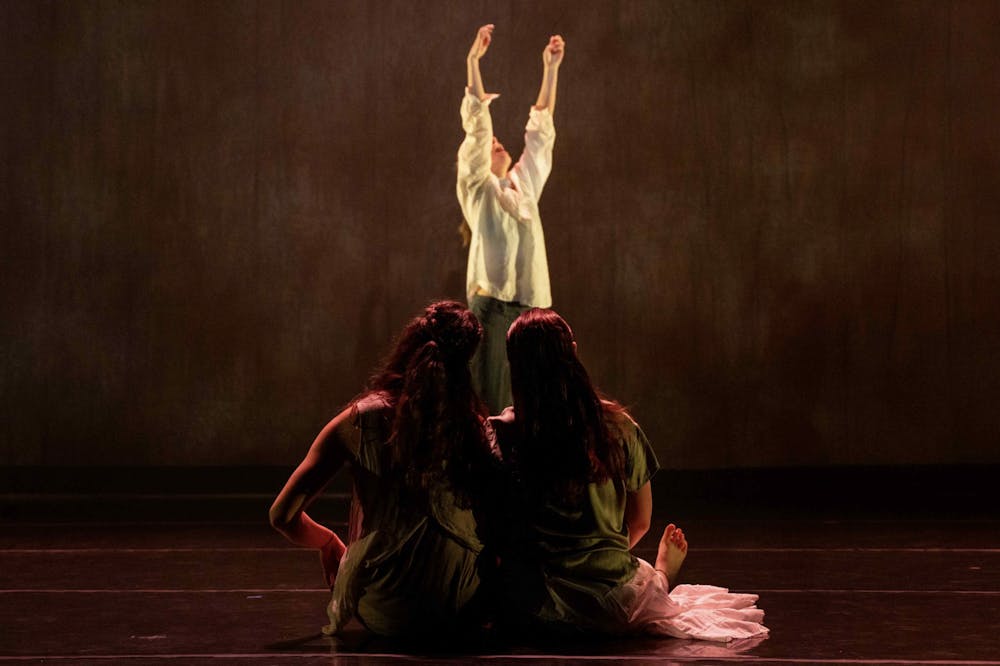
Christy Liang: Who are you as an artist?
Liefe Temple ’25.5: I am a dancer. That is my art. I would say I am fairly new to considering myself an artist. Before I started at Middlebury, I wasn’t. I danced for fun growing up, and I thought I would continue doing that here. But then I met the dance department, started taking classes and realized I could study dance seriously. I found such a home there. There is so much love and intellectualism in that space. Primarily, I am a dancer, but I also do fiber arts. I like to sew and knit. Those are hobbies, but they are artistic too.
CL: How did you first discover dance, and how has your relationship with it evolved?
LT: I started dancing when I was two and a half. My parents enrolled me in a “dance for babies” summer ballet camp, and I stayed with that same studio my whole life growing up. I made really close friends there. It was a big part of my social life, especially in high school. At first, dance was just fun. It was something that balanced schoolwork. I would sit and read and write, and then I would dance. They felt very separate. At Middlebury, that changed. I have been able to combine them. I can experience academic rigor in my body, in the studio, and that feels like research and learning. At the same time, I can sit and read about dance. That merging of what I love studying and what I love doing has been the biggest shift.
CL: As an English and Dance joint major, how do you see the relationship between text and movement?
LT: I have been thinking about this a lot, especially while working on my thesis and thinking about what comes next. I see both dance and literature as ways of expressing things that are hard to explain. How do you communicate your feelings? When you read a really good book, you feel like you are there. When you see a really good dance, it makes you feel something or wonder something or think about something big. Dance has given me an embodied perspective on reading. Now when I read, I notice how bodies move in text. Not just dance, but posture, gesture, how people exist in space. It is like visualizing movement even in stillness. The two disciplines really work together for me.
CL: What were your thesis projects about?
LT: I did two thesis projects, one for each department. For dance, I created a piece centered on the idea of dancers as embodied archives. I worked with five dancers and drew on my experience working in Special Collections and Archives at the library. For English, I built on that work. I used “Mrs. Dalloway” and its dance adaptation, “Woolf Works” by Wayne McGregor as a case study. I explored adaptation theory, how a story moves from one artistic medium to another, what gets lost, what is gained, and what choices are made. In that sense, my English thesis looked at dance as an archive of literature, while my dance thesis explored the body as an archive itself. They are connected, but distinct.
CL: Can you say more about the body as an archive?
LT: The idea started with thinking about how expansive the term “archive” has become. It can mean a physical place, a collection of objects, or even a cultural canon. For me, the body as an archive means recognizing that we carry history within us. Our experiences and our past live in our bodies. In dance especially, choreography and tradition are passed down through bodies. You can record or write about dance, but it is not the same as learning it directly from another person. I'm sure you like to experience some of these feelings or ideas like learning Bhuto with Meshi.
CL: Since I’m such a Woolf fan, can you talk more about the “Mrs. Dalloway” adaptation?
LT: I chose “Woolf Works” somewhat unexpectedly. It was what I had access to. It is not a direct adaptation, which made the project more complex. Wayne McGregor describes it not as an adaptation but as a kind of retelling. The ballet has three parts, each corresponding to a different work by Virginia Woolf. The “Mrs. Dalloway” section is called “I Now, I Then.” He does not just adapt the novel. He adapts Woolf’s writing more broadly. For example, the show opens with text from an essay, not the novel. One major change is that Clarissa and Septimus, who never meet in the book, share a duet in the ballet. They physically interact, touching and partnering, which creates a different meaning in a dance context.
CL: How do you create your own dances?
LT: I am still figuring out my process. Most of the dances I have made have been for class, so they start with a prompt. I have learned that where a piece starts and where it ends can be very different. For example, I made a dance with two friends that began with the idea of rivers. That gave us structure and a starting point. Over time, we realized it was not really about rivers anymore. It became about us and our collaboration. The initial idea helped us begin, but it evolved into something else.
CL: Does it matter if the audience understands your intended meaning?
LT: I used to think it did. I wanted to know what a dance meant. But I have learned that meaning does not have to be fixed. Whatever an audience member feels or interprets is valid. Even if it is not what the creator intended, it is still meaningful. At the same time, as a creator, it is easy to get attached to an idea, like insisting a dance is about rivers. But sometimes that does not translate, and that is okay. Not everything has to be communicated clearly. Each audience member brings their own experiences, their own archive, to what they see.
CL: Can you talk about your piece “Current”?
LT: We needed a title for the program, so we chose “Current.” I like that it has a water connotation but also refers to the present moment. The dance started with the idea of rivers, but it became more about the three of us wanting to dance together and create something. It reflects what we were working on at that time. It's current, like right now.
CL: Do you have mentors in the dance department?
LT: Yes, I love the dance department. All the professors work well together. My advisor is Lida Winfield. I have worked with her on several projects and assisted her on a conflict transformation project. Meshi advised my thesis and contributed a lot to that work. Right now, I am working closely with Professor Christal Brown in her course “From Africa to the Americas.” She has been an incredible mentor in dance and beyond.
CL: Can you talk about your trip to Ghana?
LT: We were there for a week, which felt very short. We spent time at the University of Ghana, learning traditional dances from the Ghana Dance Ensemble. These were dances from different regions, including ones tied to fishing communities and warrior traditions. We also visited Cape Coast Castle and saw the slave dungeons. That was a very powerful experience. We participated in drumming workshops, visited a village and experienced a welcoming communal environment with food, dancing and performance. It was physically intense. It was hot and exhausting, and very different from dancing here. Even though the trip was short, we had prepared for months beforehand. That preparation helped us fully engage while we were there and carry those experiences back with us.
CL: What are your post-graduation plans?
LT: I am applying to graduate programs in library and information science. I see myself working in libraries long-term, but I do not think that means I will stop dancing. I want to bring an embodied perspective into library spaces through programming, community engagement or research. I am interested in performing arts libraries, like the dance division at the New York Public Library, or academic settings where I could work alongside dance departments. I want to continue both dance and libraries as central parts of my life.
Christy Liang '28 (she/her) is an Arts & Culture Editor.
She is an English & Religion major who loves long conversations, live music in underground bars, and films that are a little pensive. She's genuinely curious about what goes on in other people's minds. Her column, "Conversational Art," is a series of interviews with student and faculty artists across all mediums.


