
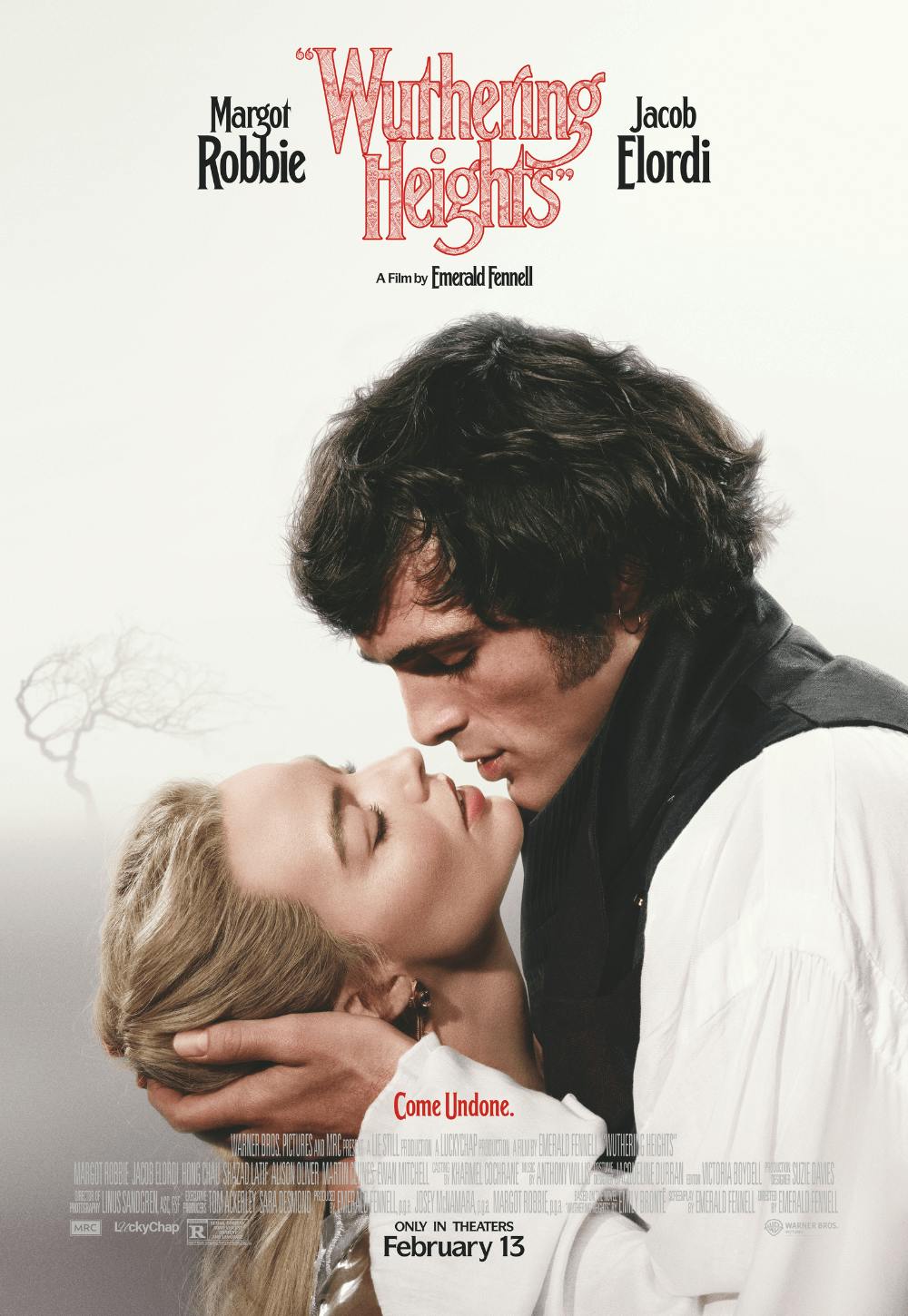
Digital discourse over representations of female sexuality, Victorian class-race politics and the proper use of quotation marks ensued after the release of Emerald Fennell’s “‘Wuthering Heights’” in theaters on Feb. 13. Since before the first trailer came out, the film adaptation of Emily Brontë’s 1847 novel has threatened to create an internet dialogue more heated than the film’s actual erotica.
“‘Wuthering Heights’” tells the story of Catherine Earnshaw and Heathcliff, respectively the daughter and the adoptive ward of a landed but impoverished Mr. Earnshaw living on the Yorkshire Moors. Mr. Earnshaw is a drunk, changeable, abusive father to the two children, but Heathcliff often shoulders the brunt of his brutality in order to protect Catherine. In adulthood, Catherine will marry the extravagantly wealthy Edgar Linton despite her love for Heathcliff. Five years later, the two reunite and begin an affair.
Predictably, the movie received criticism for its infidelity to its source material, which becomes more blatant as the film progresses. As such, the title was stylized with quotation marks, and Fennell clarified that her vision for the film was to "recreate the feeling of a teenage girl reading this book for the first time.” On this front, I found that the movie represented itself quite well as a fantasy-romp: It seemed like something I might’ve experienced as a fever dream at 14 after reading “Wuthering Heights” for a sophomore English class. It takes clear inspiration from movies like Baz Luhrmann’s “Romeo + Juliet” (1996) and Victor Fleming’s “Gone with the Wind” (1939), and is probably more similar in theme to the latter than to Brontë’s work at all.
Any unfaithfulness in adapting the book didn’t bother me — in truth, I wasn’t expecting much. I’m of the belief that an awful adaptation can still make a good piece of original art (e.g. Joe Wright’s “Pride & Prejudice” does a disservice to the novel’s characters and tone but is beautifully shot and swoonworthy). And although it is through a perhaps overly contemporary lens, anyone who’s read the original can vaguely trace Fennell’s method of condensing a cast of 11 principal characters into just six, taking aspects of the novel’s two romances (which differ in redeemability and tragedy) to make one comparatively tame tragic-romance.
Fennell’s hallmark is her visual style. If you’ve seen “Saltburn” (2023), then you’re familiar with her love of texture: gaudy fabrics, vivid colors and sensual interpretations of traditionally mundane items (in “‘Wuthering Heights’”, it’s egg yolks and bread dough and pig’s feet and even slugs). She’s particularly fond of the aesthetics of wealth and was meticulous in the design of the Thrushcross Grange set — the estate where Catherine and her husband Edgar live. Fennell cited Victorian and Rococo styles in the set design and costuming. In the same way “Saltburn” might’ve been approaching ‘camp’, “‘Wuthering Heights’” has gleefully entered that territory.
The aesthetics and visual symbolism become increasingly absurd as the film progresses — in one scene, comically high stacks of empty green liquor bottles indicate the depths of Mr. Earnshaw’s alcoholism. Choices like these emphasize the importance of hedonism and over-indulgence in Fennell’s characters. I’ve seen criticism that her characters, especially Heathcliff and Catherine, are lacking in depth, and while I think this is fair, I worry it misses the rather blunt thesis Fennell presents about humanity as a whole: every person is essentially amoral and even cruel in the pursuit of pleasure. To this end, her characters do not require individuality or even unique motivations, since it is taken for granted that they are all driven by the universal primal instincts.
This is one of the reasons I struggle to take the film’s romance seriously, and I almost wonder whether, through no intention of the director's, it could subvert the romance genre entirely. Catherine and Heathcliff’s relationship perfectly demonstrates the kind of emotionally hollow but sexually driven and possessive ‘romance’ that is so archetypal at the moment. In this way, the film seems to agree more with the work of the more moralistic Brontë sister, Charlotte (I say that as someone who prefers “Jane Eyre”) than the nuanced character examinations of Emily’s novel.
There are, however, two scenes that challenge this reading. In childhood, Heathcliff lies beside Catherine as she pretends to sleep, and he swears that he will always love her. Later, Heathcliff lies over a dead Catherine and begs her not to leave him, to ‘haunt’ him even in death (this does come from the book). These instances of tenderness might imply that the real tragedy of their relationship is that, beyond pleasure-driven and destructive exchanges, there was an unselfish love that was never fully realized.


