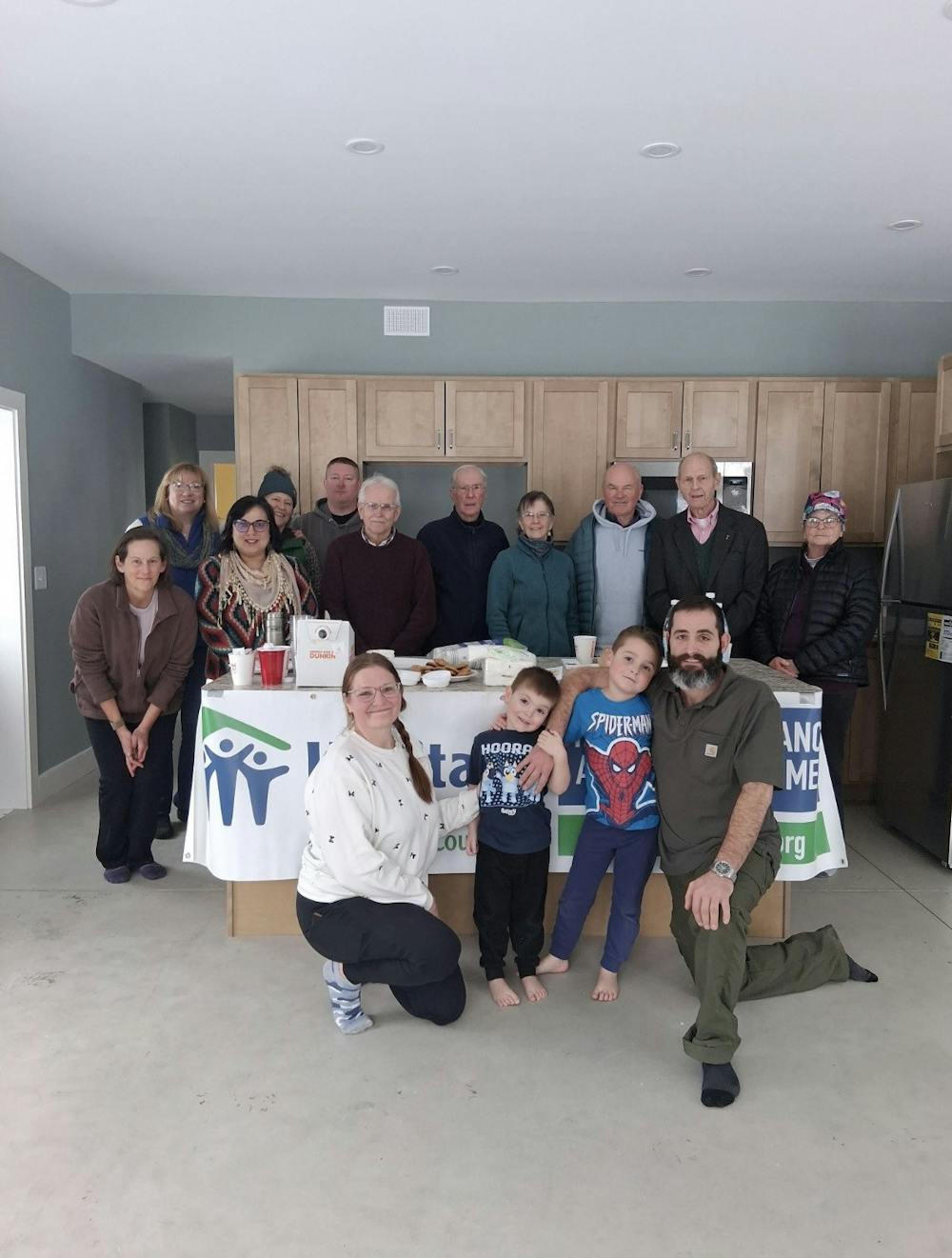
Habitat for Humanity of Addison County (HfHAC) hosted an open house on Feb. 7 at 35 Gorham Lane, inviting the Middlebury community to tour the organization’s newest build and meet the family who will soon call it home. The event marked a milestone for the all-volunteer nonprofit, which has been working to address Addison County’s affordable housing crisis since its founding in 1997.
Despite the cold weather, neighbors came out to the location in strong numbers to meet the Deroberts-Goodin family. Carl, Elaina, and their two sons are set to move in March of 2026. “They are excited to be part of the community and put down roots, and the boys are thrilled to have their own bedrooms and room to play! The whole family is happy knowing they have a home with a yard and space to grow,” Blair Kloman, the current president of HfHAC, said in an email to The Campus.
Kloman described the organization as entirely volunteer-run, with a 16-member board that meets monthly at a donated space in a local church. There is no office, no paid staff and no overhead to speak of, meaning that every dollar donated goes directly toward building homes for families in need.
“Affordable housing is not low-income housing,” Kloman said. “We provide starter homes for moderate-income families by selling our houses well below appraisal and offering no-interest loans.”
For many families, the monthly mortgage ends up being less than what they were previously paying in rent, and the long-term costs of living in an HfHAC home are kept low through the organization’s commitment to energy efficiency.
“Like all of our recent homes, 35 Gorham Lane is highly energy efficient,” Kloman said. “We partner with local vendors, including Efficiency VT and solar panel manufacturers, to make sure our homes are as close as possible to net-zero performance.”
Each build is designed by college architecture students in Associate Professor of Architecture John McLeod’s studio, which has been dedicated exclusively to Habitat designs since 2019. McLeod, an architect based in Middlebury and owner of McLeod Architects, has made the collaboration a cornerstone of his studio’s work.
“It’s a team of students that take the classes, and under my guidance and my colleague Sam Ostrow’s guidance, they do everything involved with the process from initial site analysis and outreach to neighbors, to researching zoning requirements and other permitting requirements, then conceiving of a design and exploring design possibilities that we as a team are pleased with and the client, Habitat for Humanity, is pleased with,” McLeod said.
The partnership reflects a broader philosophy within HfHAC of integrating the organization into the fabric of the local community, drawing on local talent, vendors and volunteers to get homes built.
“It’s a partnership between Middlebury College, Habitat for Humanity of Addison County, and my architecture practice, or firm, which is based here in Middlebury, McLeod Architects,” McLeod said.
The studio has produced 10 homes so far, each meeting Vermont’s highest energy-performance standards. Through partnerships with Efficiency VT and local solar panel manufacturers, HfHAC works to bring every home as close to net-zero carbon emissions as possible, meaning families save on heating, cooling, and maintenance costs for years to come.
The selection process for families is thorough, according to Kloman.
“We’re looking for families who have lived and worked in Addison County for at least a year and can manage a mortgage responsibly. Their current housing situation is usually inadequate or substandard — such as severe structural problems, poor heating, overcrowding or unsafe or unsanitary conditions,” she said.
Once selected, families are asked to contribute a minimum of 200 hours to the building of their own home, either on-site or behind the scenes. Additionally, families must complete a series of homeowner workshops.
“We provide families with homeowner workshops to prepare for successful home ownership — paying bills, maintaining property, taxes, etc.,” Kloman said. Families also participate in the building of their home, whether on-site or behind the scenes, for a minimum of 200 hours. “It can be a lot of fun and feel very rewarding to be involved,” Kloman added.
The Gorham Lane development represents the kind of long-term, neighborhood-scale thinking that defines HfHAC’s approach. Two more homes are planned for the same neighborhood. “We have two more homes to complete in the Gorham Lane neighborhood. There’s also a scale model of the whole area in a case right adjacent to the properties (by the road) so you can get the overall picture of how it will look,” Kloman said.
The organization aims to build one home per year, a modest but steady pace that reflects the realities of running an entirely volunteer-driven operation.
For college students, the organization offers a meaningful way to get involved in the broader community. Volunteers are welcome on-site on Wednesdays and Thursdays, led by a volunteer Head Builder, and no construction experience is required.
Braveny Mubuuke ’29 expressed her excitement about the possibility of volunteering with HfHAC.
“I didn't know about this opportunity until now, and I'm looking forward to learning more and engaging as a volunteer,” Mubuuke said.
Beyond volunteering, the organization relies heavily on donations to keep its work going. Individual contributions, federal and non-federal grants, and community partnerships all help fund each build.
For the Deroberts-Goodin family, 35 Gorham Lane is a place to grow, a yard for the kids, and a place to put down roots in the Middlebury community. And for the volunteers and board members of HfHAC, that outcome is the whole point.
Students interested in volunteering can reach out at hfhmiddvolunteer@gmail.com and share their skills and availability. More information about Habitat for Humanity of Addison County, including how to apply, volunteer or donate, can be found at addisonhabitat.org.
“We always need volunteers of all types and levels. If you’ve got building skills, organizational skills, clerical skills, fundraising skills…you can help! We welcome your assistance even if you can’t drive a nail,” Kloman said.
Editor's Note: Senior Local Editor Katrina Schwarz ’26 contributed reporting to this article.