
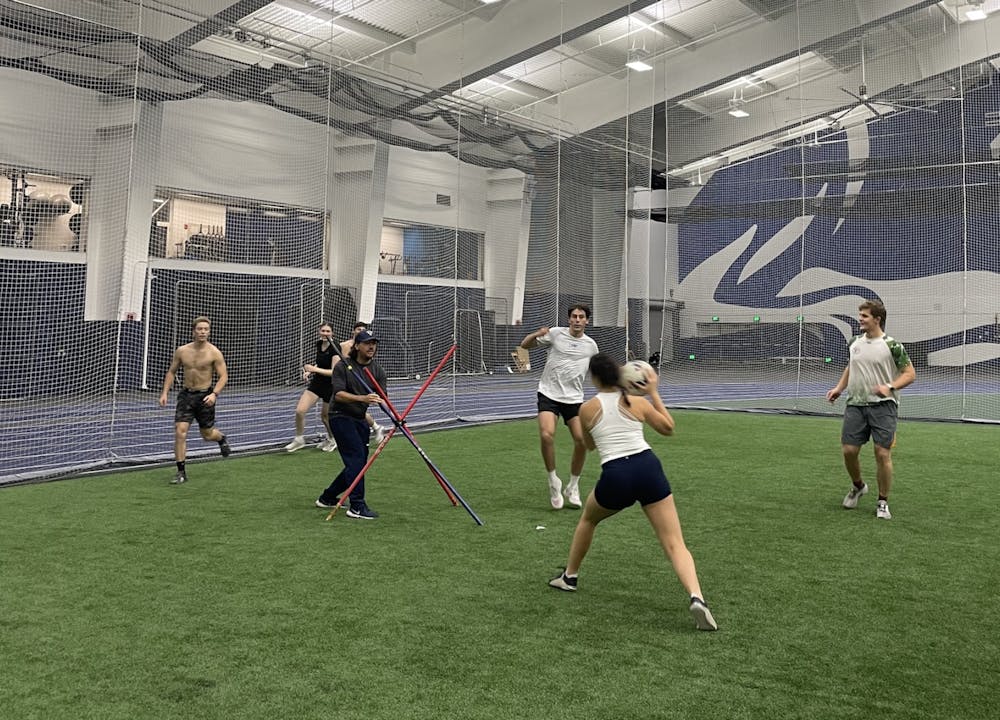
Odds are that if you’ve ever looked into the Virtue Field House around 5:30 p.m. this time of year, you’ve been captivated by all the action. Pole vaulters doing backflips on the mat, sprinters flying around the tight corners of the indoor track and throwers catapulting heavy objects towards a net make for quite the spectacle. What’s always captivated me the most, though, is the center-stage act of this Virtue circus: alpine skiers playing speedball.
In this issue of Tapped-in, I watched a speedball match and spoke with the skiers to better understand the sport and decipher the chaos.
Speedball is a combination of soccer, handball and football. Assistant Alpine Skiing Coach Parker Acosta explained that the variant played by the ski team has European origins and is common among the broader skiing community.
“Many members of the Middlebury squad have been playing [speedball] their whole life,” Acosta said.
Players can dribble the ball with their feet, and if one is particularly skilled at soccer, they can even keep the ball on the ground and weave their way through the opposing team, Messi-style. In order to possess the ball in your hands, another player must kick the ball in the air for you to directly catch it; you cannot simply pick up the ball or scoop it to yourself with your feet.
Once you are holding the ball, the opposing team can tag you. If tagged, your team loses possession and play restarts with the opposition. Unlike handball, players can take as many steps as desired with the ball in their hands, so long as they remain untagged. Because of this rule, a common strategy is to catch the ball and advance up the field as far as possible. Once a defending player approaches, you drop the ball right before they can tag you and start dribbling.
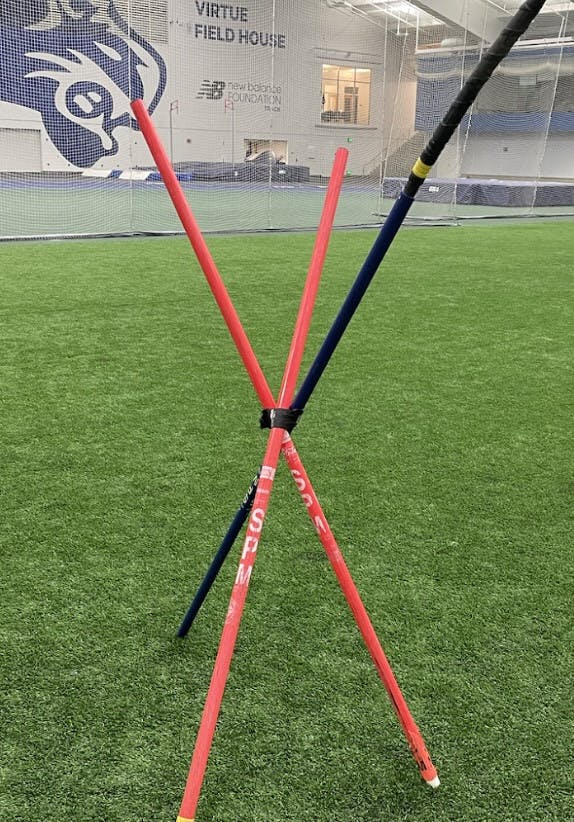
To score points, players must topple the “goal” on the opposite side of the field with the ball. The “goal” in question comprises three ski course poles tied together. Resembling the frame of a teepee, the structure stands precariously at each end of the pitch, and depending on a team’s lineup, a goalie might stand guard in its vicinity.
The primary ways of knocking over the goal are kicking and throwing the ball, and shots can be taken from anywhere on the field. In last Thursday’s game, one skier scored from a 30-yard threaded finesse shot, glancing the side of the goal and bringing the structure to a slow, demoralizing collapse. Another caught a pass from deep, receiving the ball well past the final defender and knocking down the open goal. On that note, once the goal has been struck, there is no saving to be done — the defense must watch on as the formation falls and sprawls out on the turf.
After a team has been scored on, the direction flips and they march to the opposite side to defend the other goal. The scoring team punts the ball, bracing their defense as the receiving team regains possession and charges back up the field. As the team drives forward, the ball is only considered out of bounds if it has slipped through a gap in the netting and traveled onto the track or adjacent field. Otherwise, unlike playing soccer on the indoor turf in Virtue, the ball can strike the surrounding net and remain in bounds.
Depending on one’s style of play, the ball typically spends 40 to 65 percent of its time on the ground. For skier Sebastian Segre ’26 — an experienced soccer player — an effective strategy is to outskill the defense, get in proximity of the goal and fire a shot at the first opening. Tommy Carnahan ’29 plays the game more like football, catching the ball, driving towards the goal and making quick cuts to juke defenders.
To the spectator, speedball is hectic and riveting. To Sara Paradis ’27, speedball is “intense” and “aggressive.” And to the alpine ski team more generally, speedball is actually just a pre-lift warmup.
“It’s so much better than just running a couple laps around the track,” Milan Novak ’28 said.
Sophia Palmquist ’29 agreed. “Definitely the ideal pre-lift.”
Compared to more conventional dynamic stretching, speedball builds team chemistry, and is an engaging way for Middlebury’s downhill skiers to warm up together.
“The team aspect” is Carnahan’s favorite characteristic of speedball. “It’s great to get the team playing a game before we warm up.”
House music thumping and track runners flashing by, last Thursday’s spirited game of speedball was perfectly situated within Virtue’s high energy ecosystem. Middlebury’s skiers demonstrated various ways to master the sport, incorporating soccer nutmegs and touchdown receptions into one compelling performance. The competitive spirit befitting of a Middlebury skier was also on display, and though the team typically takes their talents to the mountain, they made a strong case for their capabilities on the turf as well.
Simon Schmieder '26 (he/him) is a Senior Sports Editor.
Simon is an avid runner and biker and enjoys spending time outdoors. He is a philosophy and political science joint major with a minor in German, in addition to being a Philly sports fan.


