
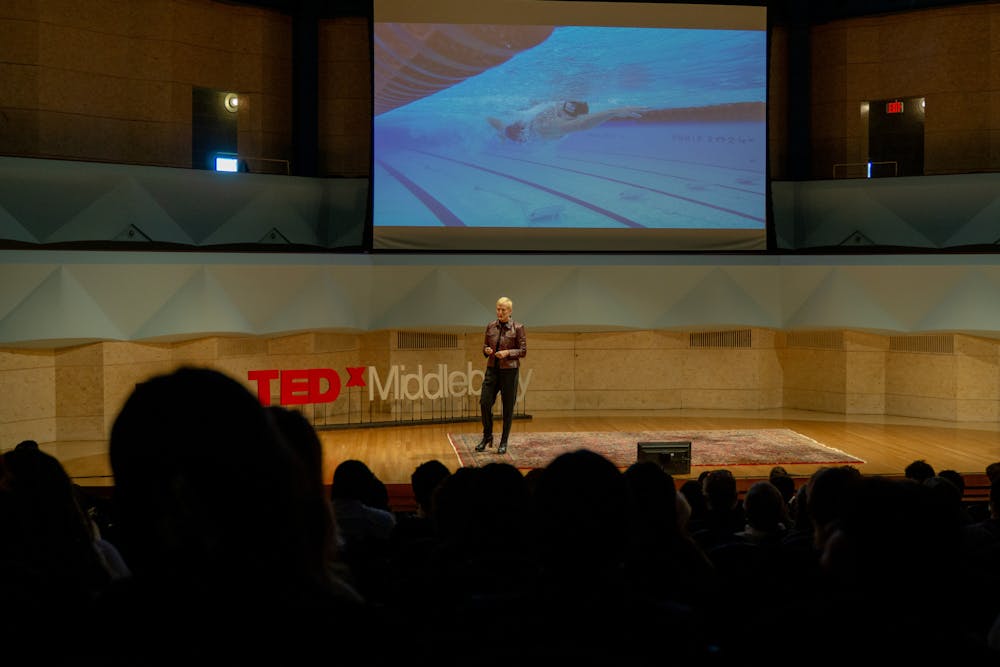
By 1 p.m. on Saturday, Nov. 9, Robison Concert Hall was busy with students, professors and community members settling in as the lights dimmed for TEDxMiddlebury 2025. This year’s theme, ‘Roots and Reach,’ inspired by Jack and the Beanstalk, invited speakers to reflect on where they come from and what they might dare to imagine.
“We wanted to do something a little playful, a little fun,” Josette Chun ’26, one of the event’s organizers, said. “Using that metaphor of climbing the beanstalk, we wanted to show how your roots — what you’re grounded in, your values — guide you on your journey to your reach, that dream or goal you have for yourself.”
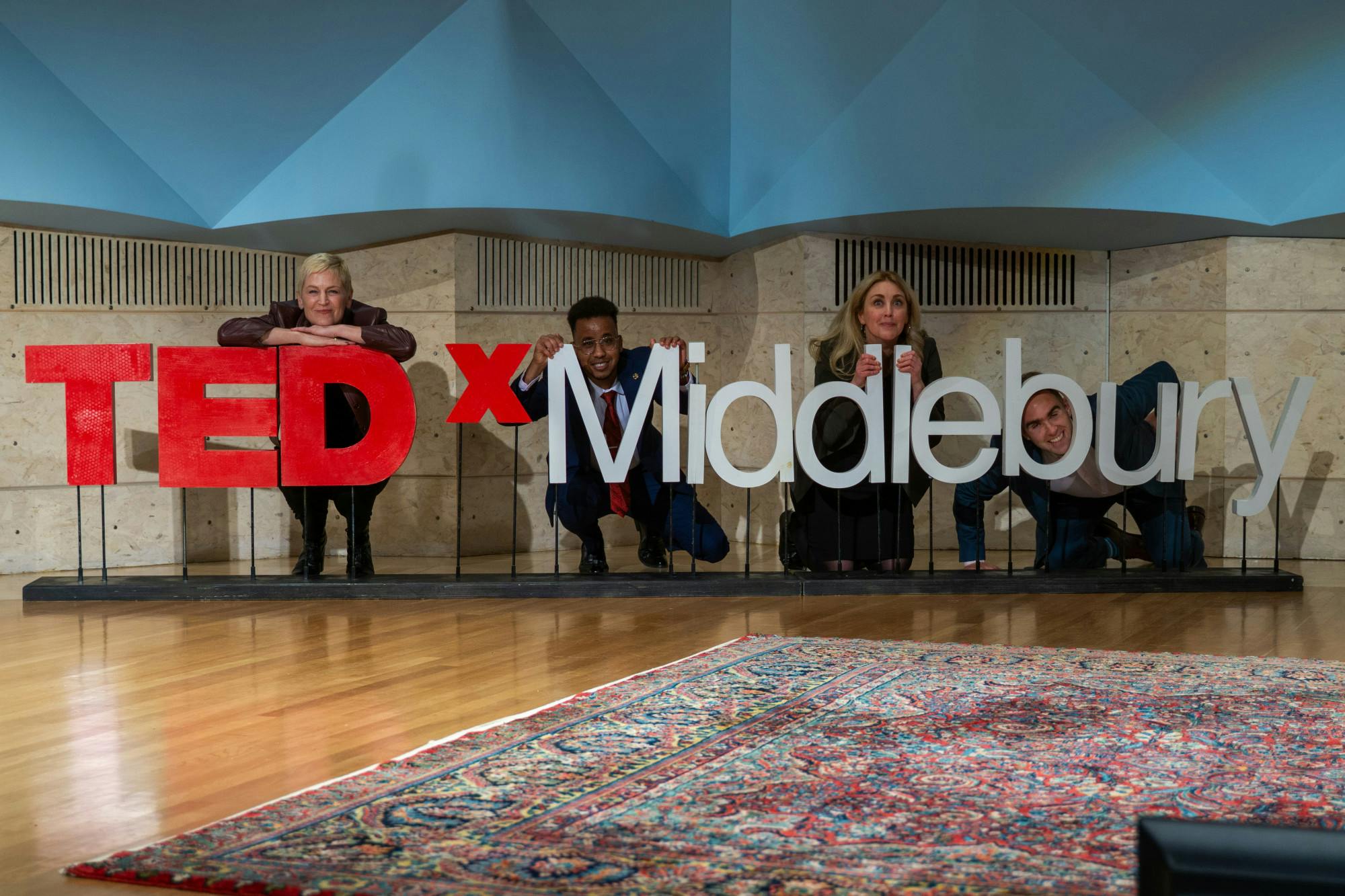
Student-run since 2010, TEDxMiddlebury is organized by a small board of students with support from the Innovation Hub and about 30 volunteers. This year’s speakers were Molly Solomon, executive producer and president of NBC Olympics; student speaker Mohamed Noor ’27; Charlie Sellars, Microsoft’s director of sustainability; and Caitlin Myers, professor of economics at Middlebury.
Solomon, an 18-time Emmy winner who has helped to produce 13 Olympic Games, was first on the stage. She began by describing a crisis moment: On Feb. 9, 2022, Mikaela Shiffrin collapsed into the snow seconds into her Beijing race.
“I will never forget this image,” Solomon said. “She sits in the snow, her head buried in her arms. I yell out to ‘stay on her.’” Despite criticism for not cutting the cameras away, Solomon defended the choice: “Just as glory and medal podiums are central to the Olympic experience, so too is the agony of defeat.”
The pandemic-era Games, with their empty stands, tested the Olympics’ relevance. Could the Olympics still unite people? Solomon’s answer lay in her roots as a storyteller. Over 30 years, she learned that producers create a “secret sauce” by transforming athletic moments into shared narratives. For the Paris 2024 Summer Olympics, her team streamed every event live, amplified athlete voices and made one audacious hire: Snoop Dogg as “chief cheerleader.”
“The Olympics must endure,” she concluded. “They’re about us — the best of us. And in 2028, when the Games return to Los Angeles, we’ll have a rare chance to come together again — to cheer and to unite.”
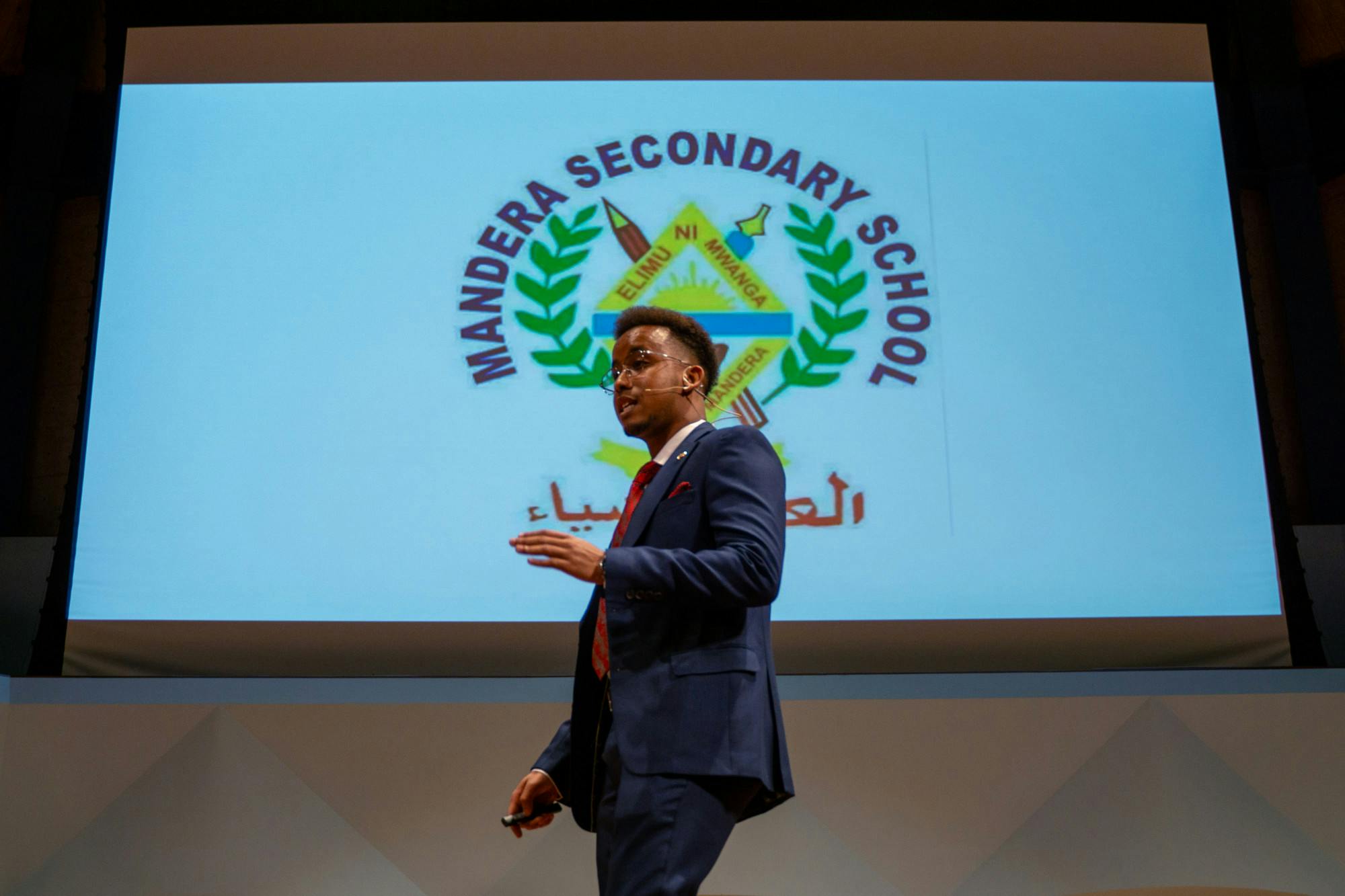
Next to the stage was student speaker Mohamed Noor ’27. Selected through a student competition, Noor began with a story of growing up in Mandera, a border town in northeastern Kenya often cut off by conflict and poor infrastructure.
“To us, Mandera is the center of the universe,” he said. “It’s where our dreams lived.”
When Covid-19 closed schools in 2020 with no online options, Noor taught himself biology, chemistry and literature through YouTube.
“I didn’t know it then, but I was building a habit that would define my life: learning without waiting for permission.”
When schools reopened without teachers, he stood at the blackboard himself. He later topped his region’s exams and earned a place at Middlebury through KenSAP.
“If Mandera is defined by the sun, Middlebury is defined by the snow,” he said.
Through the Innovation Hub, Noor received a $10,000 grant to launch Beyond Borders Orphan Aid, funding scholarships for students back home. But one encounter changed him: a mother who lost her baby en route to a distant hospital when the truck got stuck in mud.
“Education saved lives, yes, but it couldn’t save that baby,” he said. That moment inspired his pilot project, Afra Health Arc, which involves a network of solar clinics and motorbike first responders for remote villages.
His final words brought the room to its feet and earned him a number of congratulations, including from college President Ian Baucom.
Still processing his standing ovation, he reflected on what the moment meant to him. "I'm like a perfectionist, so sometimes I honestly don't give myself credit," he said in an interview with The Campus. "But when I saw the crowd standing up, it was just a very proud moment for me."
After intermission, Charlie Sellars, Microsoft’s director of sustainability, spoke next and challenged some common attitudes about climate work.
“When I tell people I work in sustainability, they say, ‘Oh, I wish you hadn’t told me — I wouldn’t have eaten meat in front of you,’” he began. “The prevailing idea of sustainability is guilt and shame. And I’m worried it’s counterproductive.” The real danger, he said, is “climate doomism,” in the sense that the problem is too big to fix, leading to burnout or inaction.
Instead, he proposed a radical alternative: making sustainability fun again. He recalled the optimism of Captain Planet of the 1990s before the 2000s apocalyptic despair. Using life cycle assessments, which he calls a “shiny new toy,” Sellars explained that most emissions come not from product use but from manufacturing. Applying that insight to his own book, “What We Can Do: A Climate Optimist’s Guide”, his team redesigned almost every element — using recycled paper, vegetable inks, sewn instead of glued binding — cutting its carbon footprint in half. “We didn’t do it because we had to. We did it because it was a fun design challenge.”
His conclusion struck a hopeful note. “If we re-root ourselves in optimism and joy, that gives us the strength to reach for change. If we want to save our planet, let’s go have fun.”
The afternoon’s final speaker brought the theme full circle. Professor Caitlin Myers explored the space between roots and reach, drawing from her own experiences growing up in a West Virginia “holler.”
“Last month, I went back to my holler,” Myers said. Her father ran a small medical practice in a church basement, and money was tight. The odds that a girl in Braxton County in the 1980s would become a teen mom were 10 times greater than her chances of reaching the top 20% of earners. Still, she made vision boards out of Sears catalogs as she dreamed of upward mobility.
“When I was in the South, I was a liberal in a conservative space. When I moved to Vermont, I was surprised to find that I might be more of a conservative in a liberal one. My politics haven't actually changed all that much, but my context did, and context is everything,” she said.

She applies that understanding to her economics research, measuring the effects of abortion policy. After Dobbs, Myers estimated that bans prevented about 32,000 people from obtaining abortions in the first year.
“You might hear that 32,000 women were denied a fundamental right, or that 32,000 babies’ lives were saved. Which is it? As a scientist, that’s not for me to say.” Having grown up among people who view abortion as immoral, she said, “I like them. I respect them. I love them. I think some of them like and love me too. What if we can start there? What if we can start with compassion and respect?”
Myers ended by zooming out.
“Eight in 10 Americans describe politics as divisive, corrupt, chaotic. In Middlebury, 85% voted for Harris; in my holler, 85% for Trump. I know and care about both sides.” She urged listeners to embrace discomfort: “There’s power in those awkward, liminal spaces. Stand in them. Talk to people. Practice respect and empathy. When that happens, it’s a lot harder to dismiss each other.”
As Noor earlier reminded the packed hall at the end of his talk, “Your roots remind you of who you are. Your reach tells you what’s possible. And the space between them — that’s where growth happens. That’s what progress really means: when your reach comes home and finds its roots waiting for it.”
Ting Cui '25.5 (she/her) is the Business Director.
Ting previously worked as Senior Sports Editor and Staff Writer and continues to contribute as a Sports Editor. A political science major with a history minor, she interned at the National Press Club in Washington, D.C. as a policy analyst and op-ed writer. She also competed as a figure skater for Team USA and enjoys hot pilates, thrifting, and consuming copious amounts of coffee.


