
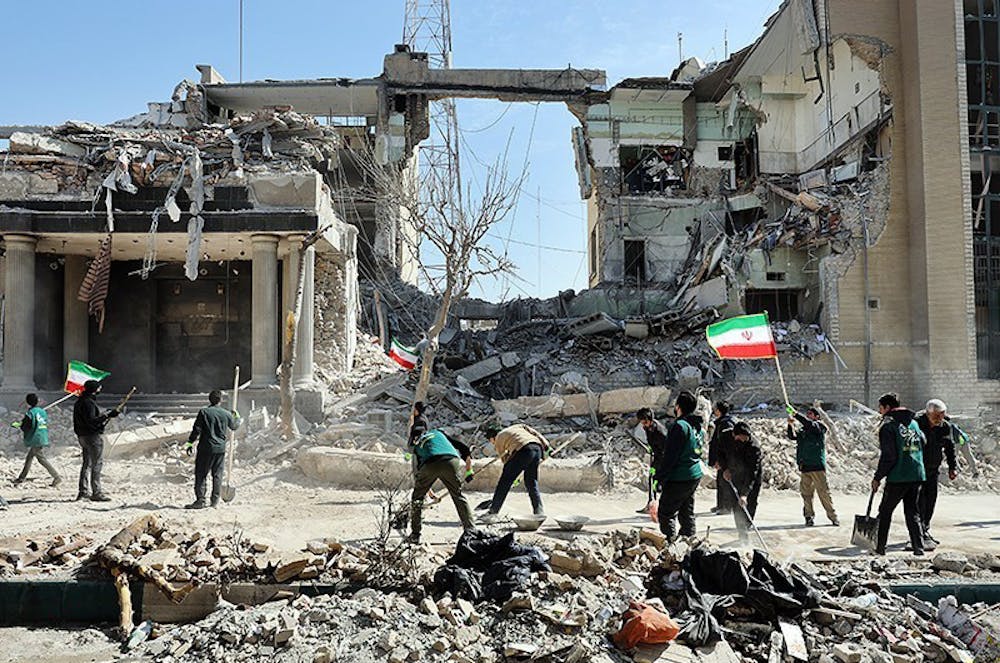
The last time I wrote for The Campus was in Ramadan 2024. I wrote a piece on the famous Persian-speaking Muslim poet Rumi and his passion for fasting in this month. Two years have passed, and I find myself writing again during Ramadan. This time, however, my pen can hardly string words together on anything sacred, as I find the cultural inheritors of Rumi’s world, my friends and families in Iran, living in fear and terror of an illegal, unprovoked war against them.
This Ramadan’s spirituality and sanctity has been shaken for many Iranians, Lebanese, Palestinians and Muslims in America and around the world. This war of choice against Iran took place in the midst of nuclear negotiations, soon after an interview with the Omani mediator and foreign minister who expressed optimism regarding its progress.
Starting for the first time in June 2025, and now again, I find myself in a state of shock and paralyzing grief, fearing for the safety of my family and friends there as many others within my community and campus do as well. The Iranian Red Crescent Society has said that within the past two weeks more than 50,000 civilian infrastructures have been destroyed, and more than 1,400 civilians have been killed, with up to 3.2 million displaced. The purpose of this unpopular, unapproved and unconscionable war remains unknown to many of us in the US.
This year’s Ramadan has been mired in bloodshed for me and for many with roots in the Middle East/West Asian region. The “Middle East” is often assumed to be a region where violence, for some reason, erupts senselessly and without reason. It is never assumed that perhaps we have something to do with it, whether through our acts of invasion, legitimization of violence in our political discourse using dehumanization of hijab-wearing Muslim women or everyday American Muslims. All this is manifested in the everyday speech of the top echelons of our leadership, where even Congressional voices can make outrageously Islamophobic statements without consequence or censure. Representative Randy Fine has said: “If they force us to choose, the choice between dogs and Muslims is not a difficult one,” and Andy Ogles recently stated, “Muslims don’t belong in American society. Pluralism is a lie.” Such statements, when normalized, both build the groundwork for legitimizing mass violence against Muslim-majority societies and attacks against American Muslims back at home. We remain at the margins of American society while many in the US feel geographically and psychologically distant from this violence, these kinds of attacks have and will trickle into loss of civic freedoms for all Americans eventually.
The month of Ramadan that is meant to teach us the beautification and stillness of the heart before God is now witness to the dismembered limbs of 175 Iranian school girls in Minab being hurled in the air by US Tomahawk missiles. The imposition of chemical warfare covers Tehran’s skies with cancer-inducing benzene and black rain through the bombing of an oil depot. World heritage sites like the Golestan Palace and the Naqsh-e Jahan Square in Isfahan have also been bombed, erasing cultural memory and heritage that Iranians so deeply cherish as a 6,000-year old civilization. But more than buildings, it is the human and psychological toll of this violence. Today, I have fasting friends and family whose only safe distance from a bomb is the measure of one street, living with shaken buildings and shattered windows and an exhausted prayer on their thirsty tongues. These are people whose lives have been beleaguered by decades of maximum pressure US sanctions that have led to the country’s economic destabilization, civic-rights suppression, and militarization of ruling institutions as a whole. Now the possibility of losing their lives and loved ones in an aggressive war that is not their choice hovers above them every day.
Promised liberation by force and the belligerence of bombs, Iranians are being promised an ironic type of safety and future. We are witnesses, potentially, to another forever war the likes of Iraq or Afghanistan, as explained in a conversation between Senator Bernie Sanders and several Iranian-American political commentators, only now on a much larger and more severe scale that risks the lives of Iranian, American and Israeli civilians. More immediately, my family and friends in Iran are promised a future that envisions not freedom, but an undermining of their national sovereignty, state collapse or even civil war/balkanization. We are speaking, in any of these scenarios, about the mass-scale slaughter of everyday civilians who simply want to have bread on their table, a job to wake up to, a person to love and a child to joyously bring into this world for a more just and purposeful future. This is the dream of every American as well. And yet, every day Americans must see their hard-earned dollars and taxes be once again funneled into endless violence and inflated prices, instead of programs of social upliftment, mobilization for our civic freedoms, and the redemption of our standing on the international stage and in a rules-based world order.
This Ramadan, unfortunately, I cannot analyze the lofty ideals and poetic metaphors by Rumi and his celebration of Ramadan’s intimacy with God. This time, I am remembering Rumi in a different light — that he wrote in the midst of the mayhem and violence of the Mongol invasion throughout Persianate lands where he was nurtured, turning him ultimately into a refugee and later a masterful poet for the world to remember. I, too, must write amidst the ruptures and ruins of an imposed war, during Ramadan. I must speak against the desacralization of life, and continued demonization of Iranians and so many Muslims, both inside and outside of the US. I must speak against the reproduction of Islamophobia or antisemitism as a result of such events. I must speak against this unconscionable trend that we continue to fall back into, again and again, as a nation. Perhaps, I must speak as Rumi did in his Divan-e Shams, saying:
Perhaps, like Rumi, this speaking out and against bloodshed is the most sacred thing I can do this Ramadan.

