
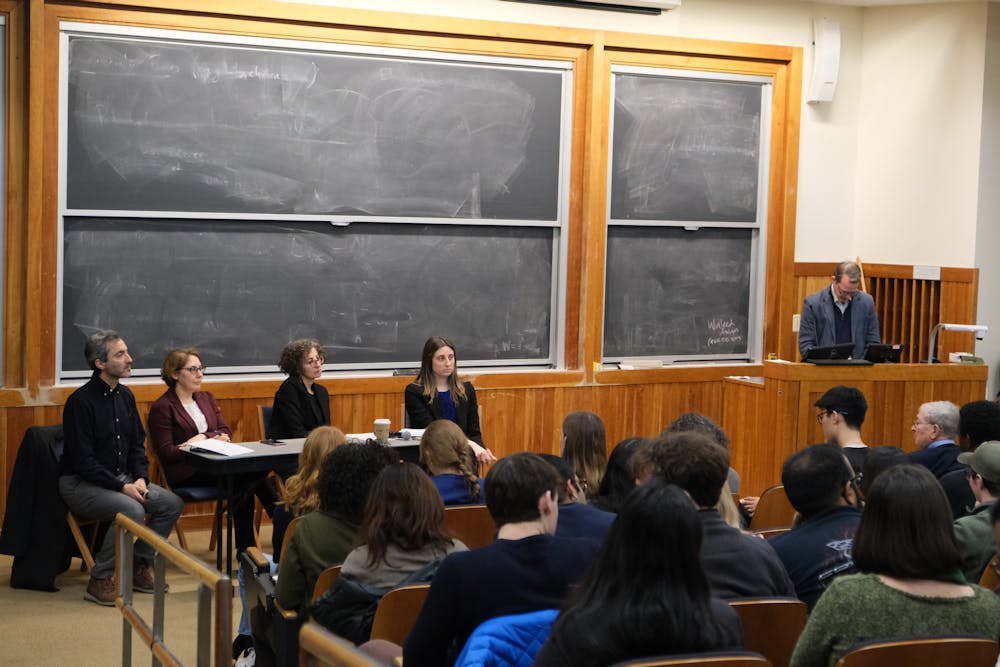
On March 12, four faculty members hosted a panel titled “War in Iran: Faculty Perspectives,” organized in response to the airstrikes across Iran by the United States and Israel beginning on Feb. 28th. The panel included Caileigh Glenn, assistant professor of political science; Febe Armanios, professor of history; Sebnem Gumuscu, associate professor of political science; and Ata Anzali, associate professor of religion.
The panel was moderated by President Ian Baucom, and the panelists spoke to an audience of over 150 students, faculty, and staff.
“We wish we didn’t have to have panels like this, but it is one of the vital energies, capacities, and responsibilities of a place like Middlebury to engage,” Baucom said as he opened the panel.
Each panelist spoke for roughly eight minutes, providing perspectives on the war and its wider impact in the region. Glenn — who focuses on research in international relations and foreign policy — spoke first, highlighting the factors at the international, domestic and state level that may have influenced the United States and Israel to attack Iran. She described the long-changing levels of threat perception the U.S. has had towards Iran, which have increased following President Donald Trump’s 2018 decision to end U.S. participation in the Iran Nuclear deal.
Glenn also commented on the Israeli-U.S. alliance, saying: “Israel's proximity to Iran, its ideological differences, its historical legacies of violence all contribute to a different and perhaps greater perception of threat that Iran poses to Israel than what it poses to the United States.”
She discussed the changing role of the US military in the world, citing the rebranding of the Department of Defense to the Department of War. “We are turning from a posture of defense to a posture of warfighting,” she said.
Armanios followed and provided information about the role of US domestic Christian evangelical movements in creating an ideology that supports conflict in the Middle East. She argued that for many US evangelical followers, Iran represented an antithesis to Christian life and a symbol of the apocalypse. “Middle Eastern wars were markers and even progenitors of a specific Christian prophetic timeline”.
“The current U.S. Secretary of Defense, or is it Secretary of War, sports a crusader tattoo across his chest, and the first crusade's battle cry, Deus vult, God wills it, is inked on his bicep.” She ended by noting that these evangelical movements have believers who are embedded in the current administration. “The loudest drumbeat for Armageddon has the deepest roots right here, in our own backyard.”
Following Armanios, Gumuscu discussed the United States' and Israel's desire to achieve regime change in Iran and cautioned that the war may not lead to such change, including institutions, security forces, elite unity, and divisions within the opposition. Citing the advanced age of the now assassinated Iranian leader, Ayatollah Ali Khamenei, she argued that "the question of succession was already a part of conversation in the Iranian regime, a topic of conversation, explicitly or implicitly. And the elite was already getting ready for that moment of succession. So this does not come as a shock to the system.”
She continued by discussing that the war will not lead to the US and Israel's desired regime change in Iran: “The war is likely to produce a united elite who are now under substantial pressure, and they need to come together, and they need to stand united.”
Panelists also noted that the war may blur the boundaries between the Iranian government and its people, of whom it does not enjoy universal support.
“As much as people that I know are opposed to the Islamic Republic, meaning the government, when you are faced with a kind of foreign invasion like this, then you know, those boundaries become less clear. Is this an assault on the government, or is it inevitably going to involve people?” Anzali said in an interview with The Campus.
Armanios also warned that the attack on Iran should be examined differently from other American regime change wars. “Iran has a really strong sense of its history. It was home to important ancient and premodern empires and resisted prolonged direct colonial rule prevalent in the Arab Middle East. This is an important marker of pride,” Armanios said in an interview with The Campus.
“The fact that the Iran-Turkey border has remained stable since 1639 speaks to the deep continuity of the Iranian state, despite its turbulent politics,” Gumuscu said in an email to The Campus.
Gumuscu ended her segment by connecting the war in Iran to concerns about democratic backsliding in the United States and Israel: “The US Congress basically surrendered its authority to declare war to an executive who turned overreach into a daily practice. So for the last year or so, we have seen Donald Trump's administration very much amassing substantial power in his hands, and now we see the external impact of that democratic backsliding.”
During the question-and-answer session, Gumuscu shared a Feb. 28th Ipsos survey that revealed fewer than 27% of Americans supported the war with Iran.
The war with Iran is likely to create domestic tensions in the United States. “Beyond feeling the cost at the gas pump, Americans will also likely face rising prices for goods that are shipped to the U.S. due to industry-wide effects of shipping insurance price increases,” Glenn said in an email to The Campus.
The final panelist, Anzali, opened by expressing his apprehension to participate in the panel: “This war has directly impacted my family and, as such, it is an emotionally charged topic for me to discuss.” Anzali spent the first 30 years of his life in Iran and has most of his extended family there. He relayed stories from his father's sighting of bomb shrapnel falling in Tabiz, Iran and his childhood memories of seeing leftover shrapnel and bullet casings from the Iran-Iraq war.
Anzali continued by speaking about the nature of war for Americans. “Protected by two oceans and the most powerful military in history, Americans have the unusual privilege of discussing war from a distance as a spectacle.”
“I believe the current war with Iran is a child of the marriage between imbecility and arrogance,” Anzali added.
Anzali also commented on the difficulty of gauging support for these strikes in Iran, citing the government's crackdown on the internet. “As difficult as it may be to imagine, there are people inside the country who believe that this war might help bring about a better future.”
Following the panelists, the forum shifted to a question-and-answer session, moderated by President Baucom. Alpana Bakshi ’26 asked the panel about domestic pressures against the war: “Will the autocracy in the U.S. ever push far enough for the U.S. peoples to want to push back?”Gumuscu first responded, describing the role of the United States in destabilising the region with the invasion of Iraq in 2003, which caused a power vacuum in the Middle East.
“The coalition that Trump built to come to power is also fracturing because of this war, right, so there's significant criticism of what he has been doing,” Gumuscu said.
Another student asked the panel if the US-Israeli strikes on Iran should be described as unprovoked, citing Iranian economic, political and military aggression in the region. Gumuscu first responded, describing the role of the United States in destabilising the Middle East.
“[Iranian actions are] not a provocation. It's actually how American miscalculation created a huge momentum in the region,” answered Gumuscu.
Glenn added to this answer, reflecting on the now failed nuclear talks between Iran and the United States.
“There [were] no American nuclear scientists or nuclear energy officials who were accompanying the negotiators,” she said.
The event was well attended, with students sitting on the floor and in the aisles.
“I am Iraqi myself, and I think we are witnessing this second cycle of American aggression in the region. I am personally affected by this conflict, and I wanted to hear different perspectives. I am very satisfied with the amount of expertise that has been presented,” Manar Al-Rikabi ’26 said.
“It was really nice to have President Baucom there. In all the panels I’ve done since I started working here in 2004, we haven't had a president participate. It signalled that this is important, and that we as a community are experiencing something quite traumatic,” Armanios said in an interview with The Campus.
“The Middle East, and Iran specifically, is a subject that gets flattened into talking points very quickly in public discourse. A panel brings together people with different expertise, different lived experiences, and different analytical frameworks, and forces those perspectives into conversation,” Gumuscu added in an email to The Campus.
Yuvraj Shah '26 (he/him) is a Managing Editor.
He has previously served as the Senior Opinions Editor. He is a joint major in History and English Literature. He was awarded a $5000 Mellon Humanities For All Times Grant through the Axinn Center for the Humanities and is conducting research about the citizenship rights of the British Kenyan Asian diaspora. He studied abroad at Keble College, University of Oxford. He is a Senior Fellow at Middlebury College Admissions, a Residential Advisor, and Arts Events House Manager. He is a member of Middlebury College’s new 10-year plan development committee. He has previously interned with the New England Review and the Middlebury Magazine. He is an international student from Nairobi, Kenya, and London, UK. He is a UWC Davis Scholar.


