
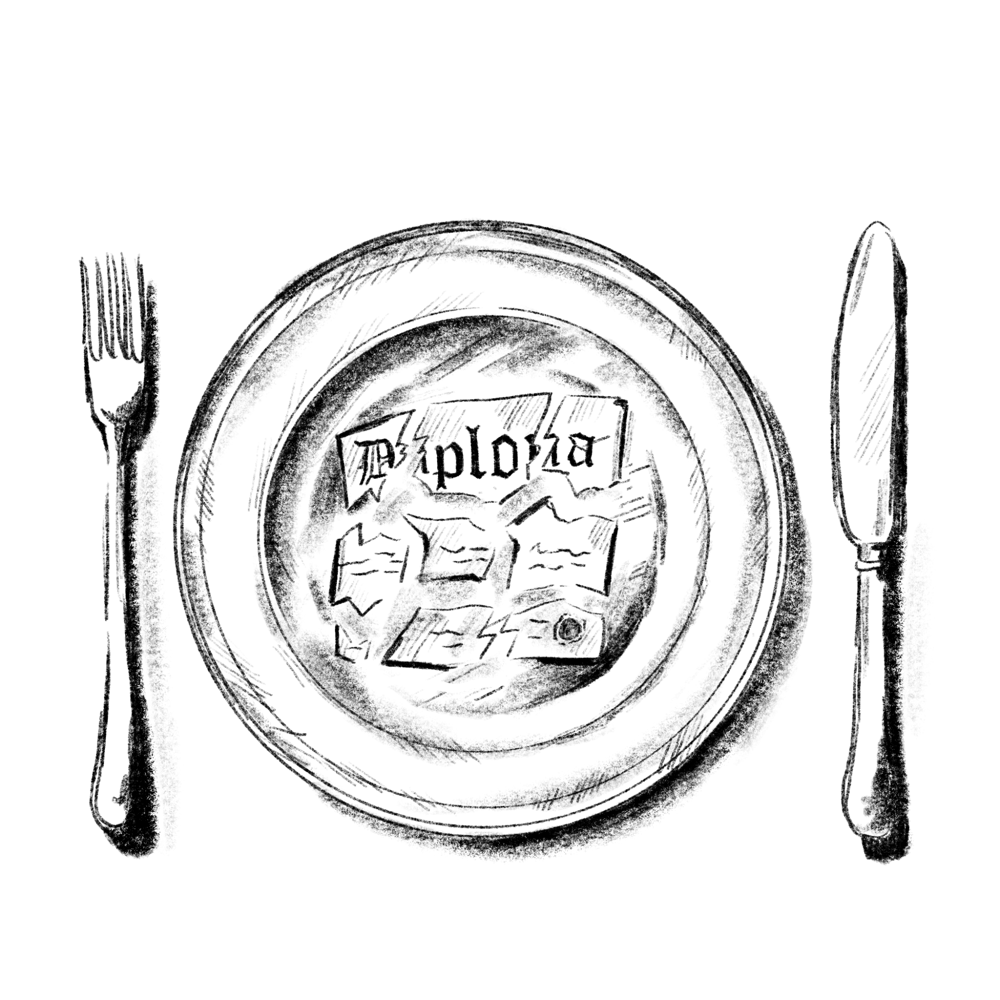
In a plenary meeting on Nov. 7, the faculty-led Educational Affairs Committee (EAC) presented a motion to eliminate the Food Studies minor. The EAC oversees the general direction of the college’s curriculum and makes recommendations on staffing and the allocation of teaching resources.
Decreased student interest, a lack of administrative organization and funding restrictions from the Board of Trustees have all been cited as justification for the minor’s elimination. If passed, the motion would become effective at the end of the 2025-2026 academic year. Students entering Middlebury in the spring of 2026 or earlier would be eligible to declare the minor, but students entering after the spring would be ineligible. The motion was tabled and will be voted on by faculty on Dec. 3.
Molly Anderson, the professor of food studies who directed the program from its inception in 2014 until she retired in June 2025, said the minor’s future has been uncertain since her planned departure. The EAC has not funded a replacement position to manage the program’s administrative and advising responsibilities.
“Three times, we submitted a proposal to replace my position, and the EAC turned us down every single time,” Anderson said in an interview with The Campus. “We lowered our demands each time, and the final proposal that we submitted was for a visiting assistant professor for three years to basically teach the introductory food studies classes. The EAC decided not to fund that.”
The Food Studies program was initially created out of demonstrated student interest.
“It took three proposals to the faculty to accept a minor in Food Studies,” Anderson said. “A lot of faculty seemed to think that food studies should be just a University of Vermont (UVM) program. It’s true that UVM has a really good food systems program and agroecology program, but there are a lot of students who don’t want to go into farming, rather things like food policy, international work in food, food economics, who would have been very well served by a food studies minor.”
According to Anderson, the number of students interested in the program was growing until she announced her eventual retirement.
“As soon as it became known that I was retiring, the number of students who were opting for the minor dropped, understandably, because students did not know if there would be academic support for them,” Anderson said.
She expressed her dissatisfaction at the possibility of the minor no longer being available to students. “I do understand where the administration is coming from but I really am disappointed because we worked so hard,” she said.
At the faculty meeting, the EAC shared that they had reached out to departments that have contributed Food Studies courses in the past, and none expressed an interest in incorporating the minor into their department due to how much administrative work it would require their staff to take on.
“Since Molly Anderson retired at the end of the spring, there has not been a director of the minor with expertise to advise students, and there is not a full time compensation number on campus right now teaching food studies courses. Without that leadership, the future of a standalone minor in food studies is uncertain,” one member of the EAC said.
EAC members expressed that they ultimately have to make difficult decisions about funding due to restrictions from the Board of Trustees.
“We receive an FTE cap from the trustees every year. That means that the EAC has to make really painful decisions about the basic curriculum,” an EAC member said.
At the meeting, several faculty members expressed their disappointment with the motion.
“It’s really a shame, especially given the fact that when we think of our location and relationship to the land. We also have issues of food, starvation and food cuts across everything. My feeling is we could have made an effort to keep this program, and rather, we let Molly retire and just let it disappear. I really think we should not lose this opportunity to rethink this,” one faculty member said.
Lana Povitz, associate professor of history, teaches one food studies course, “History of U.S. Food Politics.” Her research relates to the history of food politics along with social movements and gender and sexuality.
“We can’t have [the minor] without a designated anchor. If the program just exists in name, without dedicated resources, then it won’t be able to achieve its potential,” she said in an interview with The Campus.
Since Anderon’s retirement, it has been difficult to maintain the administrative tasks necessary for keeping the minor afloat.
“Molly Anderson was amazing,” Povitz said. “As long as she was here, it worked to have at least a minor. After she retired, she wasn’t replaced. It is a lot of administrative work to support a minor. Those of us who teach food studies courses are all pretty busy with our current responsibilities — teaching, mentoring, research, existing service roles — so it makes sense that no one was willing to also assume leadership of a minor that has very low student demand.”
As it stands, there are four Food Studies minors. One will graduate in 2026, with the remaining three graduating in 2027.
Kana DeCoste ’27, one of the current students in the program, thinks it has a lot of overlap with other areas of study on campus.
“As a conservation biology major, the things I was learning about in my food studies courses made the most sense to me,” DeCoste said. “It’s a perfect intersection of climate action, understanding how social movements and science play out in a very tangible way.”
“It’s really unfortunate that an interdisciplinary program that meets so many of the college’s strategic goals will be eliminated,” Anderson said.
With the faculty vote on the motion taking place on Dec. 3, the results remain to be seen.
Norah Khan '27 (she/her) is an News Editor.
Norah has previously served as a Arts & Culture Editor. She is majoring in Political Science and English, with minor in Spanish. Outside of The Campus, she is involved with Matriculate as an Advising Fellow and the Conflict Transformation Collaborative as a Conflict Coaching Peer Facilitator.


