
“Be not afeard; the isle is full of noise.”
- Caliban, “The Tempest”
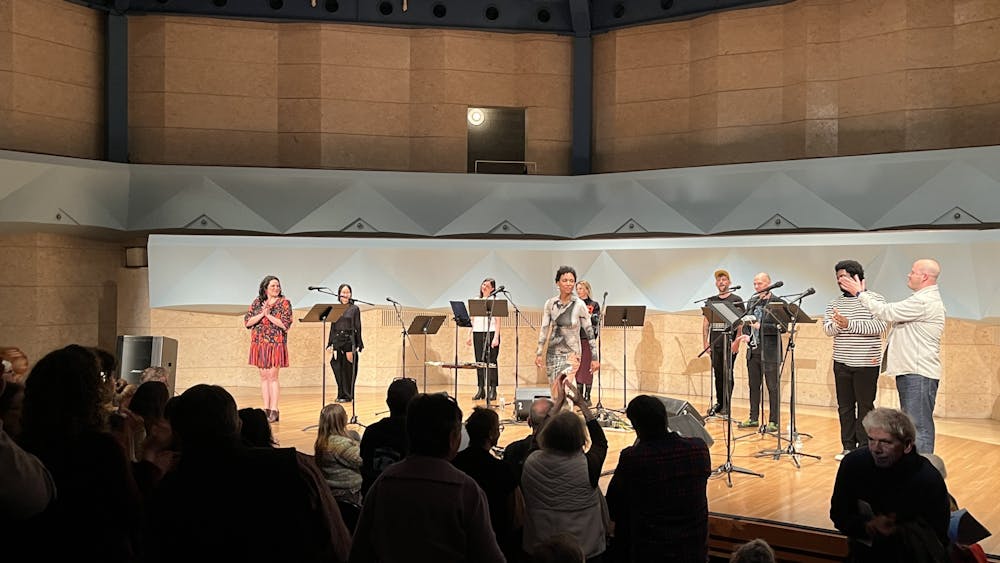
Full of noise it was, when on the night of Nov. 5 in Robison Hall, the avante-garde acapella octet Roomful of Teeth and composer, poet and flutist Allison Loggins-Hull joined forces to produce 75 minutes of utterly remarkable and deeply moving experimental soundscapes. I have heard nothing like it — certainly not live. If Bach, Phillip Glass and Laurie Anderson were to collaborate it might sound something like Roomful of Teeth. If Stravinsky, Langston Hughes and Erykah Badu did the same, it might sound something like Loggins-Hull. These artists present such an imaginative range of sounds, influences and styles that it is hard not to be immediately captivated by the novelty of it all.
Roomful of Teeth had last been part of the Middlebury Performing Arts Series in 2020, accompanied by the Dublin Guitar Quarter. This night’s performance was separated into two main sections preceded by a short introduction: “Vesper Sparrow” (Roomful of Teeth), “The Isle” (Roomful of Teeth) and “Friction” (Loggins-Hull, Roomful of Teeth).
“Vesper Sparrow”, composed by Missy Mazzoli for the band’s residency at The Massachusetts Museum of Contemporary Art in 2012, introduced us to Roomful of Teeth’s world in just a few minutes. The song is physical and earthly. It is primal, almost tribal. Mazzoli aimed to capture an “amalgamation of imaginary birdsong.” Bass and baritone pulse like churning earth and soil: the rhythm section. Alto and soprano flutter above like a host of whistling sparrows: the lead.
“I tried to capture the exuberance and energy of these individual singers as well as a bit of the magic that is created when this group comes together,” Mazzoli wrote, describing the piece.
Most of my time listening to Roomful of Teeth’s “The Isle” was spent blinking back tears. “The Isle”, a Caroline Shaw composition off of the band's 2023 album “Rough Magic", is a collection of five short pieces inspired by William Shakespeare’s “The Tempest”. The prologue (I) and the epilogue (V) take inspiration from a handful of the play’s stage directions, which reference magic, music and noise. These sections are solemn and slow; they build and fade out masterfully. The three intervening pieces each use a different character’s monologue as an extended refrain: Ariel (II), Caliban (III) and Prospero (IV). The vocalists play with Shakespeare’s language, repeating, refracting, trailing off and looping. The way in which they stretch, bend and unfold the poetry is beautiful. Their delivery is sometimes dizzying, and sometimes incredibly centering.
“The Tempest” is a story about magic, manipulation, dream, sleep and illusion. Shaw’s composition and Roomful of Teeth’s performance meets the play where it is: on the ethereal plane. Their sound is large and majestic, frequently flirting with the angelic hymn or romantic cantata.
The music can also be elusive. Gorgeous, ephemeral melodies slip in and out of the greater soundscape. Searching for those subtle sounds is its own game, and when you catch one you’d better grab it and hold on, because it will take you somewhere otherworldly.
But the greatest parts of the performance was when the whole octet sang together, with perfectly unified resolve, producing sound unbelievably rich and deep. The first time they really came in all at once – at the end of the “The Isle’s” prologue – I heard a smattering of audible gasps from the crowd. They don’t overuse that sound, so when they do pull it off, it feels all the more special.
Loggins-Hull is a multi-talent: composition, poetry, instrumentation, voice, electronics, production – it seems as if there is not much creatively she is unwilling to explore. In her newest work, the song cycle “Friction”, Loggins-Hull combines all her talents and – with the help of Roomful of Teeth – creates something fascinating.
The cycle’s sound ricochets between psychedelia, classical, jazz and experimental electronica. Conceptually the work is poetic, visual, abstract, and persistently autobiographical. She incorporates interesting electronics, samples and pre-recorded loops in her music, creating a lush and sometimes haunting background for her flute playing, her poetry and Roomful of Teeth’s accompaniment.
Loggins-Hull plays with the elasticity of noise: flute, vocals, and electronics melt into each other and become one, sometimes indistinguishable sound. There is both a consonance and a constant dissonance in her music; it challenges the ear and compels you to make sense of her complex world.
Her poetry does the same. It is stirring, aggressive and industrial. In the song “Token”, which feels like the climax of the cycle, Loggins-Hull stomps on her vocal effects pedal and her voice drops an octave, distorts and doubles. “None of the girls are black,” she repeats as the central refrain, exploring what it means for her to grow up and live as a black woman in America: the kinds of questions she has had to ask, and the answers she has felt forced to give.
Much of the song cycle adopts this tone–introspective, uncompromising and dark. But there is hope too. In “The Thread”, Loggins-Hull loops a sample of her father speaking to her from his hospital bed: “The thread in the Loggins family was always music.” The song teeters on the edge of rhythm and blues. The production is modern and groovy, while still maintaining the experimental tendencies of the rest of the cycle.
I am moved by the ways in which we can find harmony between such varied forms of expression. When Loggins-Hull first picked up her flute as her intro song “Neuro” began, it really hit me: Here is a woman, classically trained on the flute, influenced by the amazingly rich black American music tradition, who incorporates experimental electronics into her sound, and who samples King Crimson and Stravinsky; and behind her is a band whose sound draws from (among much more) Korean p’ansori, Inuit throat singing, Sardinian folk, and Western classical tradition, and who just performed a composition inspired by the poetry of Shakespeare. For me, it was a moment of gratitude. I am constantly amazed at the richness of human history and the unbelievable range of artistic expressions. When someone is able to sift that diversity down into a single vision, to make some sense of that undefinable, beautiful chaos, they achieve something remarkable.
Anthony Cinquina '25.5 (he/him) is an Arts and Culture Editor.
Anthony has previously worked as a contributing writer to the Campus. He is majoring in English with a minor in Film and Environmental Studies. Beyond The Campus, Anthony works as a writing tutor at the CTLR and plays guitar for a rotating cast of bands.


