
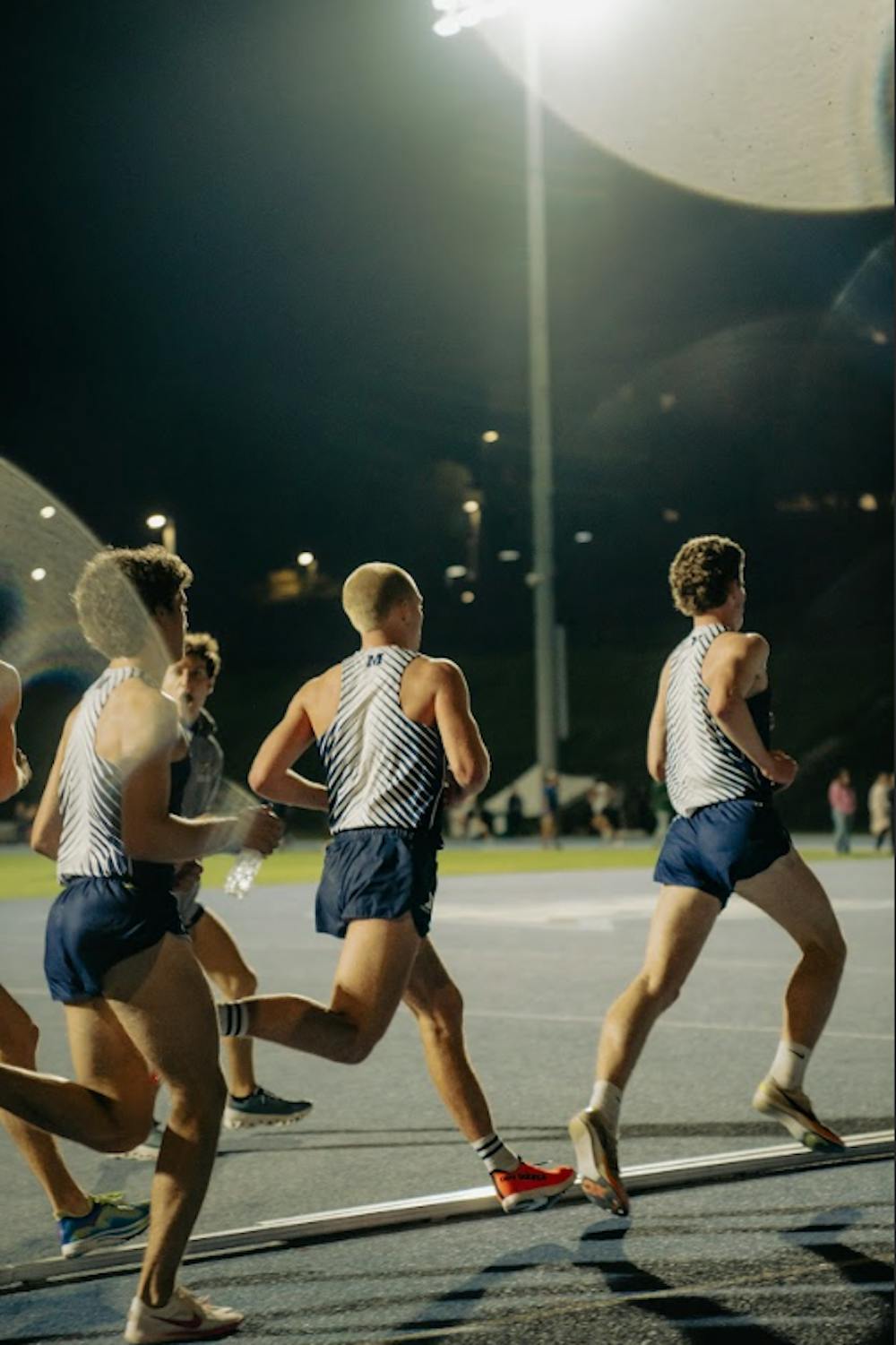
When I was in middle school, my travel soccer coach told me to stop “playing scared.” I kept playing scared, so I quit soccer and inevitably became a runner. Yet there is plenty to be scared of in cross country and track, and soon I learned that you generally can’t outrun your fears in sports. In honor of Halloween, The Campus spoke with some of Middlebury’s athletes to highlight these various sporting fears.
Fear can creep in before competition even begins, especially with an intensely focused audience looking on. Ting Cui ’25.5, a national-level figure skater, feels their presence in the rink.
“Competing in front of a massive crowd of people because the anxiety spikes and all your muscles tense and nerves can take over real quick… [it’s] the pressure of perfection in competition,” Cui said.
Leaping from the ice to the track, a similar pressure exists for high jumpers: the need to immediately get things right in front of a scrutinizing crowd.
“My first jump of a competition because it sets the tone for a meet. I am always super relieved after my first clearance,” Drew McStay ’27 said.
The pole vaulting runway also draws attention at a track meet, and the unique combination of sprinting with a long pole, stamping it into the ground, and attempting to clear a bar a dozen feet in the air can be terrifying. As Robert Altavilla ’27 admitted, shooting himself straight up — reaching an awkward standstill position while the pole is vertical beneath you — is his greatest fear. If a vaulter is less lucky, their pole can snap midair and possibly impale them, a story Altavilla shared about another vaulter.
As jumpers and vaulters attempt to soar, a less visible fear plays out on the starting line of a race.
“You’re scared of being in pain but at the same time it’s how you get faster,” cross country runner Zach Utz ’26 explained. It’s a wonderful paradox. The fear of pain through intense exertion runs through all sports, yet in every discipline, the reward for enduring that pain can be truly intoxicating.
Beyond the track, fear still looms in the stands and around the grounds — a more practical fear of sorts, as a member of the cross country team confessed: “Scariest part of my pre-race routine is always the porta potty lines 10 minutes before the gun goes off.”
However, track and skating lack one common fear-inducing factor: a ball. The presence of a ball can be scary in the dodgeball sense — simple avoidance and the evolutionary aversion to pain.
“[The press] is when the defense winds up to hit the ball, cause when you get hit with the ball it really hurts… on defensive penalty corners, running out as the fly to go get the ball because they’re also hitting the ball at you,” field hockey forward Madaket Rzepka ’26 shared.
Walk inside from the Peter Kohn field hockey field to the Bostwick Family Squash Center and the same fear lurks.
“The scariest thing that has happened to me on a squash court is definitely getting hit with the ball. Ball going 100mph, no chance to move, and it stings,” squash player Naum Lekovic ’29 said.
A ball can also be scary because of its unpredictability — a foreign object, sometimes deceptive, untrustworthy and beyond our control.
“When it’s an open goal [and] the ball comes to you but it bobbles. You can’t predict where the hell it’s going but you know you should score,” soccer midfielder Dylan Payne ’28.5 said. “The scariest part is when you make contact with it and that split second when you don’t know if you missed.”
Fear also haunts athletes as their height in the air increases — not a fear of heights itself, but of a loss of control when off the ground. Such instances are common in basketball, and the outcomes of a bad landing can be grisly.
“Going up in the air for any reason, you’re really defenseless and one hit can take you out for a while,” basketball forward Meghan McDonald ’28 wrote.
Figure skaters face a similar risk, akin to the “twisties” in gymnastics. “Losing your sense of awareness in the air because you can’t anticipate the landing or brace for a bad one,” Cui explained. “It just feels like you’re flying blind and a lot can go wrong on the landing… it’s a high risk of injury.”
This fear reaches new heights when jumping with a horse. “There is always a risk of falls, especially rotational falls when jumping and especially in eventing which can be fatal,” equestrian team member Tess Hegarty ’25.5 said.
Fatal risks in sports are another origin of many athletes’ fears. Will Kallman ’27, an alpine skier for Middlebury, competes among especially deadly conditions. “The scariest thing about ski racing is the proximity to serious injury or death at all times. Nearly every moment while ski racing, you are one poorly timed or executed move from a blown-out knee, paralysis, or even death.”
Facing the risk of one’s ski bindings ejecting at 50mph is enough to make anyone fear for their life. Runners know that feeling, too.
“My actual greatest fear is dropping dead while running,” distance runner Owen Johnson ’26 said.
“[My fear is] heart failure during a workout,” Utz added.
A final category of fear relates to one’s role on a team — a fear of not stepping up when needed, of underperforming when your teammates count on you most.
“Just missing… not doing my job,” football kicker Tony Wang ’26 admitted.
“Letting the boys down,” cross country captain Shef West ’26 echoed.
Fear has many faces in sports and its causes are endless. A fiercely focused crowd is terrifying, while a loss of control midair can scare the best athletes. The expectations of teammates breed a fear of disappointment, and many dread the imminent pain of their competitions. No matter the sport or scare, though, all these Middlebury athletes certainly share one trait: the ability to overcome these fears and play brave.
Editor’s Note: Sports Editors Kanan Clifford ’28.5, Ting Cui ’25.5 and Theodore Maniatis ’28.5 contributed reporting to this article. Cui is a sports editor and the Business Manager on The Campus.
Simon Schmieder '26 (he/him) is a Senior Sports Editor.
Simon is an avid runner and biker and enjoys spending time outdoors. He is a philosophy and political science joint major with a minor in German, in addition to being a Philly sports fan.


