
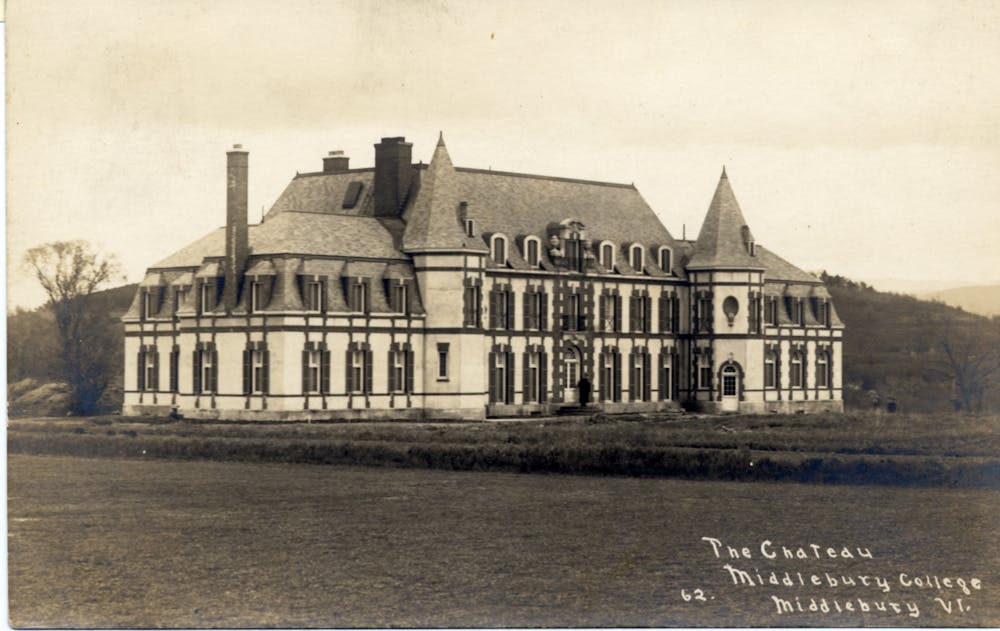
The Chateau marked its 100th birthday on Saturday, welcoming French Department alumni, students and professors for a celebration of its legacy. The dorm was the first of its kind in the U.S., a maison française or “french house” conceived and built with the purpose of speaking only French inside in mind. With its iconic dormers and peaked towers, the building has long stood out among the campus’s predominantly gray-stone Georgian architecture.
“This birthday [of the Chateau] is also the birthday of where immersive learning started [in the United States] as the first French house,” Associate Professor of French and Francophone Studies Julien Weber said.
The festivities were a mix of Chateau history lessons and group reminiscings, culminating in a panel by four college professors and a reception in the building’s Grand Salon. The crowd of around 40 people shared memories of their time in the French Department, and alumni were able to poke around in the classrooms where they once lived, ate and learned.
For many alumni that graduated before 1980, their favorite part of their Chateau experience no longer exists: the former dining hall in the basement, which is now a performance space. It was host to the original language tables for every language department and was open Monday through Friday for breakfast, lunch and dinner.
“I loved not having to leave the Chat all day in winter, being able to take literature classes in La Petite Bib, and then go downstairs to an excellent lunch prepared by Eleonore and Bob,” Rentsch Moraga ’76 wrote in a message shared with The Campus by Jolene Newton, the French Department academic coordinator. “I also liked being a waitress in several different languages. In those days, we all thought we were polyglots.”
Again and again, alumni recalled the same small joy: shuffling downstairs in pajamas and robes to join the breakfast table, talking about the day ahead of them in a language other than English. According to Karen Nicholas Treanton ’80, the dining hall was “the pull” to live in the Chateau. In the 1970s, residents had their own “beloved” live-in chef for the dining hall, according to event attendees.
Today’s language students track their professor-mandated lunches at language tables in the upstairs of Proctor Dining Hall, but for past Chateau residents, it was simply part of daily life. Stacy Nordquist ’80 recalls eating most meals in the hall’s “homey atmosphere,” featuring a professor who prided himself on being able to sit at almost any table.
“The nice thing was you got regular day to day vocabulary that you wouldn't pick up through your academic classes,” Randy Dwyer ’80 said. “At lunchtime, you could invite your professor and chat with them over lunch.”
Once the dining hall closed for the day and the classrooms emptied, the Chateau came alive with social events put on by the residents. At Saturday’s reunion, alumni swapped stories of surprise birthday parties and elaborate multi-course French dinners.
“That year [1977-78] we had a medieval costume party,” Nordquist said. “I went as Joan of Arc. One of my friends and fellow Chateau residents wore my red bathrobe and went as the pope. His friend was visiting from Brown, and he made him dress as a hunchback!”
Quieter moments stuck out as well. Assistant Professor Emerita of French Mireille McWilliams recalled many nights spent gathered around the fireplace in the Grand Salon, chatting with a group of students in a mix of French and English.
“It was a sort of second family we had in the Chateau,” one alumnus said.
The evolution of the Chateau in the second half of the twentieth century was a slow but unmistakable one. In 1972, the building’s dorms were the first on campus to turn co-ed, housing men as well as women. Until 1979, a certain level of French proficiency had been required to live there.
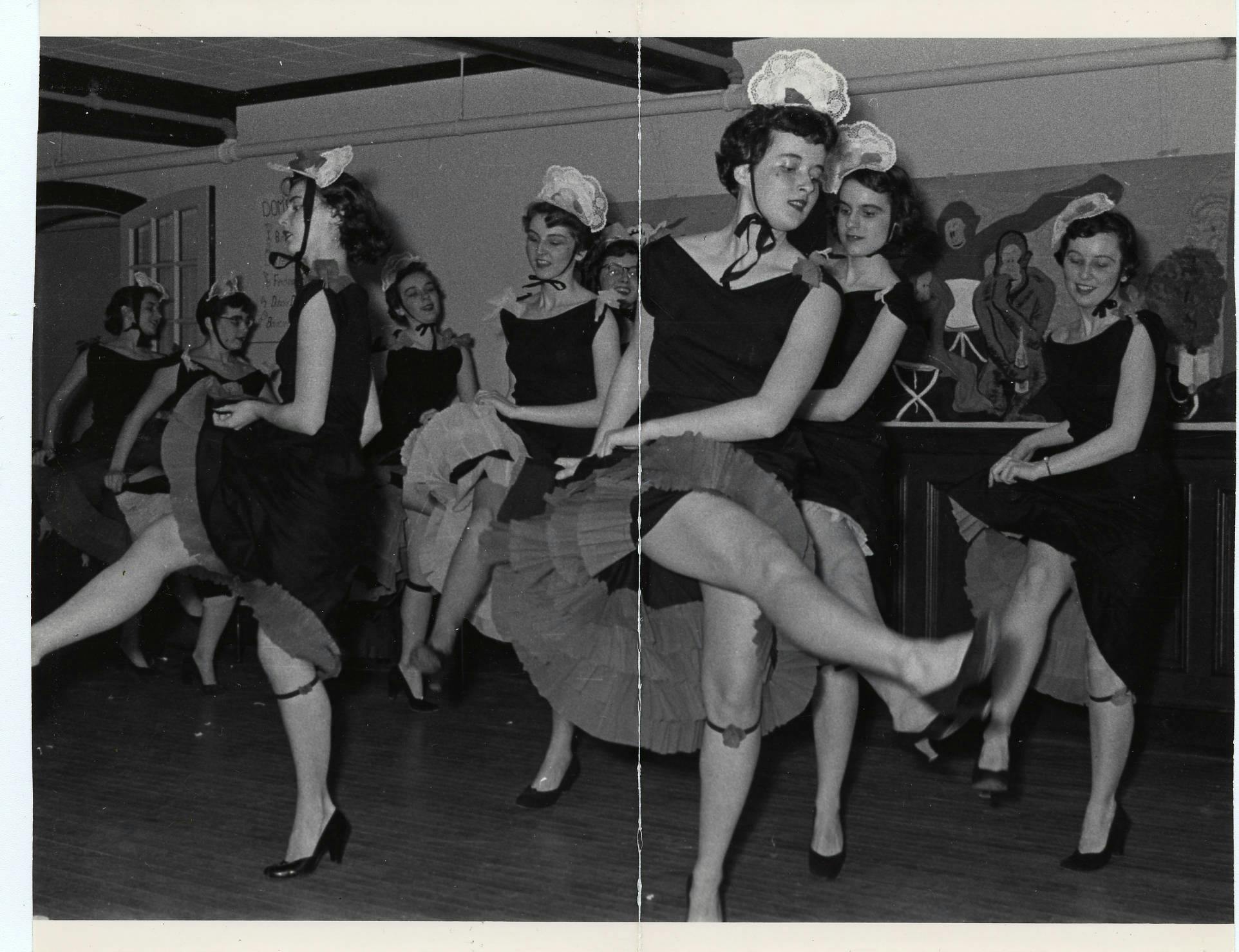
“Even though there was no [Language Pledge] requirement, there was still an understanding that once you stepped through the doors, you spoke French,” McWilliams said. “Kids were happy to speak French.”
That year seemed to stand out in the memories of those affiliated with the Chateau as a turning point. Diminishing applications from French students led to the abolishment of the language requirement in the building, opening what had long been an exclusively Francophone community to non-French-speaking students.
In the 1980s, the language tables were moved out of the Chateau and the dining hall in the basement closed for good. After a period of dwindling French enrollment throughout the 1990s, the Maison Française was moved in the year 2000 to Franklin Street, where it remains today.
One-hundred years since its opening, the Chateau’s classrooms are used by numerous departments and its housing is open to all upperclassmen. Professors noted the range of languages one might hear in a single pass through the building, but Assistant Professor of French Therese Banks maintained that even today, it is still a place where she was more likely to receive a “Bonjour” in the halls than a “Hello.”
“Even if it’s no longer an exclusively francophone space, the Chateau is an enduring symbol of Middlebury’s role in foreign language,” Associate Dean for the Arts Pieter Broucke told the crowd gathered for the centennial celebration.
Concluding his speech at the panel, College Professor Emeritus Edward Knox listed a French bookstore and faculty lounge among other facilities that the building no longer hosts; in the same breath, he acknowledged the “highly deserved” improvements to faculty offices and increased housing and financial flexibility the college gained as positive changes.
“It’s a bittersweet narrative, the life of an institution,” Knox said.
Noor Khan '28 (she/her) is a News Editor.
Noor is a History and Political Science double major. She was an editorial intern at the Los Altos Town Crier for the summer of 2025.


