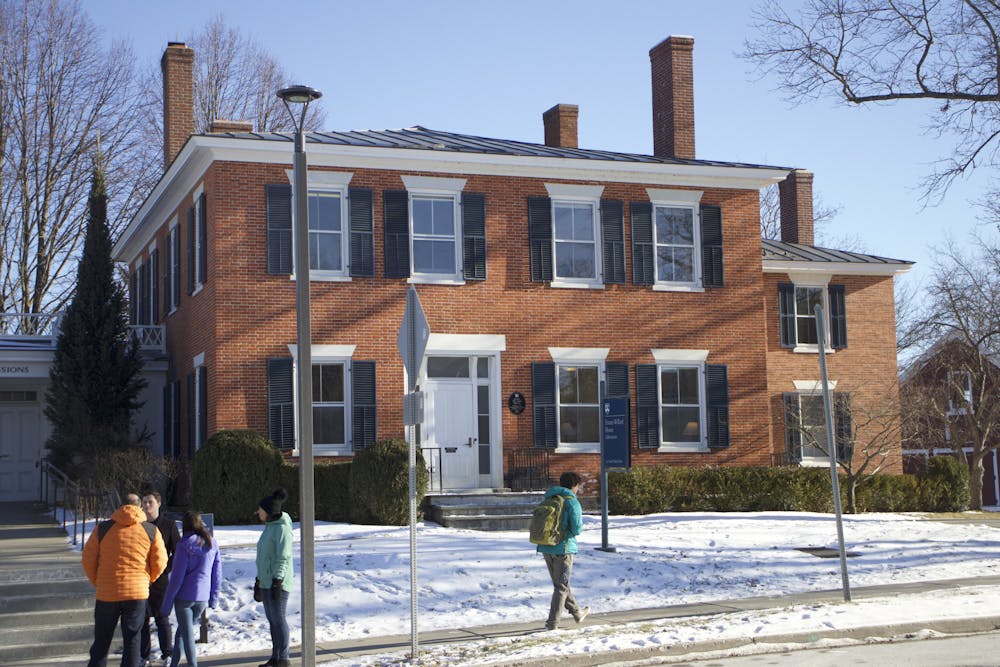
On Aug. 8, Middlebury College was named as a defendant in a lawsuit filed in the U.S. District Court of Massachusetts accusing 32 elite colleges and universities of attempting to raise tuition costs through the early decision admissions pathway.
Middlebury sits on the list among Ivy League universities — Brown, Columbia, and Cornell — and peer liberal arts institutions, like Amherst, Bowdoin, and Wesleyan as defendants. Also named in the lawsuit are private research universities like Vanderbilt and Washington University.
The lawsuit, a class action complaint filed by four former or current students of some of the schools named on the list, names the first defendant as being the Consortium on Financing Higher Education, an organization of schools constituted by nearly every defendant institution.
The Consortium on Financing Higher Education is an “unincorporated, voluntary, institutionally-supported organization of highly selective, private liberal arts colleges and universities, all of which are committed to meeting the full demonstrated financial need of admitted students,” according to their website.
The lawsuit alleges that the early decision option deployed by these institutions is an infringement on antitrust law, because it effectively prohibits schools from vying for student application and matriculation. It argues that when a student is admitted through early decision, their unofficial obligation to attend that school means the college is less incentivized to offer as much financial aid as they would to students who are potentially comparing several schools’ financial aid packages when making their choice.
“Early Decision is enforced by mutual agreement between would-be competitors not to compete for students offered admission through Early Decision at other schools. A school has no legal, moral, academic, or self-interest-based reason not to compete for students offered admission at other schools through Early Decision, any more than it does to refrain from competing for students offered admission by other schools through the regular admissions process,” the lawsuit states.
“The schools lose their incentive to compete on price for students admitted through Early Decision, driving up overall “top line” tuition levels and reducing both need-based and merit-based aid for Early Decision admittees. The result is that both Early Decision and non-Early Decision students pay higher prices than they would have paid absent the conspiracy at the center of the Early Decision scheme,” the lawsuit continues.
In response to being named as a defendant in the lawsuit, the college administration issued a brief statement asserting the college’s commitment to accessibility.
“We have received the complaint but are unable to discuss pending litigation. Middlebury has had a long commitment to meeting the full financial need of admitted undergraduate students and provides access through a variety of resources for academic, social and pre-professional opportunities. In addition to the $95 million in financial aid we expect to award in all our programs this year, Student Financial Services provides additional resources to some students, including a laptop, health insurance and class materials and/or books,” the statement reads.
Middlebury practices a need-blind admissions principle and is committed to meeting 100% of need-based aid, with 46% of students receiving financial aid, according to the Student Financial Services website.
While the college and other institutions on the defendant list practice this need-blind promise, the lawsuit insists that such a commitment fails to mitigate the lack of agency the attractive early decision pathway forces upon an applicant or a group of applicants.
“[A]n Early Decision admit who tries to negotiate an increase to merit-based or need-based aid will have little bargaining power because of an absence of competing offers,” the lawsuit states.
The last major lawsuit filed against elite institutions admissions policies was in 2022 and accused 17 schools of collaborating to offer financial aid packages that inflated the net prices of attendance. The majority of defendants settled that lawsuit for an aggregate of $300 million, according to reporting from Forbes Magazine.
Correction 9/13/25: A previous version of this article indicated that the majority of defendants in the 2025 lawsuit have settled for an aggregate of $300 million. It has since been updated to reflect that this information instead applies to the 2022 lawsuit.

Cole Chaudhari '26 (he/him) is the Senior News Editor.
Cole is a senior at Middlebury, where he serves as The Campus's Senior News Editor and studies English literature and history. This past summer, Cole taught high schoolers in New Hampshire, which he is seeking to do after graduation.