
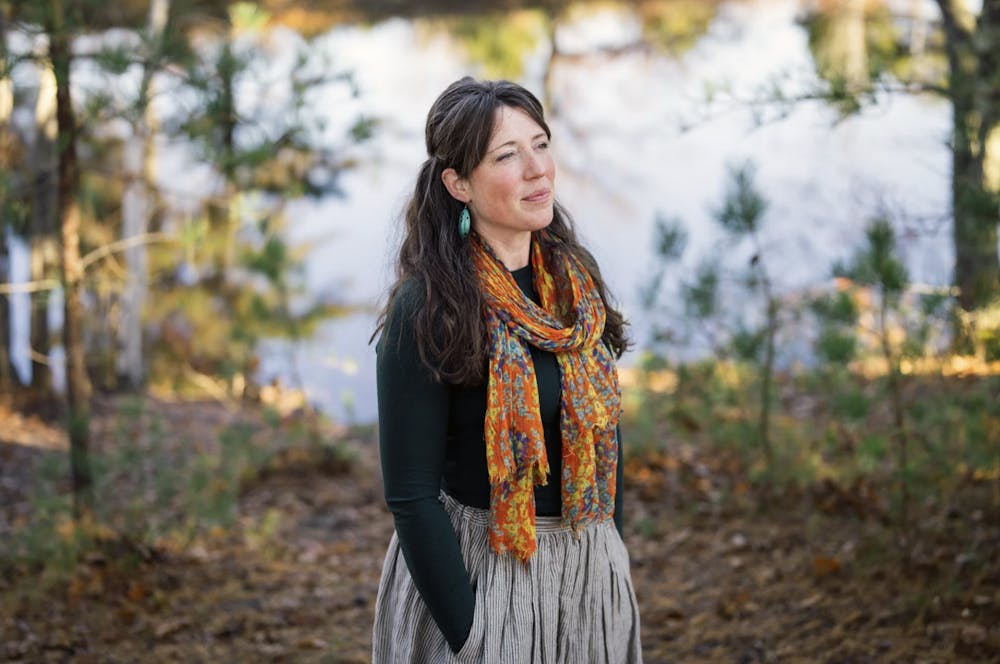
In her book “Mother, Creature, Kin,” local Rochester, Vt. author Chelsea Steinauer-Scudder weaves threads of motherhood, ecology, and spirituality together to explore what it means to raise a child in a world facing profound environmental and existential challenges. On April 8, Steinauer-Scudder visited the Ilsley Public Library to read and discuss the book.
Steinauer-Scudder explained how her childhood and life growing up in the Great Plains of Nebraska has shaped many of the themes that she explores in the book.
“My father is an ecologist and a prairie botanist… so I had a very plant-forward childhood… I was raised sort of culturally Jewish through my mom, but I grew up in a pretty secular home, and so my spiritual piece that weaves its way through this book came during college and graduate school,” Steinauer-Scudder said in an interview with The Campus.
During her time in graduate school and while working for nonprofits, Steinauer-Scudder became further immersed in the world of spiritual ecology. She spent extended time learning about how different people around the world understand the human relationship to place through a spiritual lens. She was fascinated by the diversity of thought and the ways people root their sense of belonging in the natural world.
Steinauer-Scudder spoke about tradition and spiritual connection to the land, using concrete narratives that articulate this bridge.
“There's a story about this tiny village in India where they plant 111 trees every time a baby girl is born…[and] Native Hawaiians on the Big Island of Hawaii who are protesting the building of this giant telescope on top of their sacred mountain,” Steinauer-Scudder said.
Steinauer-Scudder became pregnant just as the Covid-19 lockdown began in March 2020, prompting a personal reckoning with what it meant to bring a child into a world marked not only by a global pandemic but also by an escalating ecological crisis. Specifically, she found herself reflecting deeply on the state of collapsing ecosystems and species extinction.
In writing the book, Steinauer-Scudder sought to fill a gap she noticed in the literature. Unable to find a book that explored spirituality, ecology and motherhood in a unified narrative, she decided to write one herself.
“I think there's a saying, you write the book you need,” Steinauer-Scudder said. “I set out to kind of grapple with that question of what it means to be a mother right now. And, not only in terms of mothering my daughter, but what it means to be a mother in terms of giving care and attention and nourishment to the natural world around us, as part of that, as part of an ethic of ecological care.”
Steinauer-Scudder cited several literary influences who shaped her thinking and writing. For example, Robin Wall-Kimmerer’s book “Burning Sweetgrass” explores motherhood alongside a broader ethical relationship with the natural world. She also drew inspiration from “Silent Spring” author Rachel Carson’s profound understanding of ecology and the way she approached the natural world — with deep curiosity, attentiveness, and reverence.
“[Carson] did not have any biological children near the end of her life,” Steinauer-Scudder said. “She adopted her great grand-nephew when his mother passed away, but she just has this way of both writing about but also engaging with the natural world that is so attentive and full of curiosity and wonder. So, she was sort of a role model for me about what it looks like to give that depth of attention and care to a species and to [something] other than human life.”
Steinauer-Scudder hopes that in reading her book, people will become more thoughtful about their sense of place and their relationship to the environment, as well as the profound connection between spirituality and motherhood that has shaped her own life.
“I hope people take away… that all of us have the capacity for deep love of place and for giving care to the places where we live, and for starting to do that work of mending and repair and sort of healing our relationship to the living world.”


