
I sat. To say that this night was momentous was a disservice to the magnitude I felt it held. My brother sat, then our friend James sat. All of us lounged on the L-shaped couch in my living room, a perfect middle ground between the two speakers and amplifier that make up our home surround sound system. We had spent the previous five years anticipating this album’s release, and the previous 18 hours anticipating the first listen. Different generations will claim their own “voice,” the singer or band who best emulates the revolution that is adolescence. For the three of us on that couch, that voice was Zachary Cole Smith and DIIV.
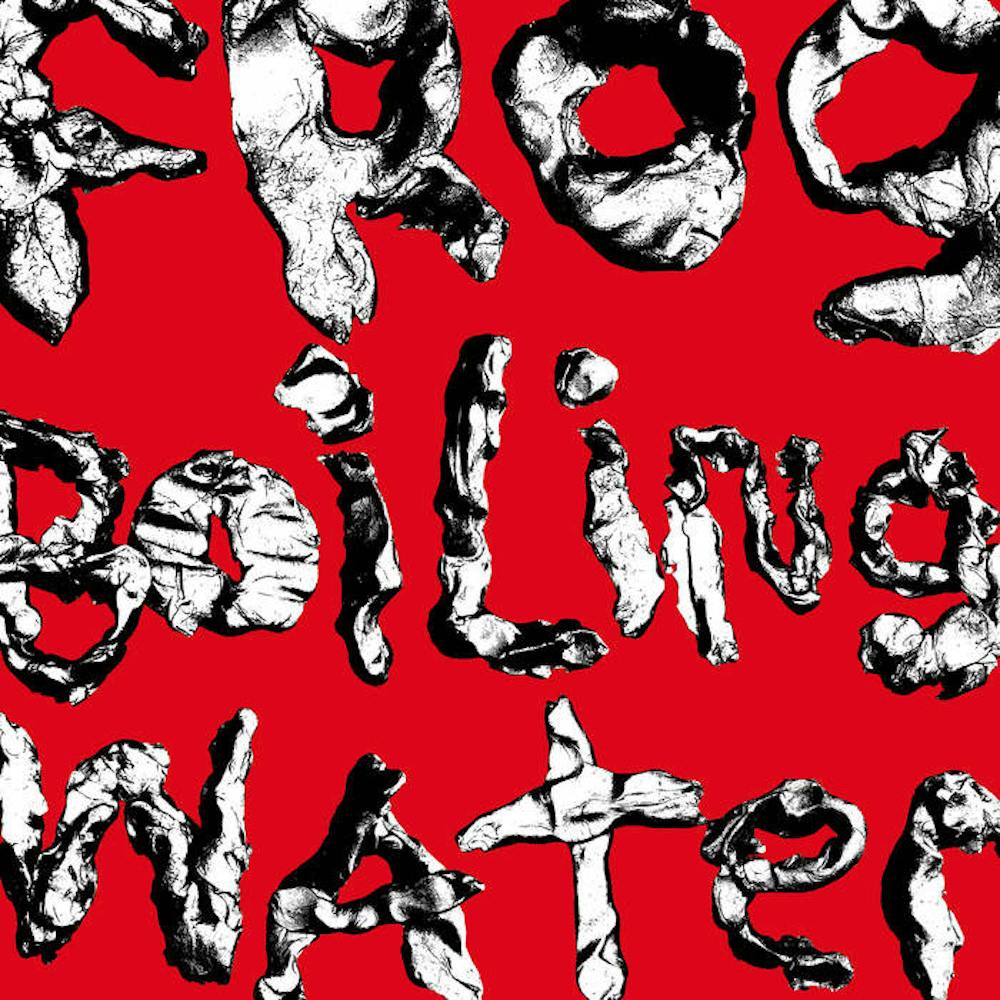
So, as we sat there listening to “Frog In Boiling Water” (“Frog”), DIIV’s fourth studio album, deep emotions swelled. A wall of sound, followed by a wall of silence. I could leave it at that. Album of the year. Flowers. However, 2025 has done more than contextualize this album: the past year has brought essential life to the piece, turning it from a long-awaited release into a necessary companion and a document of collective disillusionment that somehow arrived right on time.
DIIV are no strangers to apocalyptic gospel. Their debut LP “Oshin” became a coveted staple of early 2010s Brooklyn dreamcore, and since then the band’s sound has matured into sour and malaise-laden reflections. 2019’s “Deceiver” embraced this transition with open arms, directing a gritty, shoegaze heavy scope inward, and lamenting on the band members’ personal struggles in the difficult years prior. “Frog” flips the scope outwards.
There are many albums that masterfully weave different subjects and focuses into their tracklists, and then there are albums that focus on one thing and one thing only. “Frog” is the latter. It consists of 10 songs affixed completely to a feeling: the frustration one feels trying to navigate a failed system.
In line with the band’s independent release of the album, five singles were released early, an astonishing half of the final tracklist. The first song on the album, “In Amber,” was thankfully not one of them. Introducing the trend of simple, sludgy, best-when-played-as-loud-as-possible hooks on the album, “In Amber” builds intensity you can feel deep in your gut, while Smith mourns the sense of being fossilized in the “doomsday machine glitch.” It sets the tone for the rest of the record: stuck in time, stuck in motion, burning slowly while trying not to notice the smoke. Smith ends the song in repetition — “I want to disappear” — an unadorned plea for escape that can’t help but grab your attention.
The album’s title is a metaphor worn thin by repetition, yet in DIIV’s hands, it becomes prophetic. A frog doesn’t notice the water heating until it’s too late — sound familiar? We’re so numb to it: algorithms, war and ecological catastrophe turned daily weather. Even on tracks like “Everyone Out,” a respite from the blanketed guitars that mark the majority of the tracklist, the rage is palpable. It’s the soundtrack of the exit we wish we could find. The lyrics are minimal, often mantra-like, but, as is typical with DIIV, the instruments bear the psychic weight. You don’t need elaborate poetry to capture the feeling of being cooked alive. Just say it. Mean it. Loop it until it hurts.
And yet, there’s beauty here too. DIIV have always been melodists, even at their noisiest. On “Reflected,” a brief glimmer of something like transcendence breaks through. It’s not hope, exactly. Maybe more like a longing for a world that doesn’t require resignation as a coping mechanism. The melodies are drowned, but never dead.
What makes “Frog” so affecting is its timing. As I look back at the past year, subjects I might have laughed at nervously are no longer funny. The heat has turned up. “Frog” doesn't offer solutions; it doesn’t need to. It’s not an escape, but a mirror.
In that mirror, I’ve seen myself more clearly than I expected. Maybe you will too. The album is like a checkpoint for me: a marker in the molasses of modern life.
The roll out of this LP began with the band publicizing an early cyberspace site bearing resemblance to a radical 4chan mom’s pinterest board. Endless scrolling revealed conspiracies shodilly explained through post-internet art, and at the bottom of the page, in the middle of a nine-minute ambient recording, lay “Soul-net”, track nine.
“Soul-net” is the purest synthesization of dreamlike unease, an unfolding of a hypothetical narrator’s journey down the Prison Planet Theory pipeline, a conspiracy that DIIV’s lead guitarist, Andrew Bailey, lost a friend to. DIIV’s pointed stab at irony hits the nail on the head, a slow burn with a finale that screams ego death. “I love my pain,” Smith declares at the culmination, a heavy proclamation that makes us question whether there's even another option.
That’s the brilliance of “Frog”: it doesn’t lie to you. It doesn’t distract. It confronts you with the truth in a way that makes beauty out of decay and somehow still insists on feeling everything. Even the numbness. Even the pain.
There may not be a grand shift with “Frog.” As is, the album hasn’t started a revolution. It has, however, added a finely crafted drop to the bucket, the bucket that one day just might overflow. The development of DIIV’s discography has been long-winded and adroitly curated, but be careful not to minimize it to helpless pessimism. After all, it wasn’t pessimism that killed the “Frog,” it was the boiling f*cking water.


