
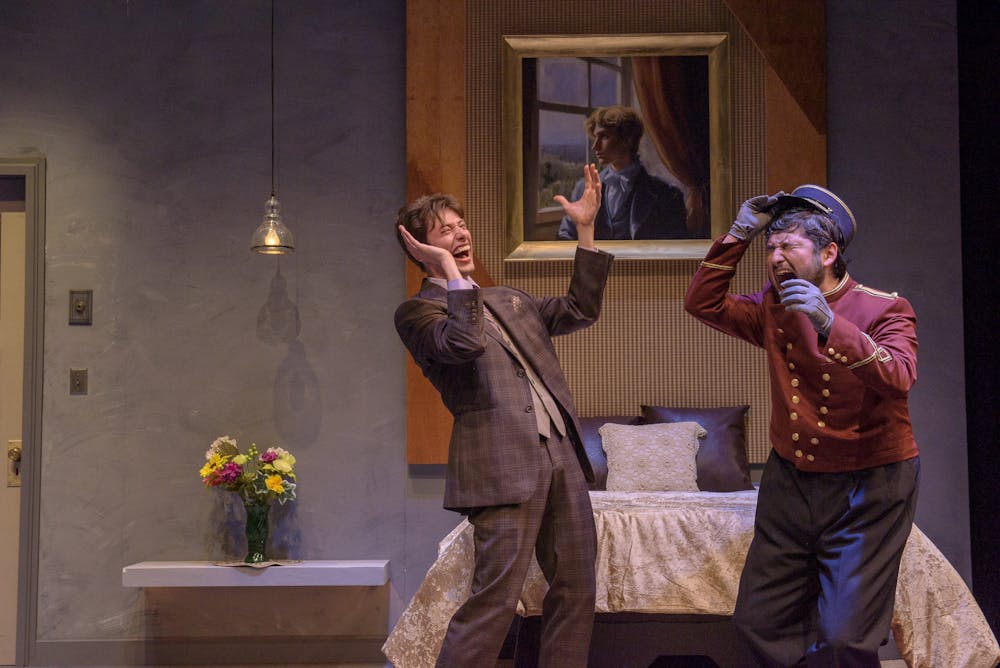
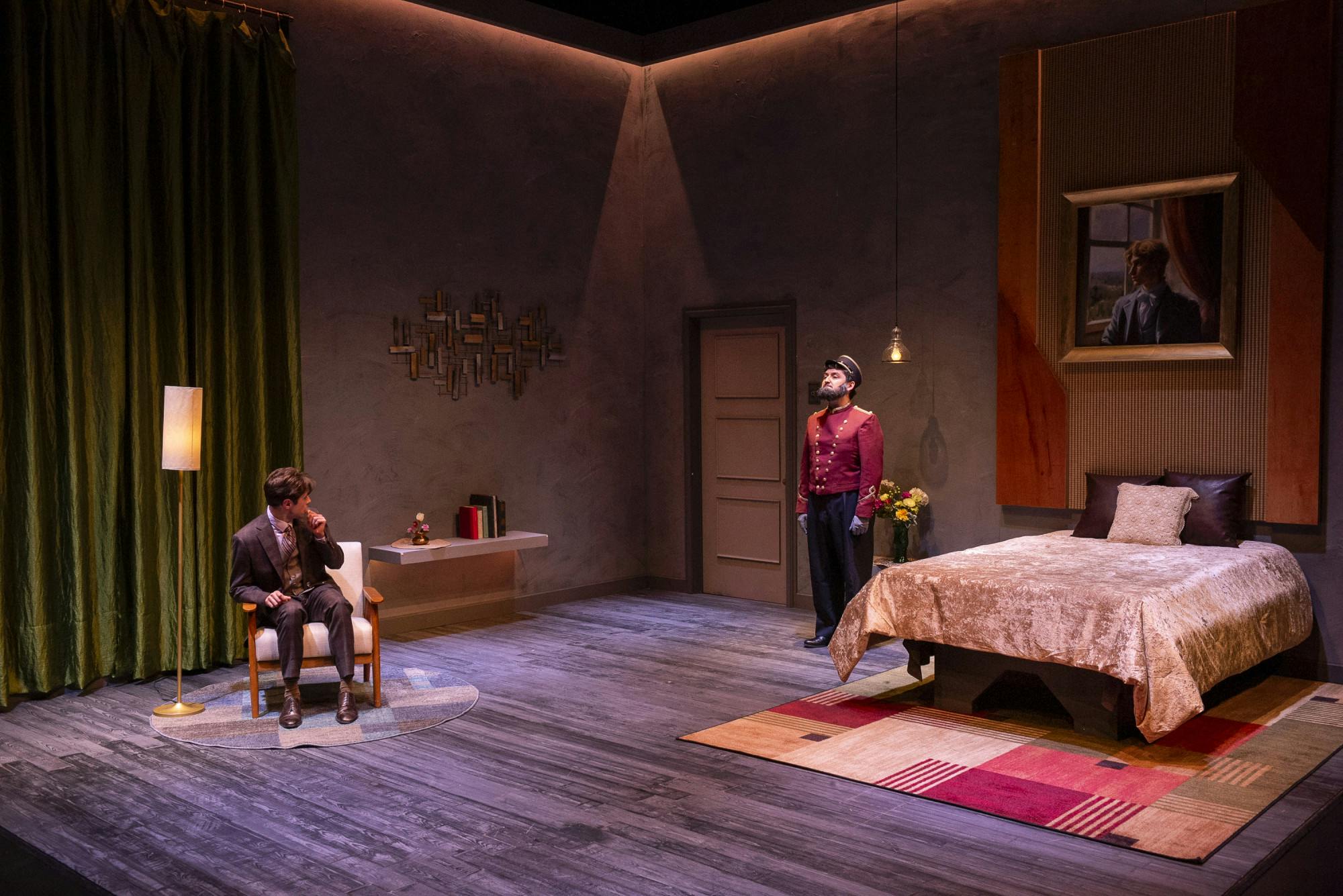
Two walls, a chair and a bed tucked into the Seeler Studio Theatre in the Mahaney Arts Center introduced audience members to the suffocating world of “The Walls” this past weekend. The play, directed by Professor of Theatre and Department Chair Cláudio Medeiros, ran from May 1–3 and offered a transformative experience, balancing laughter with moments of deep reflection.
The play was written in 1963 by Argentinian playwright Griselda Gambaro just before a period of mounting political unrest that culminated in the 1966 coup and the rise of General Juan Carlos Onganía’s civil-military dictatorship. Onganía’s authoritarian regime was characterized by the brutal “Process of National Reorganization” (1976–1983), during which the military carried out systematic state terrorism, leading to the disappearance of an estimated 30,000 citizens. Many have interpreted “The Walls” as a chilling foreshadowing of Argentina’s future dictatorships — a world where people are confined by both visible and invisible walls, reflecting the psychological and political struggles of a generation.
The play features a deceptively simple storyline, structured around a clear power dynamic between three characters: the Functionary (Molly Snow ’26), the Usher (Urian Vasquez ’25) and the Young Man (Ryan Ulen ’26). Taken from the countryside by “the tall one and the small one,” the Young Man is confined to a room that increasingly compresses his sense of reality. The Functionary and the Usher take turns manipulating him until the Young Man collapses within the very walls that contain him. The audience shares his fear and confusion as they accompany the Young Man through this mental journey.
Though the play was written against the backdrop of Argentinian political unrest, its message
is universal and increasingly relevant today, which inspired Medieros to choose it for the annual spring play.
“When I chose the play last year, there were things in it that felt very current — gaslighting, manipulation of truth, and the theatricality of politics. Those were the themes I felt would resonate with audiences,” Medeiros said. “The characters are all universal. They could be from any country, any time — and they certainly can be from our present.”
The characters are nameless and defined by labels that reinforce a universal tension between youth and authority. This abstraction, Medeiros explained, opens the door to broader interpretations that reflect each viewer’s different realities.
The Young Man is a vivid example; he works in an office, occasionally argues with his landlady and treasures a silver watch inherited from his late father. He is an ordinary person, relatable in both his routines and his vulnerabilities.
“I think the Young Man is like a young person — like our students, but also anybody who complies with authority out of a desire to be good and do the right thing,” Medeiros explained.
Another prominent character, the Usher, reflects social dynamics embedded in the narrative.
“The Usher is like a little sidekick of the functionary. He has a similar ability to gaslight people. He sometimes shows small complaints towards the functionary, too. Nonetheless, he obeys her. His authority over the Young Man — granted by the Functionary — allows him to feel superior and extract a sense of power and personal gain from the relationship,” Stage Manager Ivy Tan ’28 said.
The sense of oppression in “The Walls” is conveyed not only through the characters’ interactions, but also through the intentional set design. In a significant change during intermission, the stage shrank from 18 by 18 feet to 14 by 14 feet — a thoughtful choice by Set Designer Qinyi Hua ’25 that mirrored the psychological shrinking of the Young Man’s sense of autonomy and individuality.
“The walls restrict people’s physical movement. But more importantly, they also represent a psychological barrier that restrains the mind and the ability to think,” Tan said.
This notion of “the wall” also extends to the audience.
“It's a very intimate play. You realize that the audience becomes one of the walls that continues to change the narrative of the play,” audience member Rach Peck ’25 said.
The production depicts heavy themes through a veil of dark humor, both highlighting and obscuring the Young Man’s suffering. When he discovers that the Functionary — who presents herself as “the father of the people” — has stolen his silver watch, the Usher responds with a twisted grin: “A father gives you a watch, another takes it away.” Jokes like this recur throughout the play, undercutting moments of despair with unsettling irony.
“I don't think I should be laughing, because it's just hilarious that I'm so uncomfortable. And — oh — did it say in the play that you laugh when you're scared? So it definitely was more of that. I was laughing because I was uncomfortable,” Peck said about the play’s paradoxical experience.
Medeiros embraced this reaction as essential to the play’s effect; he believes that, by engaging with the humor, audiences are better positioned to view the story with a critical eye.
“It’s a dark comedy,” Medeiros explained. “It takes a certain experience in the theater to understand that laughter is part of the power of the play — and it’s a part of the reaction the playwright wants. Laughter is a form of recognition. It gives you distance, and by giving you distance, it allows you to see it better for what it is.”
Ultimately, the play’s ending transforms laughter into quiet devastation. The Young Man sits at the center of the room, cradling a fragile porcelain doll, still waiting for freedom in misery.
“It portrays the development of self-censorship, where, at the end of the play, the Young Man is left in the room with the door opened. But rather than leaving, he listens to the Usher to wait for the news of his freedom,” Tan said.
The Young Man struggles in confusion within the walls. In the end, he gives in to the authority. But the cycle doesn’t end there — there’s another room, and perhaps thousands, even millions more “young men,” facing the same challenge. And every one of them has the same question: What do we do?
Medeiros offers a simple answer, but one that takes a lifetime to put into practice.
“If we do not stand up for what we believe is right and just, the walls could fall in on us,” he said.


