
Last Tuesday, the college announced that Chuck Davis, CEO of private equity firm Stone Point Capital, will deliver this year’s commencement address. Upon receiving the news, we felt both confused and disappointed.
As seniors entering our final days on campus, we feel an immense sense of gratitude for our academic, extracurricular and personal experiences at Middlebury. However, we do not feel that Davis is representative of, or truthful to, these experiences. We want to make it abundantly clear that our criticisms are not about Davis as a person; rather, they are about Middlebury’s choice of an investment executive as a role model for its graduates.
Our Middlebury courses have valued interdisciplinary and innovative thought; they have rewarded active class engagement; above all, they have brought us to question normative narratives. They have taught us that as far as our learning is interconnected, so too are the world’s most pressing problems. Climate change, migration, access to health care, political instability, authoritarianism — these are all inextricably linked to ever-growing economic inequality. Based on this spring’s Zeitgeist 7.0 survey, we know that many of our classmates agree.
So as Middlebury defines itself as “an institution that prepares students to address the world’s most challenging problems,” it feels disingenuous to platform for its graduates someone whose work epitomizes capitalistic gain and exacerbates the wealth gap.
We have not overlooked that Davis has made significant contributions toward cancer research and has given back meaningfully to Vermont communities. He even intends to continue mentoring Middlebury students, a commitment that few commencement speakers have made. However, his career parallels that of many revered business executives who dually function as philanthropists, coating the wrongs of their corporations with the rights of their foundations. Without diminishing the true, measurable impacts of their benevolence, these dollars still stand as proof of success building corporate wealth, not dismantling the inequities it perpetuates.
Stone Point Capital also uses parallel recruiting tactics to many other banking and consulting companies, hiring undergraduates into ‘classes’ that mimic the stability, camaraderie and challenge of college clubs and courses. While this — and the six-figure salary it comes with — may be appealing, we wish that entry-level roles in finance were not the primary example of challenge and community modeled at our graduation.
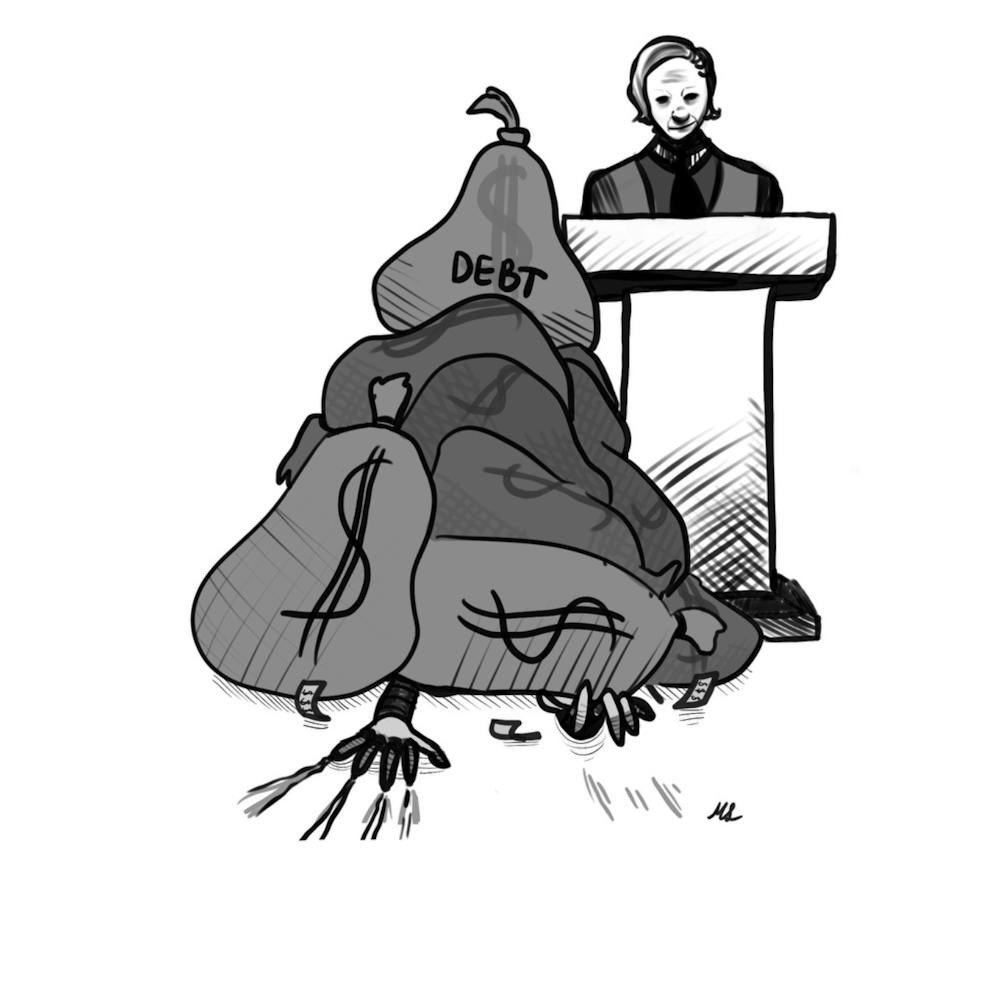
Investment firms like Stone Point Capital and Goldman Sachs are not neutral players in the modern economy; rather, they deepen existing inequalities and divisions by prioritizing short-term gains for investors over long-term sustainability, equity and resilience. Stone Point’s investment portfolio comprises over 100 companies, many of which have faced recent scandals and lawsuits. Perhaps the most ironic of these cases is with Freedom Financial Network, which was sued by the Consumer Financial Protection Bureau and the New York Attorney General for misleading and exploiting consumers in distress. Given that about a quarter of graduates at May commencement will walk across the stage with thousands of dollars in student loans, platforming a CEO whose company endorses the exploitation of clients in debt feels like a poor decision.
Many of Stone Point Capital’s investments, while defensible on Wall Street, represent business models that profit from systemic inequalities or financial distress. Like most of the other large banks and private equity firms with whom Middlebury students vie for internships, Stone Point Capital symbolizes elite capital and the exacerbation of inequality — the opposite of what has been preached in our classes at Middlebury. Arguably, it even counters Middlebury’s mission statement, which claims to “foster the inquiry, equity, and agency necessary… to practice ethical citizenship.”
We approach this year’s commencement ceremony in a world marked by uncertainty, polarization and deep systemic challenges. In times like these, we look to leaders and thinkers who inspire us and embody the kind of courage and imagination necessary to tackle the trials ahead. What Middlebury needs now more than ever is a speaker representing hope, justice and public service.
In recent years, Middlebury has invited speakers like Ayana Elizabeth Johnson, a marine biologist and conservation expert, and Terry Tempest Williams, a writer and environmental activist. These are examples of people whose lives and work have embodied values of justice and care for the world; these are figures who have asked us to think critically and creatively about the future.
We must also remark on the lack of an open nomination process surrounding the choice of a student speaker this year, following two politically-charged student speeches last May and this February. Like the commencement address, the student speaker should be chosen through a representative process, allowing the speech to channel the values and topics most consequential for the graduating class. Neither should be cherry-picked by the administration in a defensive, secretive manner.
It is hard not to wonder if the choice of Davis reflects new pressures that Middlebury faces, such as recent budget cuts, a dropping college ranking and national threats to higher education. These pressures might have resulted in the college selecting someone unlikely to disrupt the status quo and draw attention to Middlebury — a role Davis fits well as the personification of the capitalist status quo.
Megan Mayhew Bergman, a writer and Assistant Professor of English, was the speaker at February commencement. In her remarks, she asked students to take risks in the name of righteousness:
“Today I want to challenge you to think not about rules, but about disobedience. Strategic and compassionate disobedience. I want you to think about how you will take the privilege of this degree and put it to work to shape the world and the spaces in which you move.”
While Davis’s work may be an inspiration for some, we believe Middlebury can make a stronger choice. This decision is out of harmony with the spirit of the community we’ve built here at Middlebury — one grounded in curiosity, connectedness and courage.

Maggie Bryan '25 (she/her) is the Senior News Editor.
Maggie is a senior at Middlebury, majoring in Environmental Policy and French. She previously held roles as Senior Arts and Culture Editor, Arts and Culture Editor, and Staff. During her free time, she loves running, listening to live music, drinking coffee, and teaching spin classes. She is from Chapel Hill, North Carolina.
Evan Weiss '25 (she/her) is a News Editor.
Evan is an IGS major and math minor from Philadelphia, PA. When she's not editing for The Campus, she's either working as a peer writing tutor, running on the TAM, or eating chocolate chips from Proc.

