
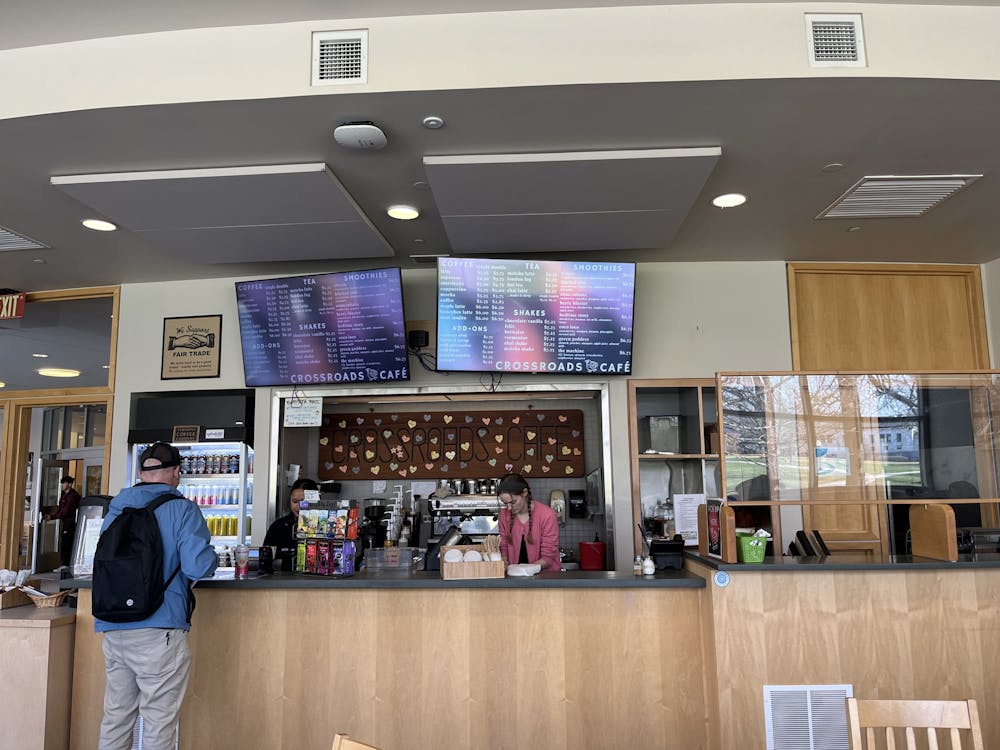
Crossroads Café has raised prices again this year, meaning students now pay over $6 for a specialty matcha, mocha or maple latte from Middlebury’s only student-run coffee shop.
Despite its popularity as a staple study location, meeting spot and caffeine fix, Executive Director of Food Service Operations Dan Detora said that Crossroads has struggled financially in recent years, in addition to other issues with supply chains and shortages.
“Crossroads is designed to break even each year, but has actually lost money over the past few years… this year they are on track to break even,” he wrote in an email to The Campus.
Jayda Murray ’25.5, one of three student managers at Crossroads, explained that securing long-term contracts with high-quality, consistent suppliers is a persistent problem for the business.
“One struggle of running a café on campus would be access to quality ingredients. This is a complicated issue, because not all local vendors are interested in being tied down by contractual agreements with Middlebury,” Murray wrote in an email to The Campus.
Georgia Gates ’28, a student barista at the café, added that national shortages in key ingredients have also limited their offerings recently.
“There’s been a serious matcha shortage. Japan has been having a nationwide shortage, and Japan is where most U.S. matcha is sourced from. Crossroads also frequently gets raided early in the week, and by the end of the week, we tend to run out of some milk products and juices for smoothies,” she said.
The business itself is one of Middlebury’s Retail Food Operations, which means that it operates under the broader dining umbrella, with its pricing and business plans dictated by Food Services. Back-office staff also have to estimate how much of each ingredient to order, a task Murray said can be quite difficult.
“Matcha and espresso beans are probably our top two most-difficult goods to match supply and demand. Those are also our most important ingredients, along with chai, so we totally understand when our customers are bummed when we're out of something,” she wrote.
The fact that Crossroads operates at a loss came as a shock to some Crossroads regulars. Jack Scher ’28 felt incredulous upon hearing that the café does not turn a profit.
“I go to Crossroads almost every morning for a coffee, and there’s almost always a small line, and the booths and tables are always full. The prices are pretty typical, even for a New York City coffee shop, so I wonder where all the money goes,” Scher said.
The cafe’s gross revenue in 2024 was $183,000, coming mostly from a mix of coffee, milkshake, smoothie and sushi sales, according to Detora. The sushi is sourced from Sushi Maru, but Crossroads only pays for whatever it can sell.
“Large and Small Latte’s are the most popular along with Matcha and Maple Lattes. Any of the house-made coffee drinks are more profitable than pre-made or bottled,” Detora wrote.
Because of Crossroads' relationship with the school, the cafe does not have to pay for rent, electricity, water or any other typical expenses that other businesses usually must shoulder. Labor and direct product cost are the café’s two expenses, according to Detora.
Labor consists of three student managers and a large cast of baristas. A barista job at Crossroads is coveted on campus and the end of every semester sees a competitive hiring process, according to Murray.
“I've been working at Crossroads since my Sophomore year — I actually got rejected the first time,” Murray wrote. “Since I was a freshman, I didn't realize being a barista was actually a very sought after position at Middlebury.”
Despite the popularity of the barista position, its compensation according to the campus-wide wage scale system means that baristas do not earn tips or wages adjusted for rush times.
“I love the job but I wish that I earned more because it can get really busy and overwhelming, and two people is not enough to serve everyone,” barista Athena Nooney ’25 said. “It falls on us to make sure that everything is running smoothly, and we don’t get fairly compensated for that.”
Above the student managers, Assistant Manager of Retail Food Operations Andy Davidson is the ultimate authority on business matters.
“Andrew Davidson is our go-to and is our savior when our espresso machine is down, or we need help expediting a matcha order to the café,” Murray wrote. “The three student managers handle hiring, scheduling, ordering, inventory, training, and so on.”
The managers also communicate weekly with staff managers regarding administrative and back-of-house operations, Murray added, making their roles more labor-intensive than the student baristas.
Student and staff managers also collaborate to set the Crossroads prices. Despite the price increases in recent years, Murray said that the café has sold a robust number of drinks this fall and expects spring sales to be strong as well.
“We sold over 2,100 double shot lattes over the fall semester, with the chai latte following right behind… As we transition to the warmer months, we're expecting to see matcha sales increase a ton,” she wrote.
Editor’s Note: News Editor Evan Weiss ’25 contributed reporting to this article.
Luke James Power '28 (he/him) is a News Editor.
Luke previously served as a contributing writer and as a news editor of "The Anvil" Middlesex school. He is majoring in economics and history. He is also a senior analyst with the Middlebury Student Investment Committee, and enjoys skiing, squash, and golf. He lives in Manhasset, NY.


