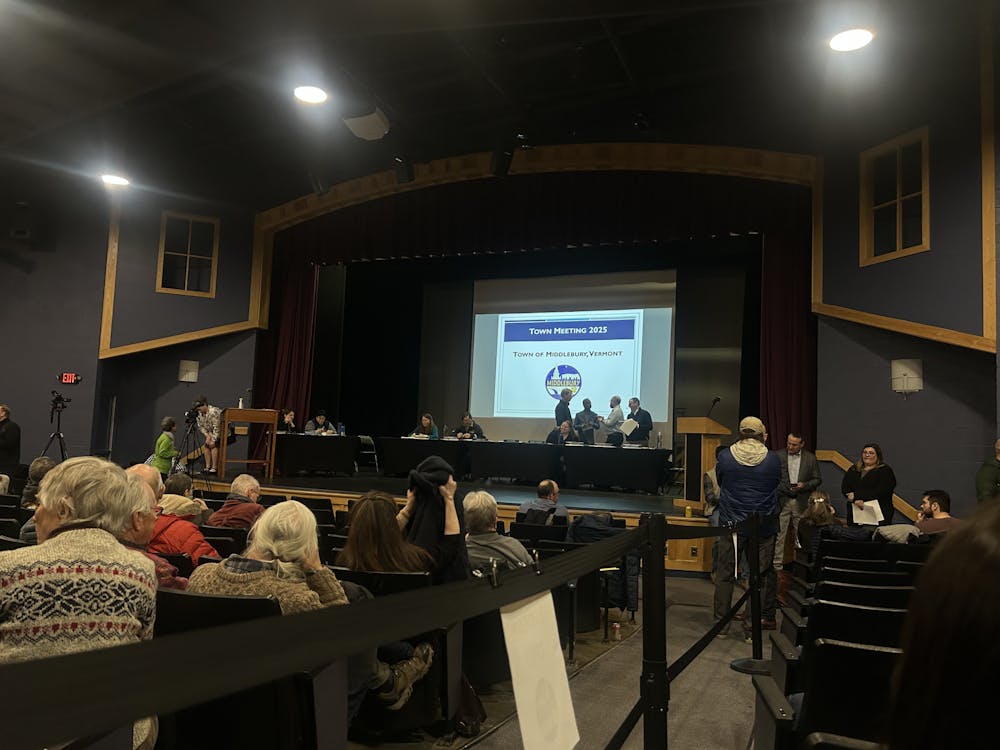
Approximately 125 Middlebury residents gathered for their annual town meeting on Monday, March 3, where they voted in favor of a $14,548,535 budget for the 2026 fiscal year. Of this year’s 10 articles, four were voted on directly in the meeting and the other six were voted on in a ballot election the following day.
Middlebury residents voted in overwhelming support of a $49 million upgrade to the town’s wastewater treatment plant, $2 million in improvements to a water pump off of Rogers Road and $1 million for a stormwater treatment system in the Adams Acres subdivision, according to the Addison Independent. Residents also approved a $51,719,284 Addison Central School District budget for the 2025–2026 school year.
Town Meeting Day is a cherished political tradition in the Green Mountain State. Vermonters and local public officials come together each year for Town Meeting Day, a cherished political tradition where neighbors discuss local issues, make collective decisions and actively participate in democracy in each of the state’s 237 towns.
Town officials sitting on the stage presented reports and reviewed key agenda items, with current town manager Mark Pruhenski — who began his job in January — outlining the town’s proposed $14.5 million budget for the upcoming fiscal year. He acknowledged the challenges in its development, citing inflation as a major driver for the 5.99% increase in the municipal tax rate over the prior year.
“Developing this FY26 budget was a challenge,” Pruhenski told the room. “The Selectboard adopted a fiscal year 2026 budget that requires an increase in the tax rate from 88.94 cents to 94.27 cents.”
One Middlebury resident, Ross Conrad, said he believes that the rise in prices was a result of health care tax increases; other people in the room applauded his criticism of the proposed hike.
“Not what I would actually call modest quite frankly. It’s a significant increase,” Conrad said to the crowd. “I’m wondering, is there anything the town can do to control health care costs? Or are we totally at the mercy of what goes on at the state and federal level? Because quite frankly, we here in Vermont and the United States, we’re overcharged.”
Another resident, Dave Silberman, brought up the increase in the police budget, which now totaled $2,311,650 — an increase of 30% over the past three election cycles.
Middlebury Police Chief Jason Covey responded to this concern by stating that the 4.7% increase had been mostly due to wages, as their current police department includes the most educated individuals they have ever employed.
“I believe we need the [Police Department] that we have, and I believe we need a larger PD,” Covey said. “We are struggling at times to keep up with our call volume.”
Other major budget drivers included capital improvement projects, employee wages and benefits, parks and recreation costs, as well as equipment maintenance and purchases.
All four articles on the floor at the meeting passed unanimously with all residents saying “aye.” The other six articles, which included the wastewater treatment plant and and other improvements to local infrastructure were up for vote in a secret ballot on Tuesday.
Everyone is given the opportunity to speak and vote at Town Meeting Day, a level of equality Professor of Political Science Bert Johnson said was a unique element of the longstanding Vermont tradition.
“The Selectboard has equal status as any member of the town,” Johnson said. “In terms of their voting power, their ability to speak, it is all level in that regard. That is what makes it different from a city council meeting in cities.”
The town meeting was led by moderator Susan Shashok, a former Middlebury Selectboard member. Shashok has held the role since 2019, when former Vermont Governor Jim Douglas stepped down.
While many New England states have town meetings, Vermont stands out for its widespread commitment to this local form of governance, which has been in place since the late 18th century.
Town Meeting Day first occurred in 1762 in Bennington, Vt. — before Vermont was established as a state — as a way for citizens to congregate and discuss issues. Major decisions such as approving budgets, setting tax rates and funding public projects remain in the hands of town residents — often with guidance from the Selectboard and town employees.
Johnson, who currently teaches a class called “Federalism, State and Local Politics,” reflected on Vermont’s unique opportunities for civic engagement.
“Town meeting day is a genuine example of what the political scientist Frank Bryan calls real democracy,” Johnson explained. “It is people getting together in the same place to vote on issues that concern the community, and that is sometimes hard work, but you learn a lot about your community in such an event, you learn about the hardships that other people face, and for that reason, I think it is indispensable.”
Non-residents, particularly Middlebury students interested in local governance, were encouraged by Johnson to attend the town meeting because it provides a firsthand look at the democratic process in action. While they may not be able to vote, students shared their interest in engaging with local issues and better understanding how decisions are made at the municipal level.
Yifan Yin ’26, a student in Johnson’s class, said she was eager to attend the town meeting because it aligned closely with the course’s content.
“In the class, we explore the power dynamics of and between different levels of government,” Yin wrote in an email to The Campus. “Professor Johnson mentioned this is a great way to observe politics at work, watching people vote on their everyday matters, and that is why I went!”

Mandy Berghela '26 (she/her) is Editor-in-Chief
Mandy has previously served as the Managing Editor, Senior Local Editor, a Local Section Editor and Staff Writer. She is majoring in Political Science with a minor in History. She currently is Co-President for the Southeast Asian Society and an intern with the Conflict Transformation Collaborative. Last summer, Mandy interned with U.S. Senator Kirsten Gillibrand and participated in the Bloomberg Journalism Diversity Program.