
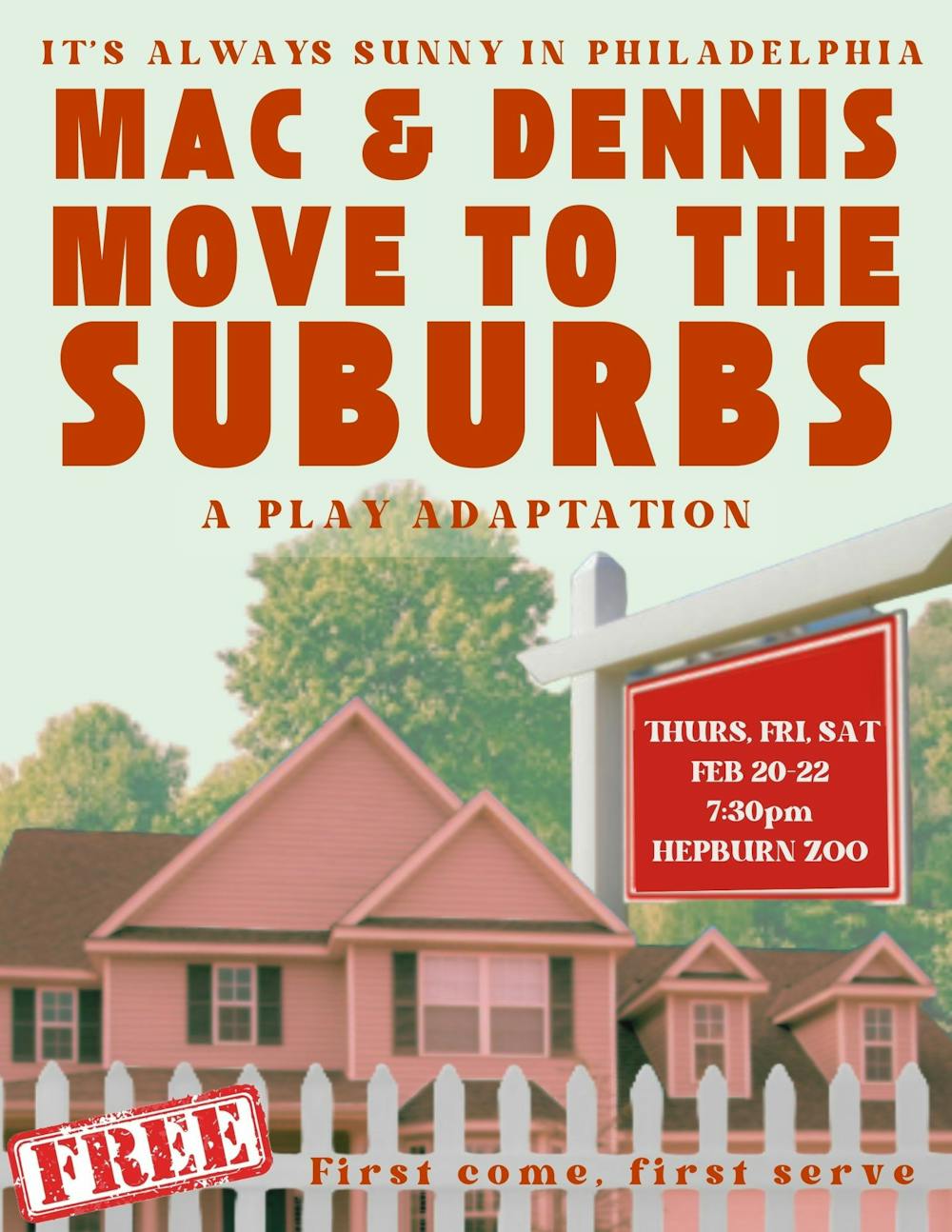
Hysterical and, at times, bashful laughter by a full-house audience filled the Hepburn Zoo two weeks ago as “Mac & Dennis Move to the Suburbs,” a play created entirely by students, ran from Feb. 20–22. August Siegel ’25 and Owen McCarthy ’25 adapted the 20 minute episode from “It’s Always Sunny in Philadelphia” into a 40 minute play starring Thomas Long ’25 and McCarthy as the eponymous Mac and Dennis, respectively.
In the original episode, Mac and Dennis opt to relocate from the city where rent prices are steep and accommodations lousy to the idyllic and peaceful suburbs. Quickly, however, the pair find that they are not cut out for the quiet monotony of suburbia, causing rifts in their friendship and prompting their descent into near-psychosis.
The play followed the episode’s script almost exactly and with minimal set design — the stage was complete with a long dining table, kitchen counter and two mattresses — which demonstrated the show’s impressive storytelling abilities. Most of the play took place inside Mac and Dennis’s new home, with the notable exception of scenes in which Dennis made the hour-long commute to his job in Philadelphia, while McCarthy, equipped with a chair and a plastic steering wheel, occupied a small space downstage left under spotlight.
The play’s inception was originally as a J-Term project originally scheduled for Jan. 22–23 before being cancelled due to illness among cast members. After watching the TV show episode together and studying it for tone and important comedic devices, the team quickly brought the show to life.
“We put it on its feet pretty much immediately after that with about two weeks of rehearsal, a week of tech, and three performances,” said Hannah Alberti ’26, who played Mac and Dennis’s friend Dee.
Plans for the staging had been in the works for some two years. Siegel and McCarthy staged another episode of the show, “The Nightman Cometh,” during their sophomore year in October of 2022, and were impressed by the source material’s ability to translate to live theatre.
“The show is super high energy and very quick, with lots of jokes back to back to back, and I really love stuff like that as an actor, where the audience barely gets a chance to breathe because they’re laughing,” McCarthy said.
Without the benefit of video editing, some details from the original episode were lost in translation. In one particularly memorable scene, Dennis (McCarthy) strips to the (almost) nude in a terrifying expression of anger towards his gratingly cheery, small-talking neighbor, Wally (Owen Foberg ’27.5). In the TV episode, it is made clear that this takes place in Dennis’s imagination, and he and the audience are brought back to reality by the intrusion of Mac (Long). In the staging however, the real-time reenactment meant that after furiously disrobing, McCarthy had to speedily redress on stage in a comically long scene transition. This moment, made unique by live and bold acting choices, was delightful for the audience, even if some nuances were lost.
The play featured some remarkably comedic — if unhinged — performances from both McCarthy and Long. Long’s portrayal of Mac as a gullible and highly endearing sidekick paired nicely with McCarthy’s towering, booming, rageful Dennis. Other supporting performances included the largely mute “Old Man” (Josh Harkins ’25) and Mac and Dennis’s troublesome friends Charlie and Frank (Aidan Armstrong ’25 and Max Gibson ’25). Alberti’s portrayal of the sensible Dee grounded the main pair’s hysterics, and Foberg’s buoyant and energetic portrayal of Wally was a popular favorite.
The opportunity to put on a piece like this is a unique one at a largely non-arts focused college. Most productions are either faculty-led, and rehearsed up to six days a week for several months, or serve as projects towards the completion of the Theatre major. “Theatre and performance at Middlebury is so often emotionally draining and light hearted things like this are just as necessary,” Alberti explained.
Siegel emphasized the importance of community space like the Hep Zoo in creating small-scale, low-commitment theatre: “I will say this to anyone who will listen, but it is truly such a special space and resource,” they said.
“Nowhere in the real world will you get a free space to put on essentially any sort of production or event, where they give you a budget to spend, and you’re surrounded by people who want to join you in your endeavors for fun and not for pay,” Siegel said. “There’s truly nothing like it.”
Editor’s Note: Josh Harkins ’25 is a Puzzles Editor for The Campus.


