
Wondering what connects Middlebury students throughout time? Look to Middlebury Special Collections’ new “Scrapped” exhibit for the answer.
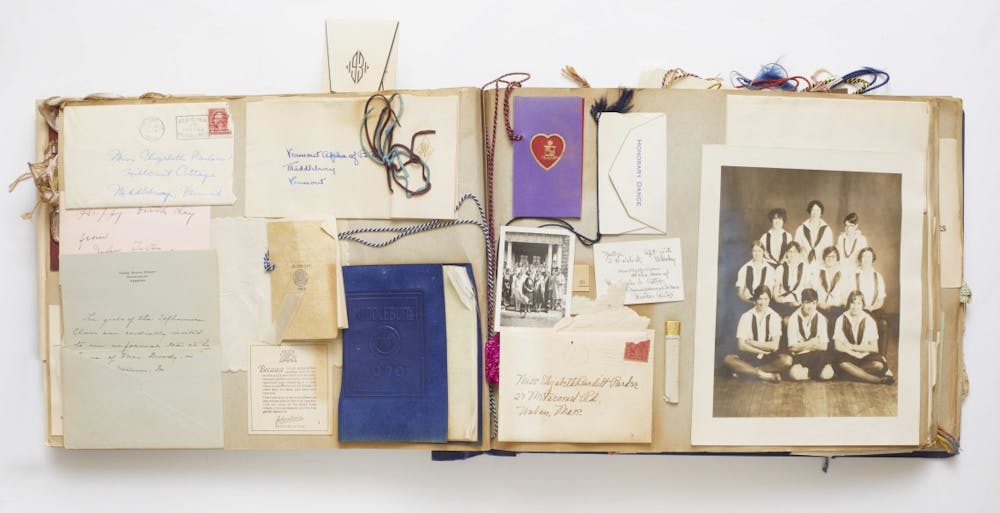
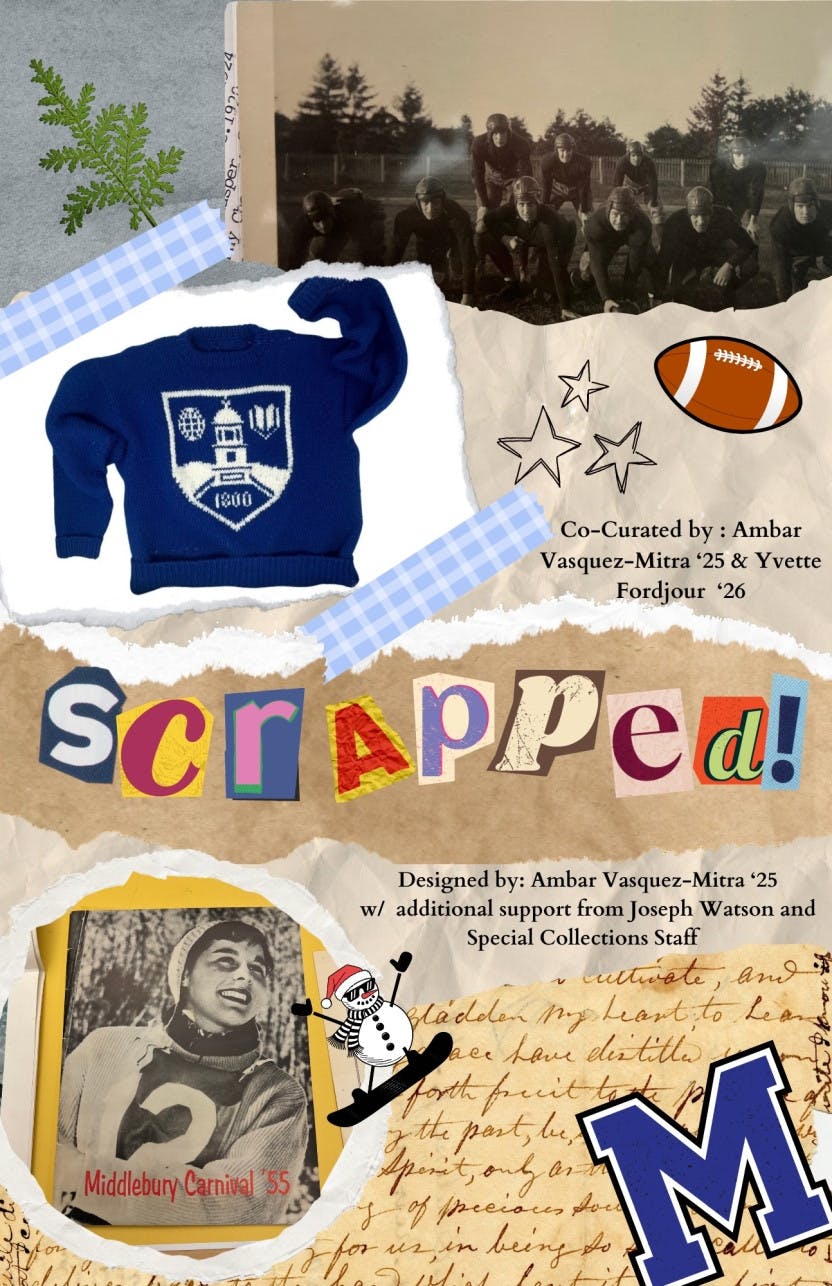
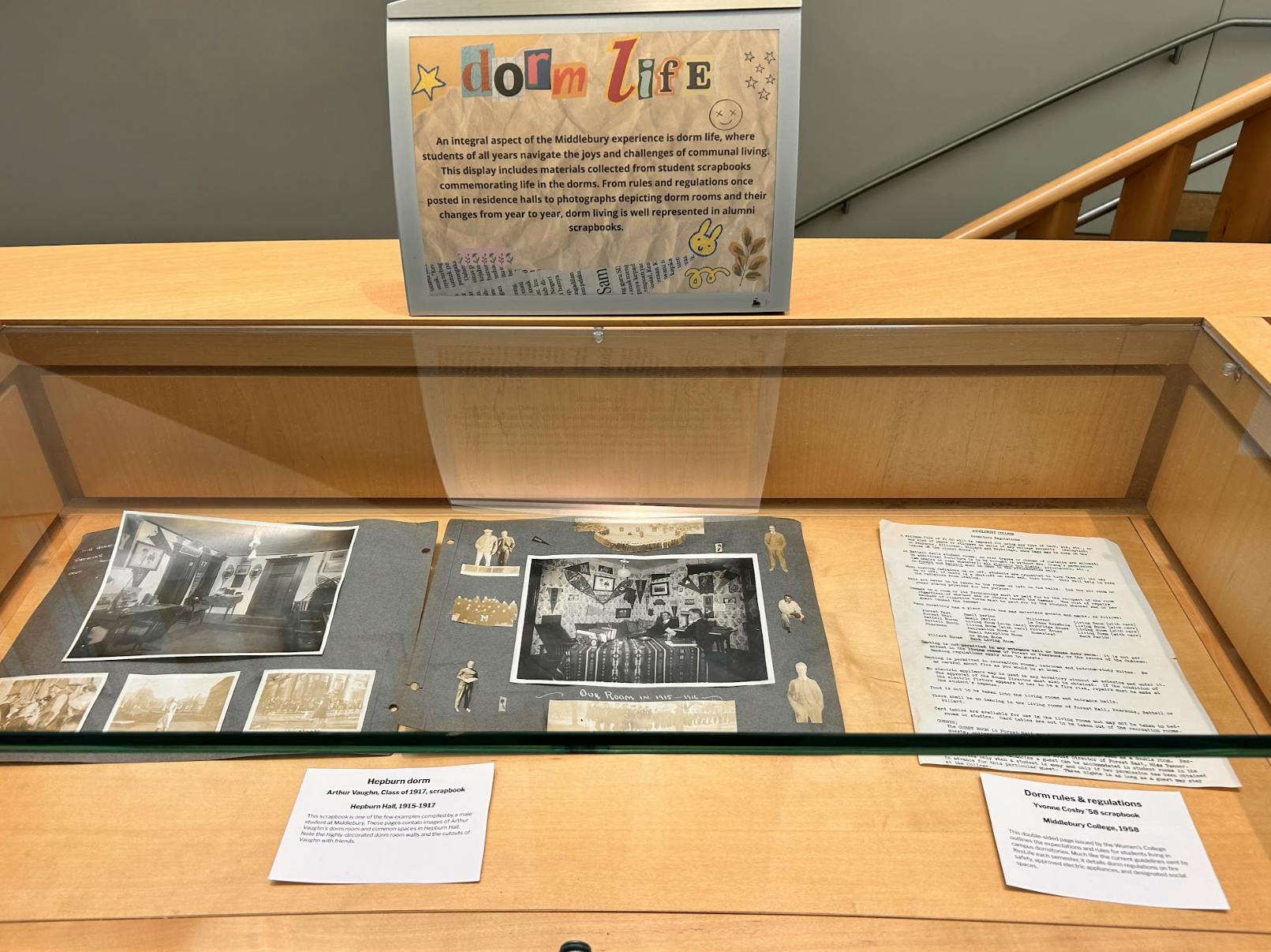
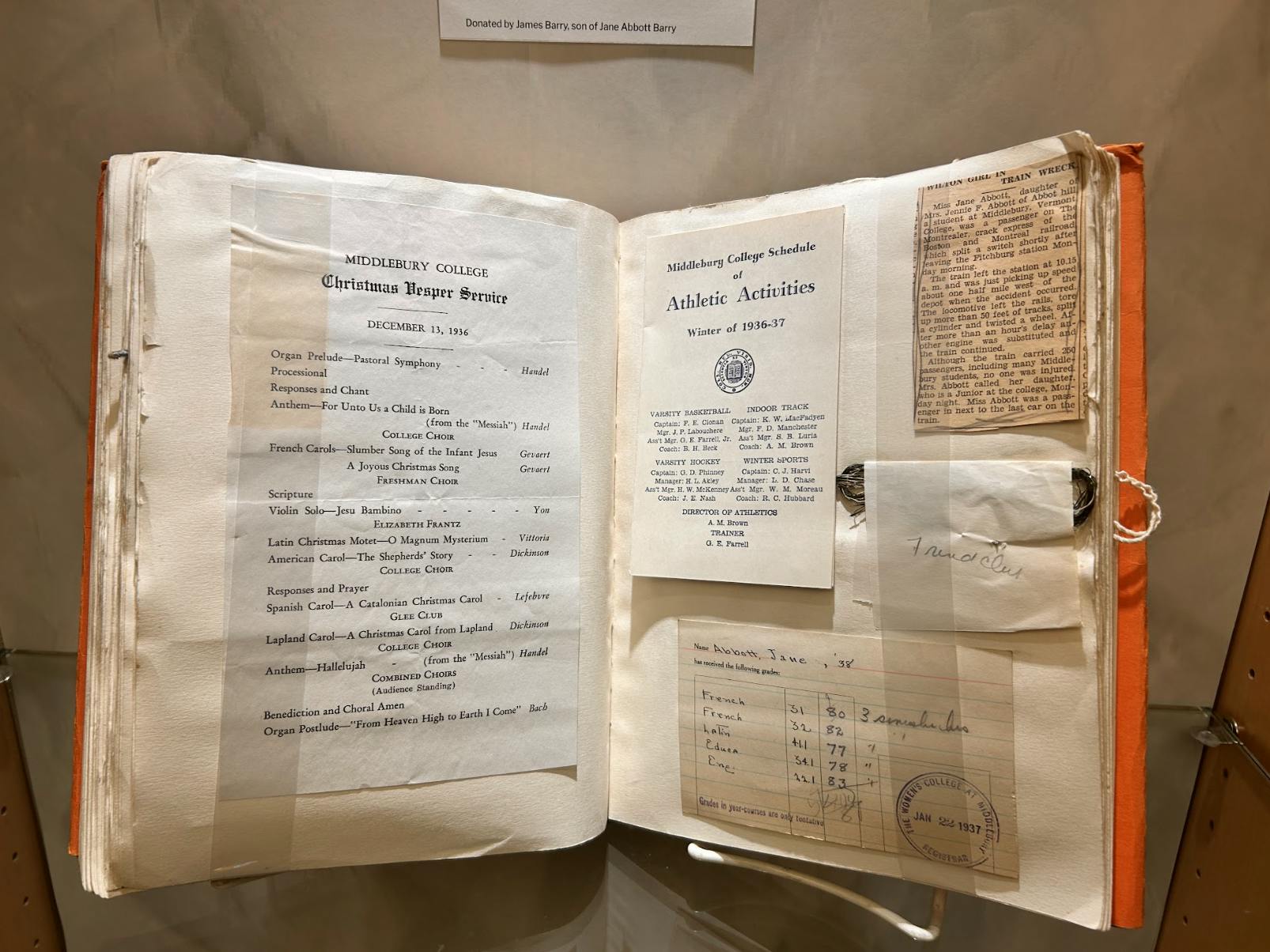
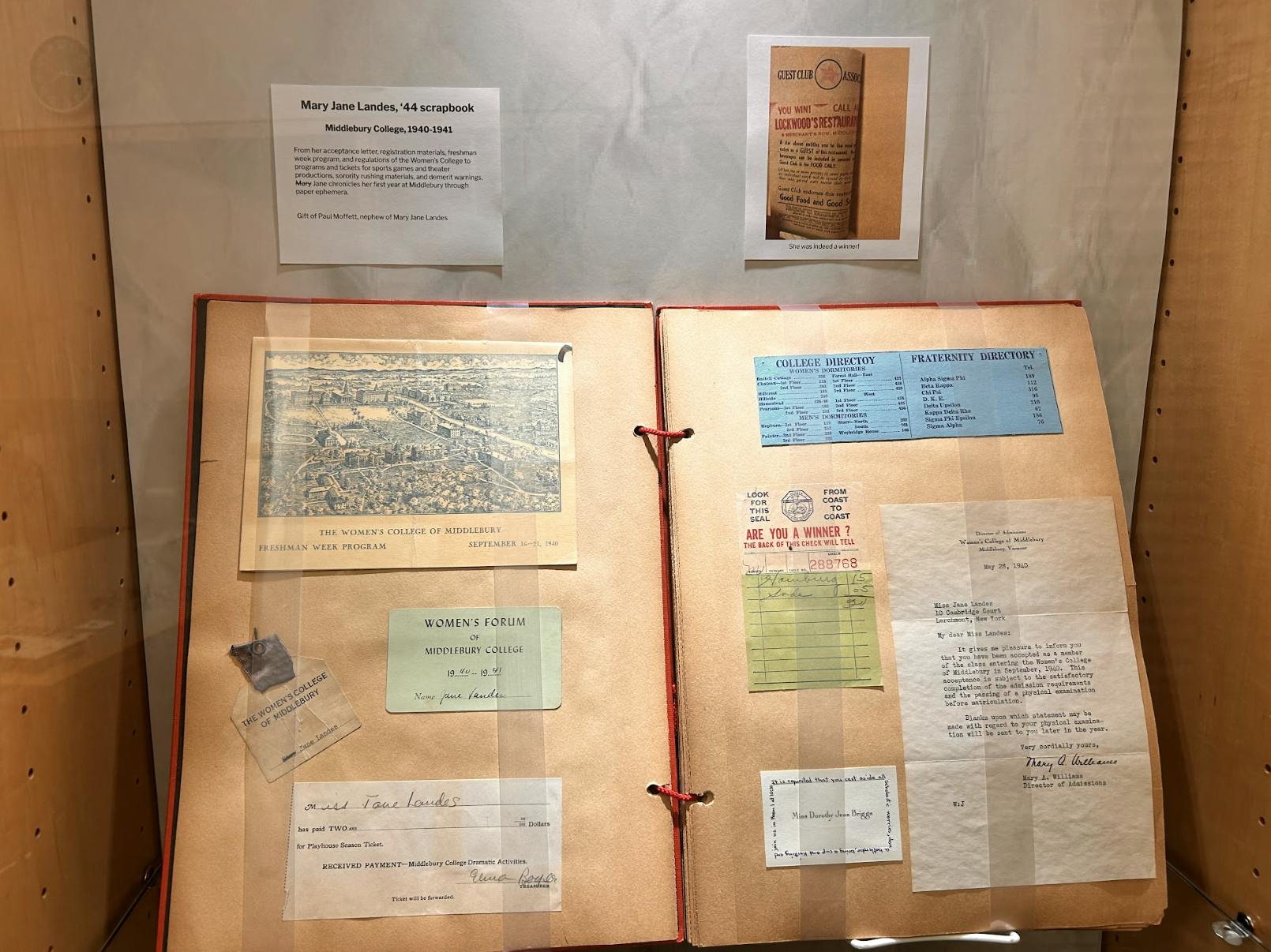
“Scrapped,” curated by Ambar Vasquez-Mitra ’25 and Yvette Fordjour ’26, is currently on display in Davis Family Library and Special Collections. The exhibit showcases a variety of scrapbooks, with some dating back to the early 20th century. It features the intimate and enduring themes of being a student at Middlebury: grades, sports, romance, dorm-life and winter carnival. Yellowing pages plastered with personal mementos are found in the glass cases, with a variety of photos, dance cards and posters.
“There’s a lot of curation that goes into the creation of the scrapbook itself, the way that someone might put a picture next to a dried corsage from a dance or a dance card, and the captions feel like inside jokes. These make them a really exciting primary source,” said Special Collections Public Services and Outreach Specialist Mikaela Taylor ’15. “You really get to feel like you were there and almost like you’re making a friend.”
Vasquez-Mitra and Fordjour spent roughly three months selecting materials, writing labels, researching the alumni who created the scrapbooks and coming up with an idea for how they wanted to structure the exhibit.
“We started mid to late October. We didn't really go in with a plan, so we pulled a bunch of scrapbooks that really came from us being nosey, like we would just flip through them and find something funny. From that, we started noticing that a lot of the experiences documented in the scrapbooks were very similar to experiences that we have had,” Vasquez-Mitra said.
Both students connected the themes to their time as students at Middlebury. Vasquez-Mitra found relatability in the social events, academic stress and even weekend trips to Montréal that were depicted throughout the exhibit.
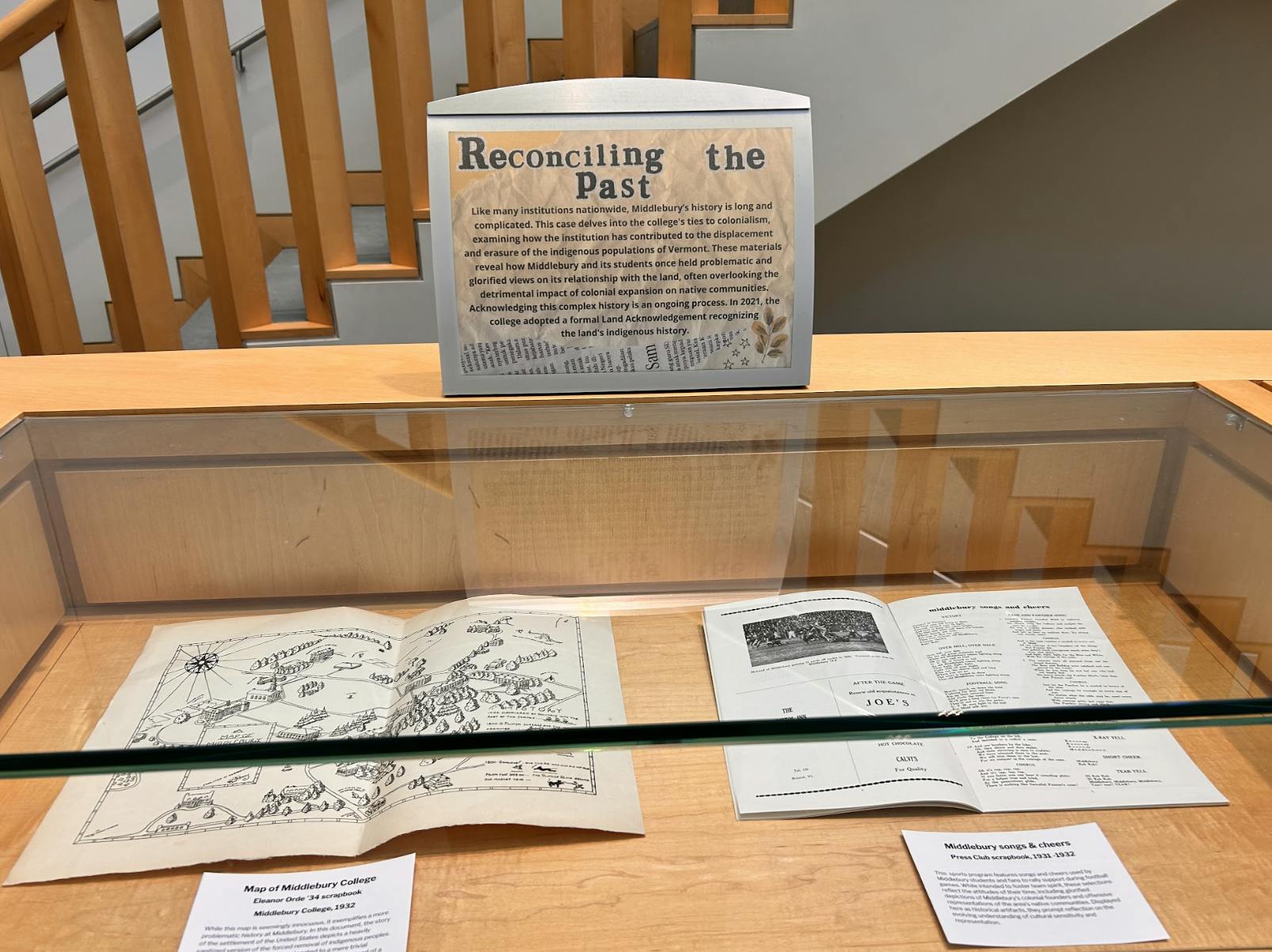
However, not all of the exhibit is lighthearted and fun. A focal point of the exhibit is change and continuity over time, looking at how Middlebury and campus culture has evolved. In the earlier scrapbooks, there are no students of color. Other spreads feature negative depictions of certain groups — namely Native Americans and Black people. The two wanted to include a case dedicated to the portrayal of racism and how Middlebury was idealized as a colonizing institution in the Native land of Vermont.
“As a Black person working in the archives, there is something so intimate when you read a document of someone degrading your entire humanity, doing blackface. There is a lot of reckoning there when you walk into work. It was important to share the burden with the community to say, yes, we’ve come this far, and there is still so much to be done,” Fordjour said.
Vasquez-Mitra echoed this sentiment, highlighting the importance of displaying content even if it is harder to digest.
“There is a lot of difficult content in the scrapbooks because they are products of their time. We want to acknowledge that, learn about that, and also showcase the fact that they existed and how Middlebury as an institution is moving past that,” she said.
Middlebury became co-educational in 1833, before which it was two separate colleges, one for men and one for women. The classes and dormitories were divided by gender. Due to social norms of the time, a lot of the rules and regulations in the college handbook were for women: what clothing they wore, what times they were allowed in and out of their dorms in accordance with curfews and excursions. There was a lot of policing of women and the way they handled themselves on campus. One of the cases includes a warning slip for a young student who was penalized for being one minute late to her dorm curfew.
Taylor also spoke about how Special Collections plays an important role in exhibits such as “Scrapped.” Through providing access to the materials housed in the Special Collections Library, curators are able to devise their exhibits. Taylor also spoke about the different ways in which the college acquires the archival materials that are housed in Special Collections.
“Sometimes a descendant [of an alumni] will be cleaning out an attic and find Middlebury College paraphernalia, and think ‘What do I do with this?’ The materials that are sent over are really rich historical documents that not only reveal so much information about Middlebury, but also about the time,” Taylor explained.
The exhibit ultimately reinforces the importance of preserving physical memories through art and the community that forms as a result.
“Having stuff on your phone, on the cloud, is convenient and you can have your pictures anywhere, but what happens when you lose your phone? It’s important to enjoy memories and be able to see others’ memories, if not for yourself, for future generations to be able to talk about it,” Vasquez-Mitra said.
Fordjour pointed out the importance of having agency over crafting stories in the present-day.
“This experience made me appreciate archival work and what archivists do in saving and preserving our history. I know deep down I am adding into a lineage of people who wanted to sustain and preserve our lineages and history,” Fordjour said.
So next time you are struggling with classes, or simply want to show off your tokens of joy and preserve your memories, consider the solace and wonder that some glue and paper can provide. Who knows, maybe your scrapbook will be part of an exhibit in the future!
Norah Khan ’27 (she/her) is the Editor-in-Chief.
She previously served as a News Editor and Arts & Culture Editor. She is a joint Political Science and English Literature major with a minor in Spanish. She spent her summer interning at Seven Days and completing research on campus. In her free time, she enjoys running on the TAM and cooking with friends.


