
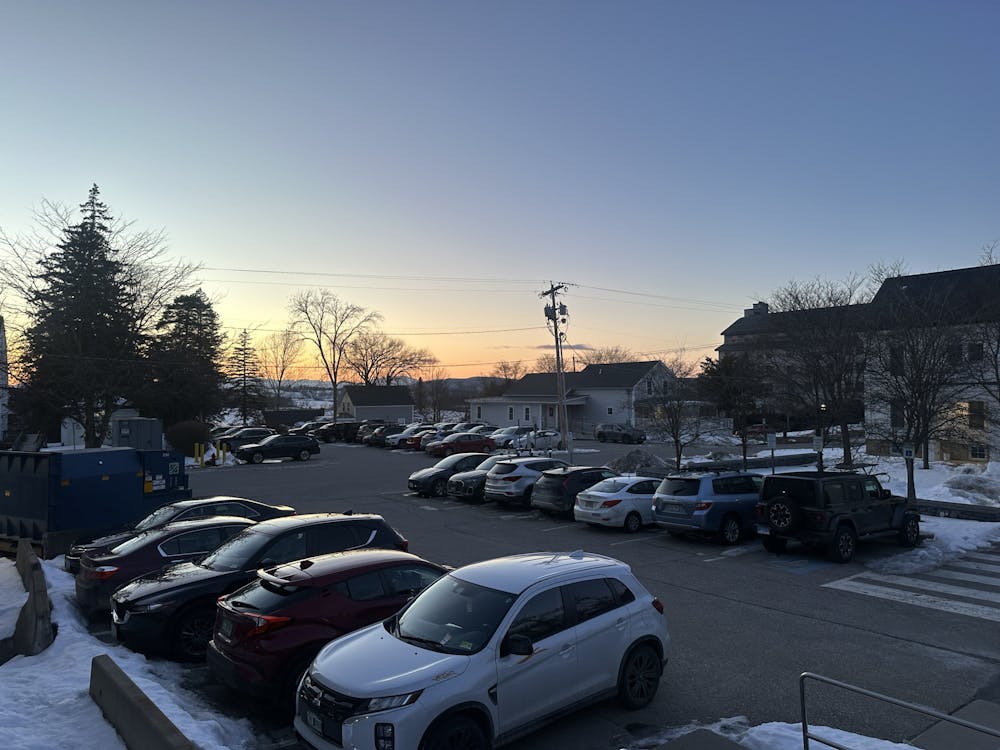
Recent proposals have sought to improve parking availability on campus for faculty and staff by penalizing students who receive parking tickets, suggesting they should be unable to graduate or register for courses until all fines are paid. Parking permits issued for temporary medical conditions are also being reevaluated under the umbrella of the Center for Health & Wellness to ensure only students who need the accessible spots qualify for them.
The Department of Public Safety Lieutenant Rick Whitney explained some of these developments in parking on campus in an email to The Campus.
“When members of our community park their vehicles in violation of the parking policies, it can lead to critical challenges for college operations, create unsafe situations that may impede emergency services and limit the ability of students, faculty, and staff to park in the lots designated by their parking permits,” Whitney wrote.
He noted that when students park in faculty lots overnight, Facilities Services is unable to plow there, which makes it more difficult for faculty members to park during the day.
Whitney isn’t the only person on campus who has considered the issue of parking policy violations. At the recent faculty meeting in February, professors discussed their frustrations over students occupying their designated, limited parking spaces.
Faculty Council President Jason Mittell announced at the meeting that Public Safety is in the process of modifying requirements surrounding parking fines.
“First thing, they are working with administrators to get the parking violation’s lines included on the student bill, and to implement a requirement that students cannot register for classes or graduate until their fines are resolved,” Mittell explained.
This updated strategy for fines, which has yet to go into effect, is not Public Safety’s only method of incentivizing parking policy compliance. Parking tickets, warnings, vehicle immobilizations and additional signage emphasizing faculty designated spots all encourage drivers to follow the college’s parking rules.
“Since October first, [Public Safety] has issued more than 2,000 parking tickets and 1,300 warnings. Over 50 vehicles have been immobilized or booted, and 50 students have had their parking privileges revoked and have been referred to the community standards office for disciplinary follow-ups,” Mittell said. “There have also been hundreds of phone calls and emails sent to students who have parked in [an] area that is not authorized.”
Associate Professor of History Maggie Clinton shared her personal frustration with the students abusing faculty parking spaces, relating the issue to a recent trend where professors and staff are obligated to do more work for diminishing returns.
“Apart from student entitlement, the parking issue is part of the overall deterioration of faculty and staff working conditions. The extra time we spend looking for parking and walking to our classrooms/offices is time that's not reflected in our salaries. For years now, we’ve been asked to give five minutes here, five minutes there, to tasks that used to be addressed by other employees but now fall to us,” Clinton wrote in an email to The Campus. “It adds up.”
While parking tickets and warnings can be written for a variety of policy violations, one issue that has received particular attention this year is the winter parking ban. The ban stipulates, among other rules, that neither students nor faculty and staff can park in the main lots between midnight and 5 p.m. Having clear lots during these hours ensures snow is removed effectively and promptly, which has been especially important following this year’s significant snow accumulations.
Drivers that do not comply with the ban will be towed without prior notice; Public Safety issues $150 fines for the first tow and $175 fines for all subsequent offenses.
One exception to the winter parking ban applies to students who hold medical parking permits. These passes offer tailored parking accommodations to students who have medical needs, which allow them to park in spots not normally designated for students but that are near their classes or campus residence.
While these permits are necessary for some, they have provided their own set of challenges for the administration. Mittell shared that Public Safety has met with the Disability Resource Center to clarify these accessibility policies.
An administrator at the meeting added that accommodation passes do not currently allow students to park in faculty and staff spots. They shared that the Center for Health and Wellness has taken over the process of issuing parking permits that comply with the American Disabilities Act (ADA) this semester to allow medical professionals to determine who needs accessible passes and for how long.
“We are also cutting down the duration of those disability passes,” the administrator said. “A student might have a boot for three weeks, but they were getting a pass for the entire semester… so we are no longer doing that. We’re understanding what are some of the needs of our students and working with them.”
Alison Finch, director of Health Services at Middlebury, described the process of evaluating medically required permits and renewing them this year.
“Permits are currently issued to be clinically tailored to the needs of the student, based either on the assessment of the student in person with a Center for Health and Wellness clinician, or based on documentation from a member of the student’s care team in the community. If a student continues to need a permit after the initial expiration date, we will reassess their needs and extend the permit,” Finch wrote in an email to The Campus.
There has been no formal change in policy as regards to temporary medical parking permits, though the Center for Health and Wellness said it remains committed to assisting students with mobility challenges in the midst of weather complications.
“We have been having continued conversations with campus partners about how to best support students who are experiencing mobility challenges,” Finch wrote.
Clinton emphasized how the parking situation has continued to be a constant source of irritation for virtually all faculty members at the college, herself included.
“A friend joked that irritation about the parking situation may be the one issue that unites the entire faculty,” she wrote. “She’s probably right!”
Editor’s Note: Editor in Chief Ryan McElroy ’25 and Managing Editor Madeleine Kaptein ’25.5 contributed reporting to this article. Faculty Council President Jason Mittell is the faculty advisor for The Middlebury Campus. He had no role in the publication of this article.


