
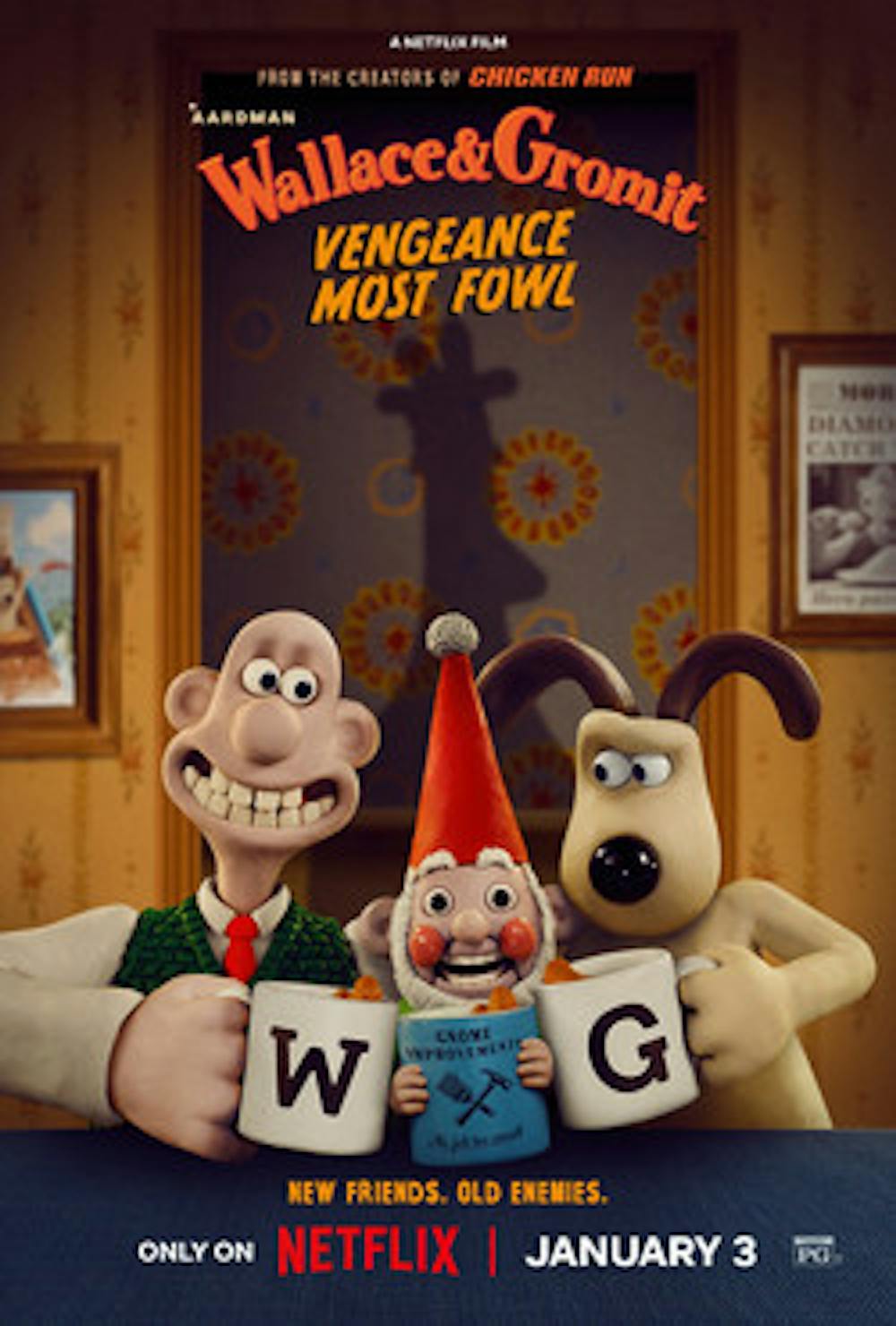
With the release of “Wallace & Gromit: Vengeance Most Fowl” onto Netflix this month, audiences saw both the return of the beloved Lancastrian duo after 17 years as well as the series’ most iconic antagonist, the penguin Feathers McGraw — criminal genius and master of disguise.
At the start of the film, the audience is introduced to Wallace’s latest invention: Norbot the Nifty Odd-Jobbing Robot, a robotic garden gnome powered by artificial intelligence (AI). He is designed to carry out gardening tasks like hedge-trimming, mowing and “pointlessly blowing leaves around” with frightening zeal. Norbot is actually meant as a gift for Gromit, who takes a visible satisfaction in completing all these “tedious” chores with care. But when Norbot is let loose on Gromit’s garden with the instructions of making it “neat and tidy,” he shears every flower bed bare, fervently mows the grass down to nubs and reduces every hedge to severe geometric motifs. Already, the audience spots the danger in this newest gadget, a danger that Wallace is invariably oblivious to.
However, the stakes are heightened when Feathers McGraw, imprisoned in the local Zoo since his infamous diamond heist, manages to change Norbot’s settings from GOOD to EVIL by hacking (with remarkable ease) into Wallace’s files from a zookeeper’s computer. He programs the gnome to begin mass production on more Evil-Norbots and eventually, break him out of his exhibit so that he can enact his vengeance on the man and dog who put him behind bars all those years ago.
The film makes several overt criticisms on the use of AI and capitalist society’s over-reliance on technology. This shouldn’t come as a shock to longtime Wallace & Gromit fans who, over the years, have watched the pair battle with a less-than-friendly robot living on the surface of the moon, a pair of self-walking trousers rewired by a certain malicious penguin and a malfunctioning, murderous, sheep-rustling cybo-dog. But many viewers were surprised and impressed by what Letterboxd reviewer PJ called “[the] most nuanced AI commentary of the decade.”
Wallace’s superfluous use of technology for mundane everyday tasks has been a long-running gag in the franchise, with his inventorial approach often being compared to ‘using a sledgehammer to crack a nut.’ Several of the series’s films (including “Vengeance Most Fowl”) feature a montage of Wallace getting ready — or rather, being readied — in the morning by an elaborate sequence of automated machinery. But in this installment, Wallace’s inventing takes on new heights of irony: Wallace goes so far as to outsource his own affection for Gromit when he makes him the Pat-o-Matic, a machine to give his canine friend ‘pats’ of customizable intensity. The concept of the so-called “labour of love” is clearly lost on Wallace who thinks he is saving Gromit from the ‘ages’ he spends ‘toiling away’ in his treasured garden by gifting him the nightmarish Norbot.
Wallace’s gross overuse of technology is contrasted by the very medium of the film. Stop motion animation is by nature a slow, highly manual technique. One second of filming consists of an average of 25 individually posed frames, which can be accomplished at a rate of around 30 frames per animator per day. The team that produces the franchise, Aardman Features, has been resistant to the use of computer animation in their films. Aside from a six-year partnership with DreamWorks Animation which saw the creation of “Chicken Run” (2000), “Wallace & Gromit: The Curse of the Were-Rabbit” (2005), and “Flushed Away” (2006) (the only film of the three to be majorly produced using computer animation), the franchise has exclusively utilized stop motion. It’s an artistic practice that routinely pays off, as evidenced at the very least by the franchise’s charming mise-en-scène (in “Vengeance Most Fowl”, Gromit can be seen reading, variously, “Paradise Lost” by John ‘Stilton’ and “A Room of One’s Own” by Virginia ‘Woof’).
The film also points to the unethical exploitation of labor that fuels AI engines by upholding the rage-baiting dynamic between its two protagonists. Gromit historically supports Wallace as his emotional and physical caretaker, often enabling him past the comical limits of codependency and “Vengeance Most Fowl” is no exception. Gromit waits on Wallace, operating his ‘self-readying’ machinery and aiding in his inventing, often without thanks or acknowledgment. Instead, Gromit is written off as a “daft pooch” when he justly mistrusts the army of gnomes militarizing in their basement. And when Wallace is investigated in connection to a series of garden-related robberies in the area and the delightfully (to some) incompetent ‘coppers’ confiscate every last one of his inventions, it is Gromit who sets out to uncover McGraw’s plot and clear Wallace’s name.
In only the first 30 minutes, the gnomes’ behavior escalates from unintentionally destructive to strategically violent, going so far as to trap Gromit in a tool shed before sneaking off with a van-full of stolen garden supplies. But the tension established in the early part of the film suffers over the next hour as the plot drags between chatty exposition and thoroughly wrung-out chase scenes. The tightest sequences are those achieved entirely non-verbally, like Gromit’s and McGraw’s face-off in the canal tunnel (a reference, among many in the film, to Tom Cruise’s heroics in “Mission: Impossible”). Gromit and McGraw are old foes and classic character foils who, with their steady wits, mute sardonicism and love for classical music, are well-suited to each other in conflicts that fly miles above Wallace’s comprehension. Disappointingly, “Vengeance Most Fowl” seems to underrate the dog-penguin pair almost as much as Wallace routinely underestimates the two of them individually.
What the film’s overwrought final act does offer (but perhaps fails to execute) is a resolution to the imbalance in Wallace and Gromit’s relationship. It takes Gromit literally hanging on the precipice of life and death for Wallace to admit, “I can live without inventing, but I can’t live without …(gulp; tears)... me best pal.”
In the film’s final scene, Wallace serves Gromit tea in his garden, which has been restored to its wild beauty, and personally grants him a loving pat on the head.
While certainly clever but hardly impressively ‘nuanced’, “Wallace & Gromit: Vengeance Most Fowl” takes on the rise of AI in the everyday while resolving one of the most fraught audience-film tensions in history. Even if it could afford to lose some 30-40 minutes, it is a charmingly animated and classically punny ride for all eighty.


