
The Opera Company of Middlebury (OCM) is hosting their two-week-long fall festival, “Music in Troubled Times,” Sept. 23 through Oct. 4 at Town Hall Theater, bringing together film, chamber music, a lecture and opera. According to the company’s website, the festival “celebrates the 250th anniversary of the American experiment with an exploration of music’s resistance and resilience in the face of injustice.”
The festival additionally received a $5,000 state grant tied to Vermont’s commemoration of the 250th anniversary of the American Revolution.
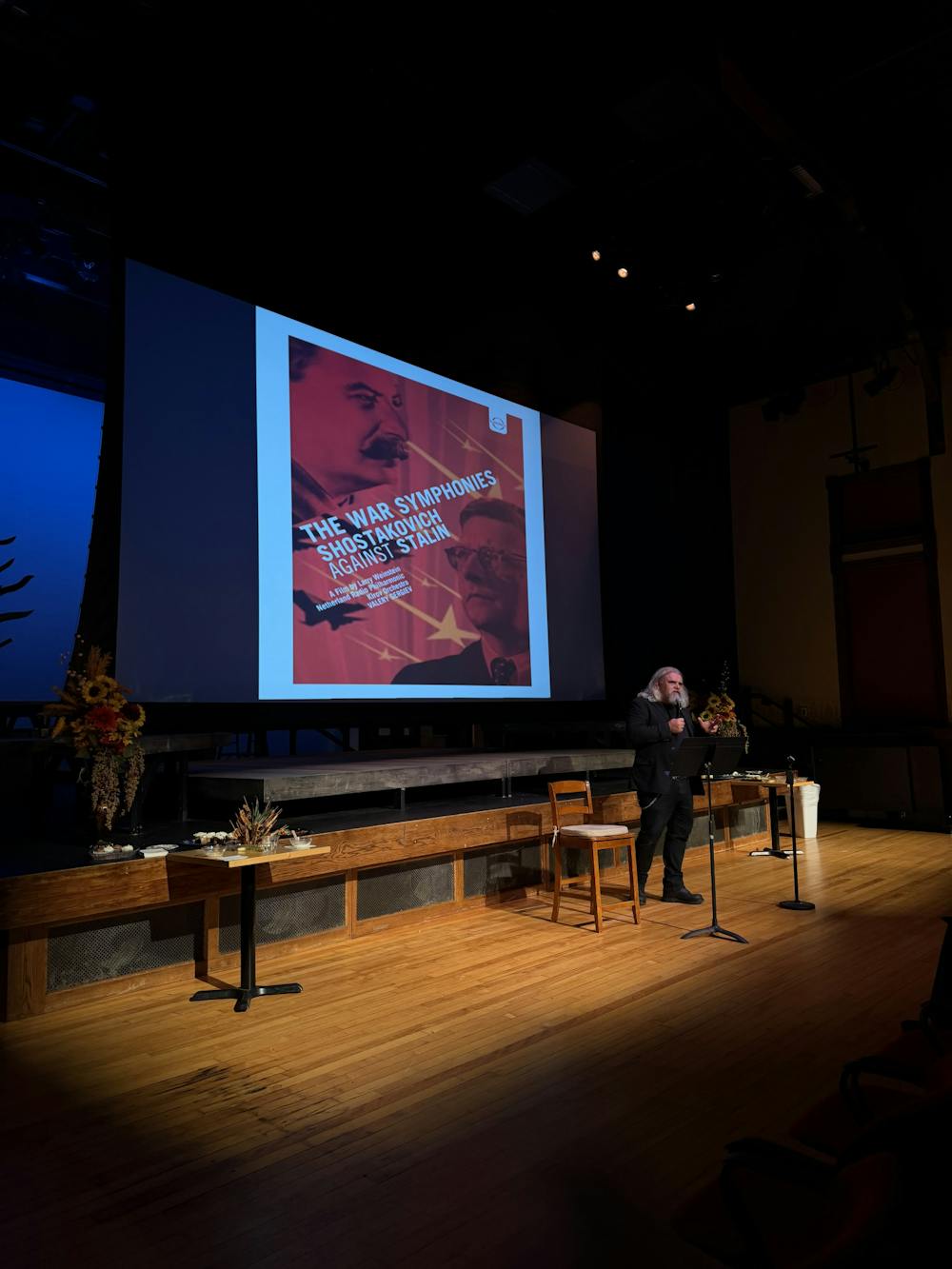
The festival opened with a screening of “Shostakovich Against Stalin: The War Symphonies,” a documentary celebrating the works of Soviet composer Dmitri Shostakovich, several of which were created during the regime of Joseph Stalin. Following the screening, the OCM Festival String Quartet performed the following day on Sept. 24, with a lecture by Professor William Nash of American Studies and English titled “Music and Social Power” scheduled for Sept. 27.
The festival culminates with the festival’s cornerstone event “Rappahannock County,” a theatrical song cycle and operatic tapestry capturing key emotional, sociological and historical moments in the Civil War. Composed by renowned composer Ricky Ian Gordon featuring a libretto by Mark Campbell — whose operas have won a Pulitzer Prize and a Grammy Award— the song cycle mainly takes place in Virginia from secession in 1861 to defeat in 1865, drawing inspiration from diaries, letters and other accounts to give voice to soldiers, enslaved people, families and civilians who lived through that turbulent period of American history.
The opera originally premiered in 2011 and was later recorded by Naxos Records.
OCM has been a part of Town Hall Theater for over 20 years, and typically puts on two professional opera performances every season, with the last four years highlighting different American composers.
The festival would not be able to happen without the help from the town and volunteers. Walter Deverall, one of the volunteers, first joined with the intention of working as an accountant for no more than a couple years. However, after 21 years, he’s still there. Deverall explained that people have stayed committed to the theater even through tough times — such as when renovations soared over budget in 2023 and the theater didn’t know if it would be able to stay open.
“It took a community to bring this place together and when it happened, the square was filled with people,” Deverell said.
Sarah Cullins, OCM’s general manager and education & outreach director, began her work with the company 13 years ago as a singer before stepping into her current role in 2025.
“The production is called Rappahannock County [and] it's about The Civil War,” Cullins explained. “We decided to build the festival around that piece and talk about how music is important in processing troubled times … and describing them.”
Not only is this festival here to help those going through hard times, “all of our shows have a composer struggling with something,” Cullins said.
Douglas Anderson, OCM’s artistic director and founder, opened the night by discussing Shostakovich’s need to keep writing under Stalin, using music as a creative outlet.
Shostakovich’s documentary offered glimpses into his life under Stalin and showed how it inspired him to compose music. The screening also revolves around Shostakovich’s creation of his fourth through ninth symphonies — called the tombstones that honor and remember those who died under Stalin’s regime, and serve as a form of protest.
Stefán Örn Arnarson, a cellist who performed with the Addison Country Quartet during the festival, also spoke at the opening night. A native of Iceland, Arnarson grew up in an extremely musical household and went on to perform across Europe. He has since gone on to teach 20th-century music at Rutgers University.
“I could go on for a while about what music means for the soul,” Arnarson said. “It just is so impactful.”
Later on in the night, Anderson explained the String Quartet’s program speaks to people “with all kinds of stress,” and he pointed the audience to William Nash’s lecture, “Music and Social Power.”
Nash’s lecture explored the relationship between music and social power in the United States, adding an academic dimension to the festival by connecting the history of protest music to the performances audiences will see.
The festival is scheduled to run until Oct. 4, with performances of “Rappahannock County” occurring on Oct. 2 at 7:30 p.m. and Oct. 4 at 2 p.m. Tickets range from $50-$100, however OCM is offering individuals under 26 free tickets to both performances.


