
Dr. Hannah Miller has now been to all 212 libraries in Vermont. The nearly three-year quest ended this past Saturday, when Miller visited the Rutland Free Library with a final talk, donuts and a group photo with the people who came to see them finish.
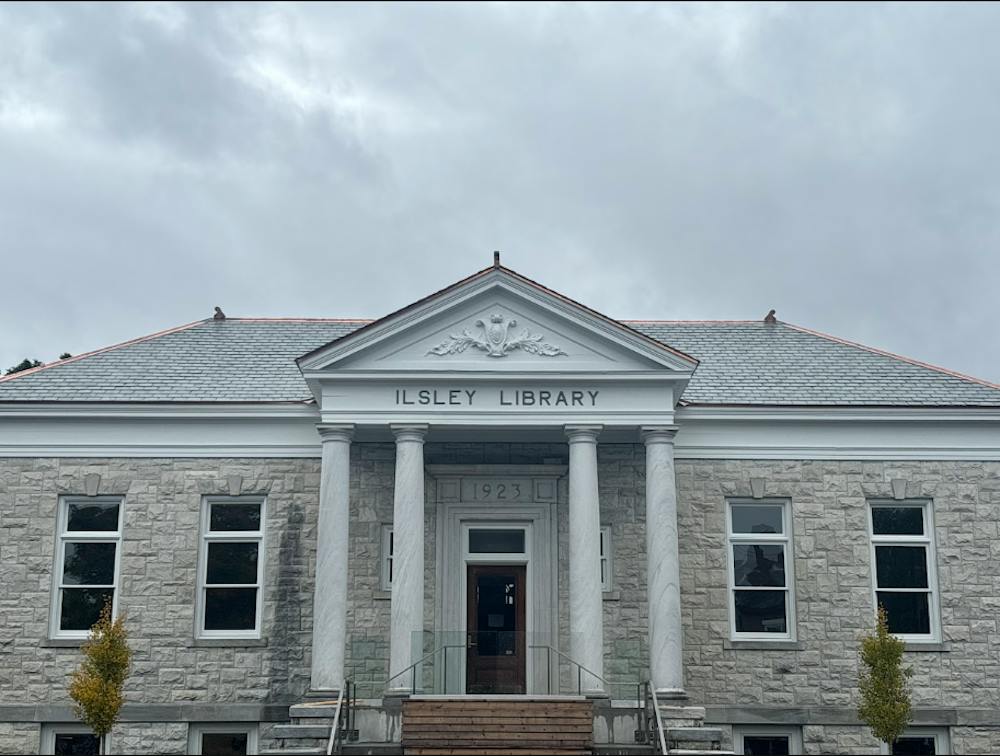
On Thursday, Sept. 17, Miller brought the story to Ilsley Public Library’s Community Room as part of the Weekday Symposium series. Since a sabbatical in January 2024, Miller, a professor at Vermont State University, read, wrote and knit their way through every public and academic library in the state. Miller drove what they calculated as the equivalent of 65% of the Earth’s circumference, or to California and back three times, all within a state small enough to make it home the same night.
“My feelings about finishing are definitely complex,” Miller explained in an interview after the talk. “This has been a life-changing experience for me in a way that I didn’t expect. I thought, when I started the project, it would just be a place to write. I didn’t realize how much it would teach me about what these libraries are doing to uphold democracy and community and civil rights.”
Miller described the project as part autobiographical and part ethnographic, distinct from “Where the Books Are,” a 1995 effort in which an Aldrich Public Library librarian visited every library in Vermont and documented each one’s history and architecture. Miller said they were after something else entirely: not a library’s history, but what it felt like to walk into it that day.
For Miller, that meant paying attention to what most visitors might not think twice about. Miller has a running fascination with library busts and takes a selfie with every one they find. At one library, Miller and the director were puzzling over an unlabeled bust when a patron ran over from the children’s section and declared it Julius Caesar. The three of them — strangers thirty seconds earlier — cleared off a table and lifted the bust up to look for a maker’s mark.
Miller’s talk kept circling back to small joys like that one: library dogs recruited so children have someone nonjudgmental to read aloud to, the taxidermy tucked into so many small-town libraries, aisles Miller says they can’t stop photographing, and the fifty-one knitting circles across the state that Miller tracked down with help from a librarian LISTSERV — an email list software. Miller travels with a hand-knit chicken they call their emotional support chicken, which reliably draws over both children and strangers who become conversation partners.
Underneath the quirks, Miller kept finding libraries quietly doing the work of protecting the people who use them. In Greensboro, they traced a sign reading “The FBI has not been here” back to the Patriot Act, when a since-repealed provision let the government seize library reading records and barred librarians from telling patrons if their own records had been pulled. Librarians worked around the second restriction with the sign itself, built to come down the moment it stopped being true. To this day, it is still posted.
At the Haskell Free Library, which straddles the border between Vermont and Quebec, Miller found something that caught them off guard. Patrons used to be able to cross freely between the two countries inside the building, until increased security in recent years brought cameras, border patrol and a public reckoning with what the library’s binational design was meant to symbolize. “Usually when I’m in a library, it feels peaceful,” Miller said. “I had never felt so surveilled.”
In Sharon, Miller spent hours reading eleven years of Baxter Memorial Library board meeting minutes, trying to understand a controversy over a taxidermied grebe that had outlasted several committees, a fundraiser and years of disagreement before the library found it a permanent home. Miller called it a small, patient model of how local democracy works.
“It's a lovely reflection of the way democracy can work in very local spaces,” Miller said. “They make sure that even if we disagree, people can show up and talk to each other and try to figure out how to make decisions together in a community.”
The building hosting Miller’s talk has its own recent history of transformation. Ilsley reopened on Aug. 29 after an 18-month, $17 million renovation, drawing more than 3,700 visitors on its first day. Dana Hart, the library’s director, chose Miller’s talk deliberately for the moment.
“I saw Dr. Miller speak a year ago about libraries, and I thought the theme of library as place was so perfect for this moment in Ilsley’s history,” Hart explained. “This renovation and expansion project is an acknowledgement of the important role the library plays as a third space in our community.”
Hart said the new building has made the library easier to use in ways both practical and symbolic, with at-grade entrances and automatic doors, clearer signage and more room to read, study or meet. Middlebury students, who make up close to a quarter of the town’s population, are a demographic she hopes to see grow. The library already relies on students who come to study or socialize, and Hart said she would like to see students in the future use the space to exhibit art or present their own work.
Miller closed the talk without naming a favorite library, a question they said they get constantly and refuse on principle.
“I will never write a capitalist listicle that says the top ten libraries,” Miller said.
What they offered instead was closer to an instruction. Now that the project is finished, Miller hopes people who hear about it feel moved to support their own library, whether through a donation, a volunteer shift, a seat on the board or simply a library card — and that they remember the librarians who keep these small community centers running.
“They’re just places where people can be themselves,” Miller said. “It’s nice to know that you have a place like that in your community.”


