
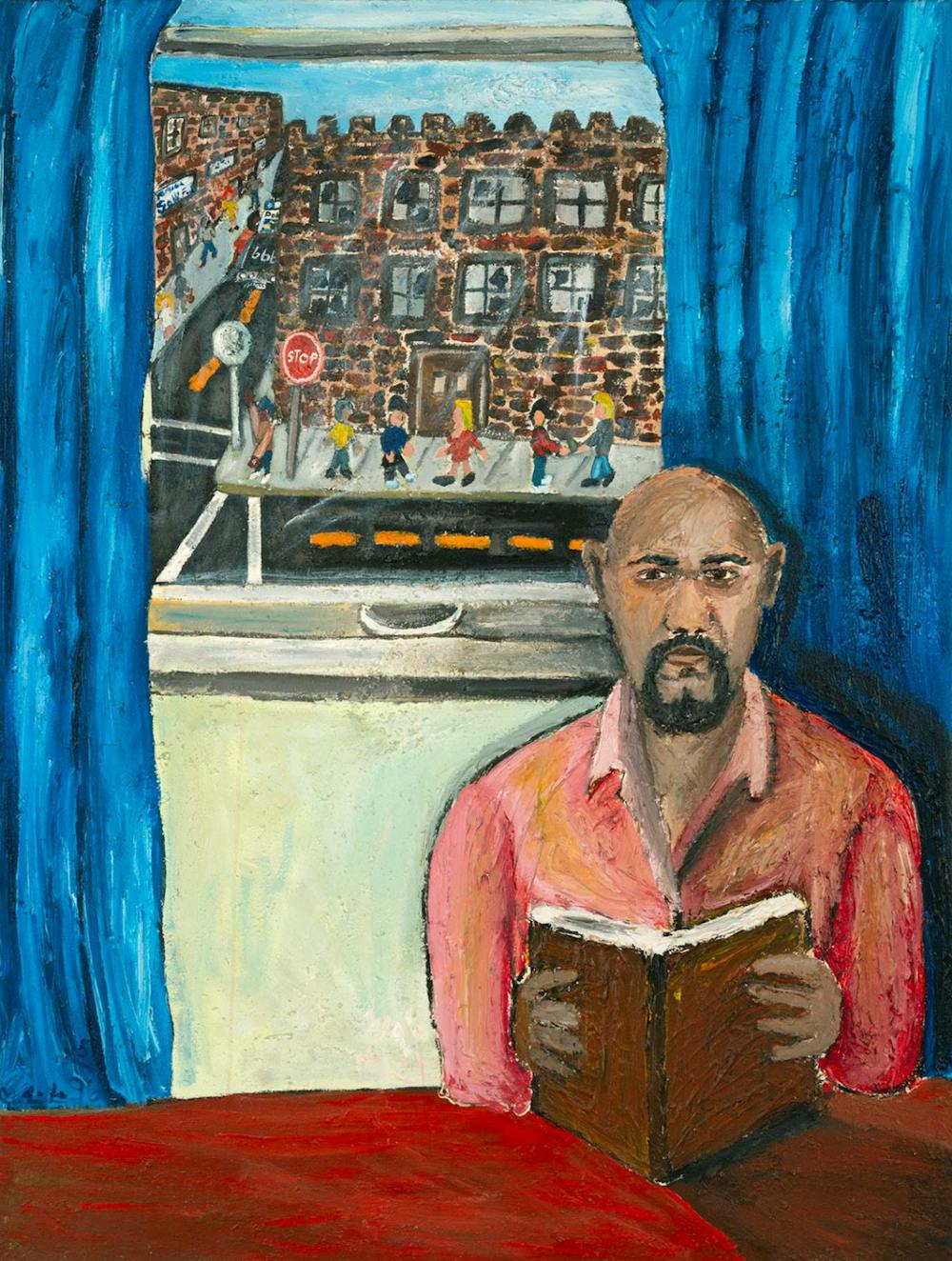
The Middlebury College Museum of Art, located within the Mahaney Arts Center, is currently displaying a temporary exhibit of Michelangelo Lovelace’s work. Titled “Michelangelo Lovelace: Art Saved my Life”, the exhibition will run through Jan. 10, 2027.
Michelangelo Lovelace was born and raised in Cleveland, Ohio, and most of his work depicts images of the city. His work highlights the familiar scenes of his hometown, portraying daily settings with an emphasis on colors. Primarily using acrylic on canvas, he prioritizes vibrant palettes to emphasize regular scenes from his life. The pieces are lively enough to jump off of the canvas at you. As the museum’s exhibition description says, “Lovelace chose to paint in an intentionally simplified manner because it allowed him to show what he called ‘the raw power of life in the inner cities of America.’”
Despite the major role art played in his life, Lovelace worked as a nurse’s aide by day. This job helped fund his art ventures, while the men and women he assisted in the nursing homes became subjects for one of his portrait collections. In a review of an exhibition dedicated to these pieces, Charity Coleman wrote, “The artist creates a visual vernacular of caring, a silent form of storytelling that begs to be heard.”
Lovelace endured much in his lifetime, from poverty to addiction, and in 2021 passed away at the age of 60 from pancreatic cancer — yet his dynamic art lives on. The museum's exhibit in particular highlights the therapeutic aspect of his work. After getting arrested at the age of nineteen, he leaned into his artistic side, claiming “I’m one of those people who say ‘art saved my life,’ and it truly did.”
Lovelace used his art to express both personal and political matters, and the exhibit illustrates just this. The first part of the exhibit includes a self portrait of him reading in front of a window that looks out onto a street in Cleveland. The rest of the room is covered in pieces similar to the view seen from this window.
The last room showcases Lovelace’s Rodney King collection. Around the time the footage of King being beaten was broadcast on national television, Lovelace found himself in Los Angeles. He witnessed some of the protests that ensued, which inspired him to create this showcase centered around political graffiti and street art. In his artist's statement he wrote, “I wanted to express the anger that as a black male I felt see[ing] another black man being beat[en] in the streets of America by the police. I was trying to express Black Pride, Black Unity, and Black Anger [toward] the American justice system.”
To encourage students to attend the museum, Ariana Troutman ’27 and Jori Almahadi ’27 hosted a Museum tea party. The event included a spread of cupcakes, a charcuterie board, and lots of tea to choose from on the back patio of Mahaney. As the Event Coordinators with the Student Friends of the Art Museum, the two aim to incentivize students to venture to that side of campus and enjoy some of the art Middlebury has to offer.
“We think about things that maybe are museum related, and a lot of museums have cafes or some sort of way to get tea, so we kind of wanted to replicate that experience at the museum,” Troutman explained.
Lilja Anderson ’29 attended the event after receiving an email from the College Museum. “[My highlight was] getting to hang out with my friend,” she said, “and the food was really good and the people who were hosting it were really nice too.” Anderson also explored the rest of the museum afterwards. “I thought it [the exhibit] was really well done,” said Anderson.
Alexandra Lee ’29 also went to the tea party on Friday. Lee has visited the museum a few times for classes, and went for the first time as soon as she arrived on campus in freshman fall. She feels her peers are less interested in visiting. “I think there's an issue with third spaces in general,” Lee said.
Lee and Troutman cited the distance of Mahaney from central campus as a reason that students may not venture into the museum. “In general, people have a lot of excuses as to why they can't do something, which most of the time they're valid and it's about work,” Lee said. “But a lot of people in general, if they have the opportunity to be lazy, then they'll take it because everyone's doing stuff all the time.” Troutman thinks people overstate its distance, adding “It's not as far as going to the gym or that kind of thing.”
Troutman believes the new Marna O. Davis Museum, replacing the old Battell Hall dorms, might help with this apathy. However, she also hopes students can learn to see the accessibility of Maheney. “We have an amazing collection,” she said. [Visiting the museum is]s a wonderful thing to do. People complain about not having anything to do here in Middlebury. Go to the museum. That's what you would do in a city or something. So why wouldn't you do it here?”


