
It was a windy day when a friend and I joined a voice call to play Life is Strange. As we drifted into the deep end of the story, nothing remained on either end of the line save for a long, heavy silence and the quiet sound of us both weeping. Stepping into this world for the first time, I never imagined a video game could make me so profoundly feel the boundaries — perhaps even the soft decay — of cinema as a visual art. In the screen’s place stood a breathtaking, three-dimensional world that breathed and lingered.
Life is Strange is an episodic narrative adventure game crafted by the French studio DONTNOD Entertainment and published by Square Enix in 2015. The story follows Max Caulfield, a high school girl with an enduring love for Polaroid photography, who stumbles upon the power to rewind time. Reunited with her long-estranged best friend, Chloe Price, she sets out to unravel the dark, quiet currents hidden beneath the tranquil surface of Arcadia Bay, a fictional seaside town in Oregon
In the mechanics of this world, you can reverse time again and again, altering past decisions until everyone you love stays by your side. In those years of separation, Chloe had been left alone to bear the grief of her father’s death and the sudden departure of her dearest friend. Thus, Max uses this ability to rewind time to rescue the one person who means everything to her. The intoxicating sense of control feels like pure magic at first: you can rephrase a misplaced sentence in a dorm hallway, soften an awkward moment of hesitation, or even pull a hopeless golden-haired girl back from the brink of a rain-slicked rooftop on a gray night.
But the storytellers were far too wise — they saw straight through causality, through reverence, and into the very texture of memory itself. In this world, free choice reveals itself to be a poetic phantom. Every rewind, every alteration, eventually gathers into a colossal storm hovering above the town. If you wish to save everyone in Arcadia Bay, you must allow the branching timeline born of your rewinds to fade into nothingness — which means standing motionless in that quiet bathroom where you first met Chloe, watching her fall to a gunshot without lifting a finger. It means Chloe will die without ever knowing that Max had returned to her side, without ever knowing how fiercely she was loved. And so, Max can only shrink into the corner, waiting for the gunshot to echo; her desperate, solitary efforts buried forever in silence. The moment her fingers pressed the controller to turn back time for the very first time was the exact moment the butterfly flapped its wings in the dark.
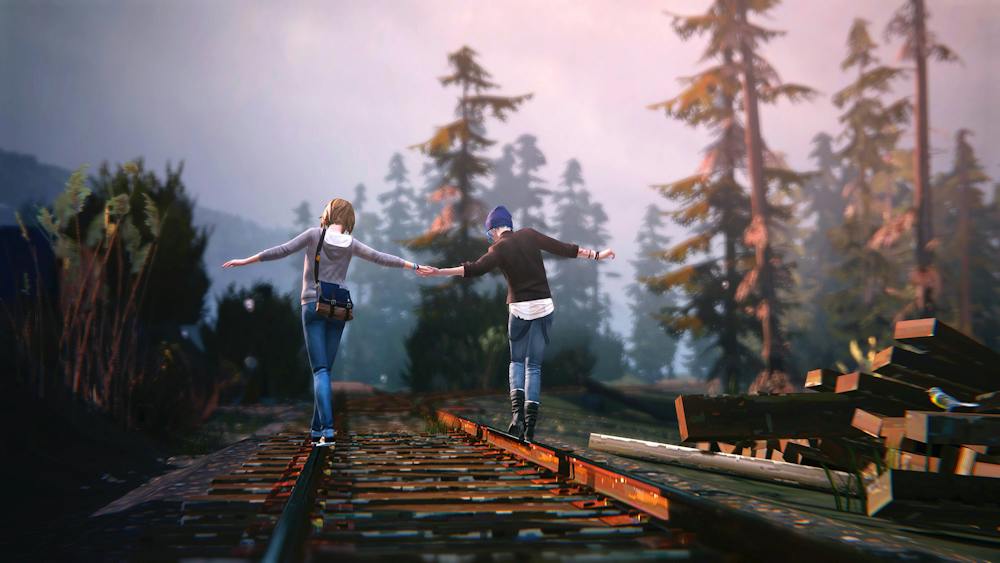
Girls lying in bed with a cool breeze floating through the room, listening to the raw, scratchy pulse of punk rock; girls opening their arms to walk the balance on abandoned train tracks at golden hour, as the translucent ghost of a deer glides past; girls firing shots in a junkyard piled with old tires and rusted furniture, believing themselves to be invincible heroes — these shared memories, filtered through Max’s eyes, keep haunting me. Even in that alternate timeline born from altering fate, where Chloe sits in a wheelchair, anchored to complex medical equipment just to endure each day, she looks at Max and softly asks her to end her life. Did they still remember that summer they shared? And that forgotten scratchboard art tucked in the corner, keeping safe their lost childhood and everything that was once luminous? When the moon haunts the night sky, and a monstrous typhoon finally sweeps through, the roaring winds and crashing waves shatter Arcadia Bay’s iconic lighthouse, leaving their lives, their youth, and all the heartbreaks they cannot bear exposed and defenseless before the elements.
In the wake of this vast tide of preservation and ruin, I found myself drawn back to those eternal questions of memory and choice in literature and art. Our involuntary memories are always caught off guard, reawakened the moment a Madeleine cake touches hot tea. If we choose to forget simply to escape the ache, erasing pieces of our past feels like a quiet betrayal of who we used to be. It mirrors the ultimate cruelty Max carries in the end — she becomes the sole keeper of a world that no longer exists, the only person alive who remembers everything that transpired across those dissolved timelines. Denied the gentle mercy of forgetfulness, she must walk on as the lone bearer of those memories. So perhaps it hurts, but living on with those memories intact — carrying our abundant, bruised emotions and keeping a genuine, beating heart that still feels and ponders through the wreckage — is the only meaningful way forward.
Yet, if one were to return with all these memories, one would no longer be the person they used to be. Perhaps we are so hopelessly enchanted by this game because it captures the quiet texture of time — much like the Polaroid print Max holds in her hands, developing slowly into view. Memory works precisely like that: looping, swirling and overlapping, fading irreversibly the very second it freezes into permanence. We cannot disrupt the flow of time; causality and consequence follow us like shadows. Choice is merely a beautiful illusion, and learning to carry the scars left by our decisions may be the only truth time leaves behind.
If a quiet corner still lingers in the depths of memory, do not linger, and do not look back — before the wind begins to blow, let us just hold each other tight, one last time.


