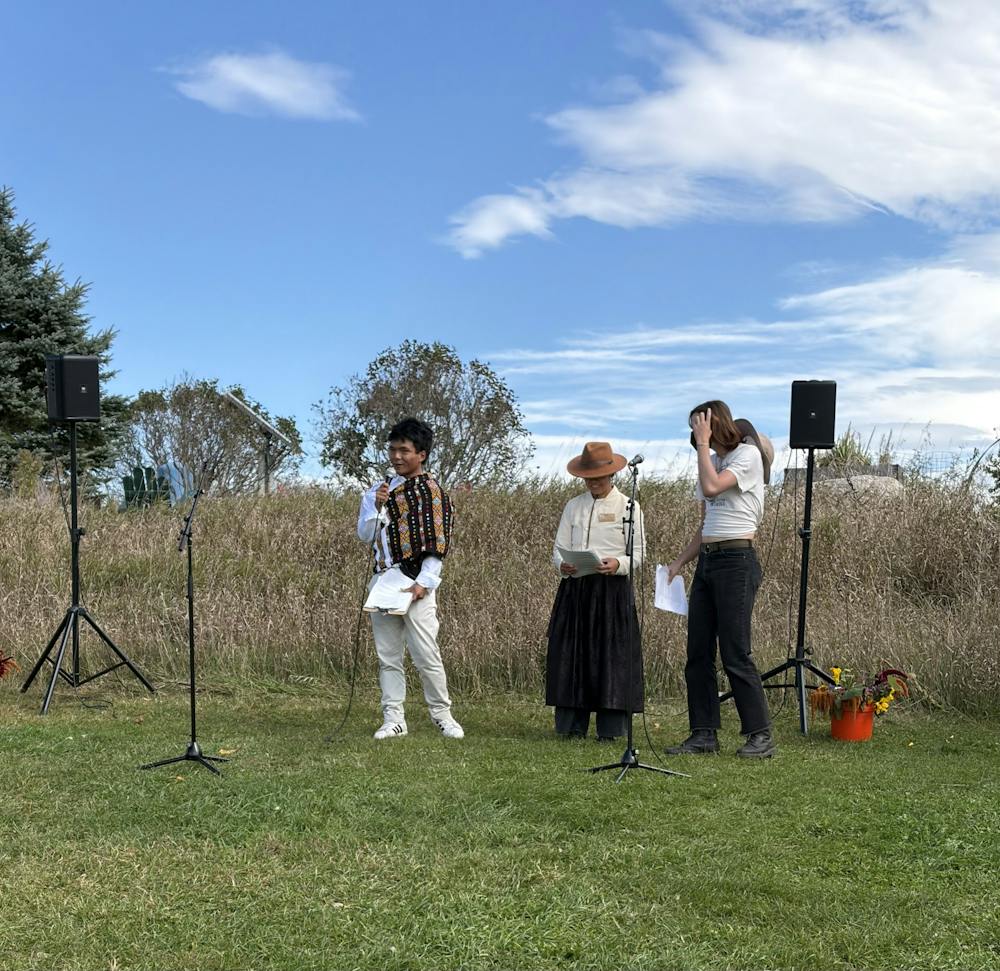
Over 430 students, faculty and community members gathered at the Knoll on Sept. 26 for the fourth annual Mid-Autumn Harvest Festival, an afternoon of food, performances and cultural traditions centered on the harvest season and the full moon.
Around 15 student organizations, academic departments and community groups hosted tables at the event. The festival was opened with a warm welcome by members of the Kuaka Pedagogies group visiting from Aotearoa New Zealand and featured performances by the Bobolinks and Green Mountain Samulnori, a local Korean drumming and folk percussion group.
This year’s festival brought together traditions with different relationships to harvest, food and the changing seasons. Knoll Associate Director Megan Brakeley ’06 said bringing those traditions together is also about maintaining connections to culture and place while living away from home.
“There’s this will to remember, the will to create new ways to honor traditions, the will to make some meaning and do with what we have here in our hands on the land that we’re on, with the recognition for the people whose stories are connected to this land long before ours,” Brakeley said.
Tony Thung ’29, who interned at the Knoll over the summer and helped organize this year’s festival, did not grow up celebrating Mid-Autumn. Thung, who is from Burma, said his mother’s ethnic group has its own harvest celebration later in the year. At this year’s festival, Thung shared part of his culture by wearing a traditional tunic while emceeing the event.
When Thung attended his first Mid-Autumn Harvest Festival at Middlebury last year, he expected it to center primarily on cultures that traditionally celebrate the holiday. Instead, he found a broader range of traditions represented.
“Everyone’s welcome, all cultures are,” Thung said. “[The festival] is where cultures are colliding.”
The range of traditions represented expanded this year with the participation of the Kuaka Pedagogies group. Members of the visiting group opened the festival and later hosted a table where attendees could learn about Māori and Pasifika knowledge surrounding the harvest season. Festival materials highlighted Matariki, a Māori harvest celebration marking the end and beginning of the lunar year, as a time for honoring ancestors, assessing the health of crops and communities and looking toward the year ahead.
Other groups offered activities that introduced attendees to their own traditions. Participating organizations included Addison County BIPOC +, Fostering Inclusive Recreation Experience (FIRE), the Muslim Student Association and several language houses. Each organization had a different activity for attendees, with the Japanese House teaching students to write their names in Japanese.
Connections between culture and harvest also extended to food grown at the Knoll.
The Knoll has worked with University of Vermont Food Systems PhD student and graduate fellow Alexis Yamashita to grow culturally meaningful crops, including adzuki and mung beans, as part of research on seeds and crops adapted to Vermont’s climate. At the festival, Yamashita hosted an adzuki bean showcase where attendees could view varieties grown through the research.
Brakeley said that while the Knoll has held harvest festivals since its beginning, its first major Mid-Autumn Harvest Festival was held in 2023, the Knoll’s 20th anniversary.
Changchang Ma ’26, who worked as a Knoll summer intern in 2024, helped organize the festival for the following two years. Ma said she built on the collaboration that began in 2023 with the goal of making the festival an annual event.
For Ma, who is from China, creating a space for students to celebrate together was also personal. Mid-Autumn in China centers on family reunion, a connection Ma said is reflected in one of the holiday’s central symbols, the full moon. Its circular shape represents reunion, while the shared sight of the moon connects family members separated by distance.
“Being an international student, especially so far away from any bigger Chinese community...it is really isolating, especially for many young students,” Ma said. “It would feel very empty for people if we just let [Mid-Autumn] pass as a normal day in the college.”
The festival’s importance was highlighted in past years when it coincided with Fall Family Weekend. With many international students unable to have their families visit campus, the festival offered another opportunity to gather.
“That was kind of a way for us to create our own family,” Ma said.
Organizing this year’s festival began before students returned to campus. Thung started working on the event in August alongside Brakeley and Maddie Stevenson ’27.5, a Knoll events intern, coordinating with participating organizations, arranging performances and advertising the festival.
Thung said Ma’s work on previous festivals also influenced how he approached bringing different cultural groups together this year. He pointed to an idea she had shared with him: “oneness slash unity is not the same as sameness.”
For Thung, the festival offered a place for differences to remain visible while still bringing people together.
“We can all have this community and this place where our culture is celebrated and valued,” Thung said.