On Sept. 24-25, students, faculty and staff gathered in Wilson Hall for the annual Clifford Symposium — this year’s theme “The Preconditions of Inquiry.” The event kicked off what will become a yearlong discussion over what academic freedom truly means, and whether the liberal arts can still teach students how to disagree productively.
President Ian Baucom and Dean of the Faculty and Professor of American Studies Roberto Lint Sagarena decided on the topic in accordance with the college’s strategic plan.
“Academic freedom and free speech are just defining of our mission. They ground everything we do and who we are,” Baucom said in an interview with The Campus.
The Symposium covered student expression, free speech and curriculum, and consisted of five events; among them, a faculty colloquium, a presidential conversation and a student debate.
Professors Reflect on the Goals of the Liberal Arts
After a brief welcome from Baucom and Lint Sagarena, the faculty colloquium began, with the goal of defining academic freedom.
Ioana Uricaru, professor of film and media culture, Enrique García, professor of hispanic visual culture, and Bert Johnson, professor of political science sat on stage. In front of them, an audience of mostly professors and administrators, dotted with a few students listened intently. There were a couple dozen attendees. A photographer milled through the crowd, occasionally snapping photos.
Each professor started with opening remarks on the meaning of academic freedom and threats to its’ integrity.
“Academic freedom in teaching and research, as well as tenure are … essential to this overarching goal,” Johnson said.
Uricaru agreed that academic freedom is essential to the common good of an institution, but she viewed it slightly differently than her peers. To her, academic freedom is a political mission to bridge the gap between educational institutions and the broader community.
“We could feel a little bit separated from the world and from society if we don’t embrace a political position,” Uricaru said.
Beyond the importance the professors placed on academic freedom, they also noted the looming threats to this freedom. García framed academic freedom as a way to protect fields of study, but identified external danger to that protection.
“If corporations control our research, that can also be an issue,” he said.
Johnson agreed with García’s sentiment.“I would submit that today we are entering an era in which threats are more likely to come from the government…than from governing boards,” he said.
The discussion then opened up to the audience for questions, with topics spanning from the complications of residential campuses to the difference between free speech and academic freedom.
Ian Baucom, Sian Leah Beilock and Sarah Guyer on Academic Freedom
Following the faculty colloquium, Baucom joined President of Dartmouth College Sian Leah Beilock and Dean of Arts and Humanities at University of California, Berkeley Sarah Guyer for a presidential conversation. The conversation focused on the differences between academic freedom and free speech, as well as how the two function differently in public and private institutions.
“ [Academic freedom] is not freedom just to say anything; it’s actually freedom to be wrong — freedom to test out ideas, and test out ideas in a community that is committed to … truth and to discovery,” Guyer said, differentiating academic freedom from free expression.
The three also discussed how to best cultivate classrooms ripe for disagreement and curiosity.
“When [students] go to study the liberal arts, we know that they are there because they are training their minds, their networks, themselves for a future. They’re not choosing the liberal arts by accident,” Guyer said.
Beilock echoed Guyer, emphasizing the importance of a liberal arts education both within and outside of the classroom.
“We are in a world where we’re so quick to villanize or demonize, and the ability when you’re on the forefront of knowledge to make mistakes, to extrapolate from sitting in that English seminar room to what’s happening on university campuses … is so important,” Beilock continued.
When asked after the panel what he thought was the most important takeaway from their conversation, Baucom said, “The biggest takeaway was just the broad agreement…we want people to disagree on our campuses about all sorts of things, but we’ve got a real strong, shared collective agreement.”
Students Debate Free Expression on College Campuses
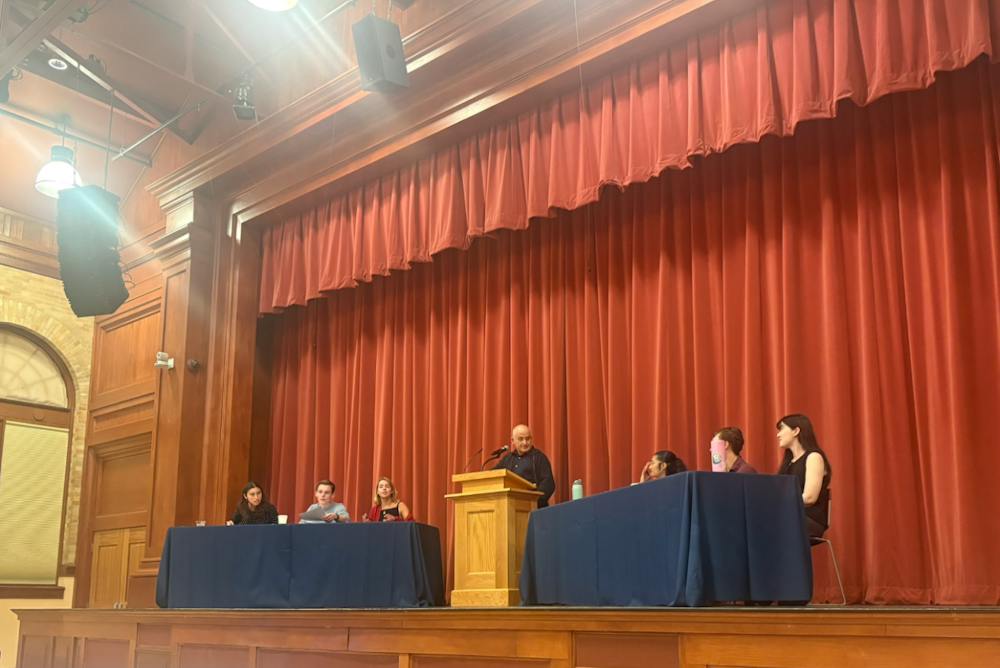
On the second day of the Symposium, six students from the Middlebury Debate Society participated in a formal debate, following the faculty-student lunch. Around 30 people attended, mostly students, alongside a few professors.
Skyler Shooer-Sampson ’27, the president of the team, proposed the debate to Lint Sagarena, with the goal of making the Debate Society — the oldest club on campus — more of a public-facing organization, rather than solely focused on competitions.
The six debaters were randomly assigned to support or refute the proposition that the liberal arts should protect all forms of free expression. Each student then gave a seven-minute speech, alternating between proposition and opposition.
The proposition posited that when problematic language or discussions occur, it should be the students’ job to discuss how to move forward, rather than the school intervening with disciplinary action.
The opposition took issue with the use of the word “all.” They argued that not all speech adds something useful to the academic conversation and that, in fact, silencing offensive or hurtful language ends up generating more free speech in the long run.
For Shooer-Sampson, this debate exemplified exactly what the Symposium aimed to discuss.
“I think in a lot of these discussions, especially political ones, people get very caught up in their ideals and not the arguments for either side. But debate is all about the arguments, and so you really have to hear people out for the arguments they’re making,” he said.
Baucom agreed with Shooer-Sampson’s argument.
“Between the two groups, you got a full range of student perspectives, and it was thoughtful, engaging, rigorous, civil, and I just think we kind of modeled that.”
A Yearlong Conversation
This year’s Clifford Symposium was intentionally much shorter than in past years. Because of the complications and intricacies of the question, the college will continue to hold discussions surrounding the topic each month for the rest of the year.
By the end of the Symposium, however, faculty and students were able to reach broad agreement on the importance of academic freedom.
“The consensus was [academic freedom] is absolutely necessary no matter what ideological spectrum you fall on and that it’s central to advancing the pursuit of knowledge,” Lint Sagarena said.