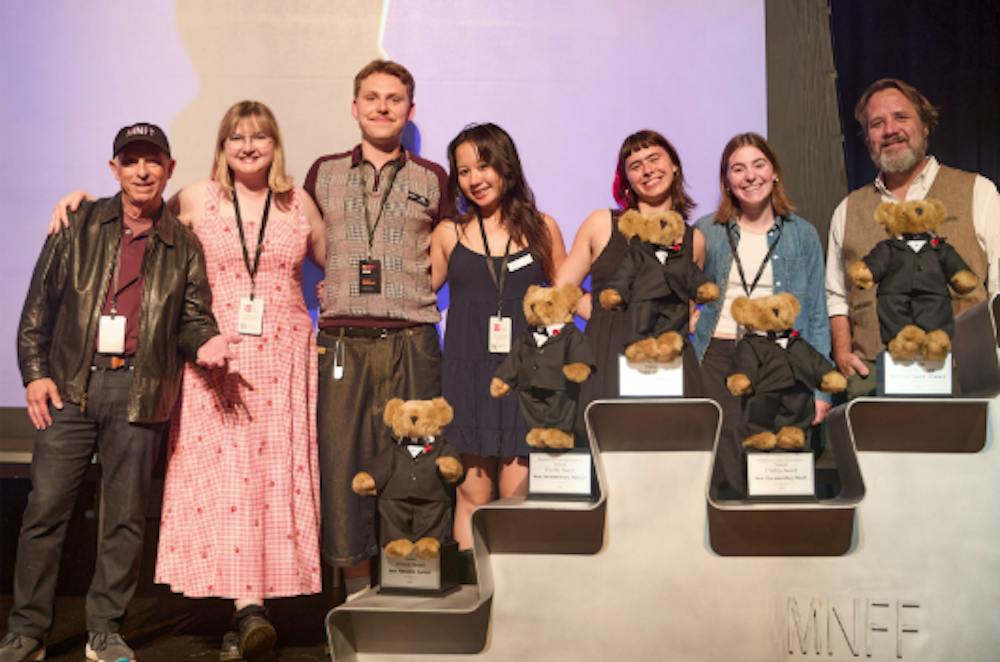
From Aug. 26-30, the 12th annual Middlebury New Filmmakers Festival (MNFF) took place across various venues throughout Middlebury, filling the town with creative energy and vivacity. Since its founding in 2015, the festival has become a hallmark event for aspiring filmmakers, whose films take center stage. This year’s event brought together novice film producers from 35 different countries, marking a new height for the festival’s outreach and impact.
In July of 2014, the Addison Independent first announced the festival, revealing Jay Craven’s and Lloyd Komesar’s plans to “create a unique opportunity for moviegoers and directors alike with a three-day festival that could preview as many as 60 films, including shorts, full-length features and documentaries.” The duo, who met at Craven’s screening of his film “Northern Borders” in Brandon in autumn of 2013, immediately began to lay the groundwork for the first edition of the festival.
Komesar, who spent 25 years working for the Walt Disney Company in Pasadena, California, identified a lack of opportunity for new film producers, who face competition from multi-million dollar pictures. When conceiving the idea for a new film festival, Komesar and Craven saw Vermont as the perfect location to provide a new opportunity for budding filmmakers.
“At a certain point, I thought, ‘LA doesn’t need any more film festivals; they have about 50,’” Komesar said in an interview with The Campus. “Middlebury has zero!”
Out of the 566 films submitted to this year’s festival, only 18% were selected for screening. Each film is meticulously screened, reviewed, and rated from one to 10, with films scoring above an eight usually making the cut. This year, the festival screened 80 premieres and saw record-breaking attendance, with over 1300 visitors.
As the festival’s organizers began to identify their niche directing towards first and second-time filmmakers, the festival has received global recognition as a platform to discover new films. Numerous veterans of the film industry have attended to offer feedback and insights, such as Jane Fonda, a renowned actress with seven decades of experience, and Kirsten Johnson, a world-class cinematographer.
The organizers of MNFF are intentional in organizing the festival programming, for example, they would place one or two short films before the more lengthy ones to deliver a punchier reaction to the audience. This approach ensures that short films are not overshadowed by features, which can happen at other film festivals where short films are shown in blocks of seven or eight.
“We are all about the egalitarian spirit, the spirit of discovery,” Komesar said. “In other festivals, the viewers’ sense of proportion is warped when short films are being followed by $60 million pictures. This festival is about equal footing.”
The festival has a special connection with the Middlebury community, as filmmakers are often hosted by locals in their homes.
“People know the filmmakers have a good time, and people are happy to host them and support the cause,” Komesar said.
Since the film festival’s opening, Middlebury College has also offered its support through promoting engagement from faculty and students and offering facilities. This year, college President Ian Baucom addressed the audience at Dana Auditorium during the festival’s opening night while screenings were held across campus at Dana Auditorium, the Town Hall Theater, the Marquis Theater and other venues.
Andy Mitchell ’96, the new managing producer of the festival and an alumni of the college, lives in Middlebury and founded a non-profit called Middlebury Underground, which hosts a yearly culinary festival called Foodaroo, usually held in early Aug. Mitchell plans to apply his experience in the film industry to further enrich the festival’s offerings.
“I’ve lived 25 years in Middlebury, and I’ve been to tons of film festivals. What is special for our festival is the community,” Mitchell said in an interview with The Campus. “It’s not Brooklyn, it’s not Hollywood. It’s Vermont. Filmmakers have a great time, they’re well-treated and there’s warm camaraderie from the whole community.”
Many students and faculty have interned or volunteered for MNFF to facilitate the festival’s annual production. Jay Parini, professor emeritus of english and creative writing, is a veteran board member of MNFF who began his involvement during the festival’s first edition.
“I’ve been glad to see the festival and college working in tandem to make this one of the fine cultural assets of our community,” said Parini in an email to The Campus.
Another Middlebury faculty member, Alexander Draper ’88, has lent his professional acting experience to the festival.
“This year’s festival opened with alumna Anais Mitchell’s Hadestown, and several recent graduates had films in competition, including Bianca Giaever, whose film Stalin Boys won the award for Best Documentary Short,” Draper said.
Due to the festival’s use of college facilities such as Dana Auditorium and Twilight Hall, the organizers are unable to host the event during Middlebury’s academic year, barring most college students from attending. To promote student attendance, the festival plans to launch a program next year that will provide four students with college housing and All-Access Passes to attend the festival.
This summer, two Middlebury students interned at the festival, Sophia Shen ’27 and Molly Kaplan ’27.
“It was beautiful to see Middlebury being populated by filmmakers like it is a summer camp for filmmakers,” Shen wrote in a message to The Campus. “It was a great privilege to meet and work with the talented filmmakers coming from around the world. Not only was I grateful for the work experience, but also the doors that the network of the filmmakers could open.” ”
The awards ceremony brought a satisfying conclusion to this year’s festivities, with 19 awards being given out to the most outstanding films.
“We need to keep doing what we’re doing right,” Mitchell said. “Our biggest problem this year? Too many people came and there were too many sold-out shows.”
Editor’s Note: Managing Editor Met Ly ’28 contributed reporting to this article.