
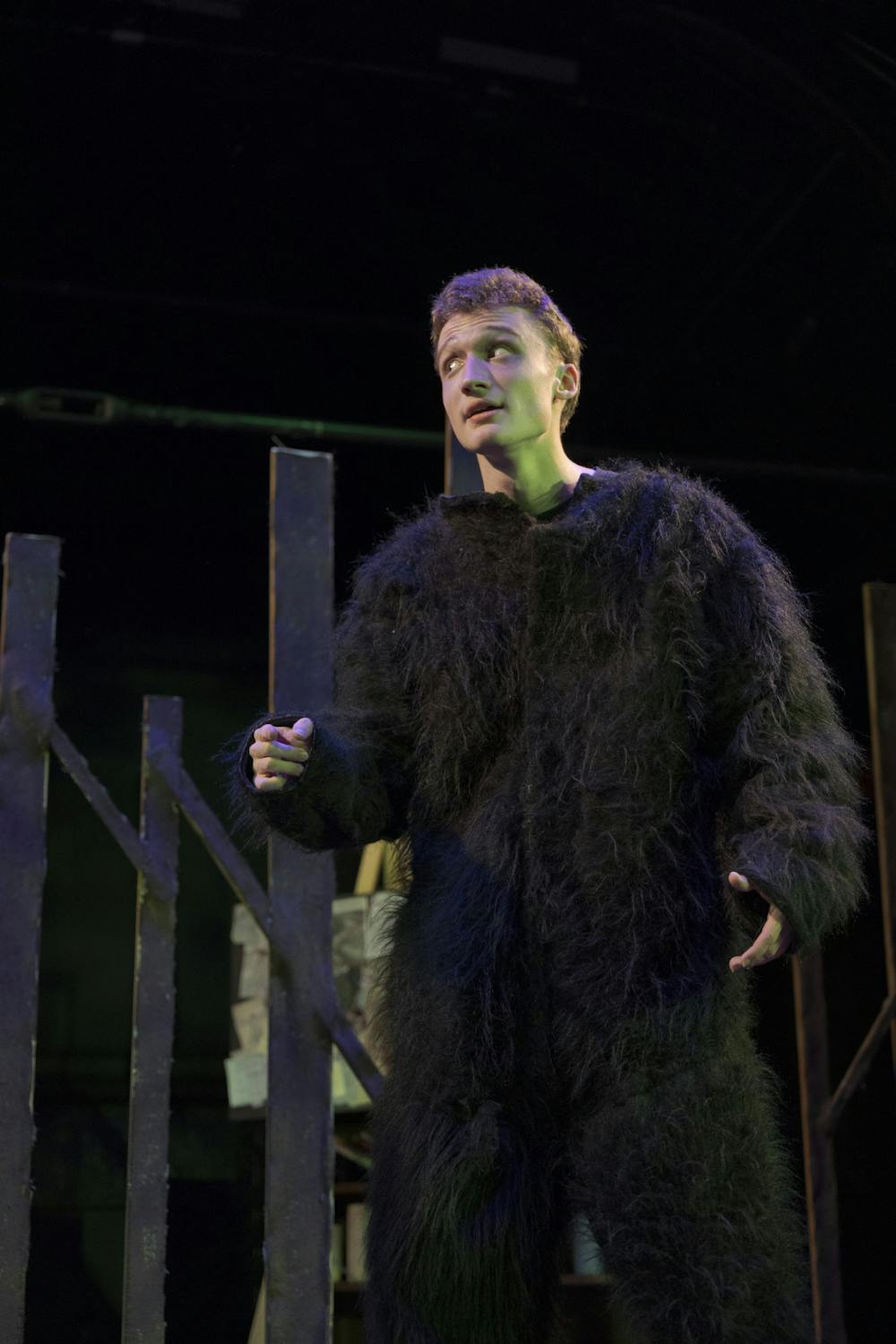
In the middle of a distant forest, two sisters and a man in a Bigfoot costume are looking for the truth. Things quickly fall into disarray as this search for the truth takes a violent turn: the two sisters begin to doubt one another and the bigfoot impersonator is holding the sisters at gunpoint. As Matthew, the bigfoot impersonator and Alyssa’s stalker (Owen Foberg ’27), glances between the two sisters, he decides on a plan: whichever one of them is “right” will survive.
This isn’t the first time that the sisters have disagreed with or doubted each other, but it’s the first time their lives are on the line. With the stakes reaching a boiling point, Holly (Hannah Alberti ’26) and Alyssa (Celia Kadoi ’26) must reconcile with their differing perspectives on each other’s lives and their childhoods, all while trying to escape unharmed. These themes and more are featured in “Bigfoot,” a play by Meghan Endres Brown, which ran from April 16–18 at the Hepburn Zoo. The play was Hannah Alberti ’26’s senior thesis in acting, Alex Garcia ’26’s thesis in lighting design and an independent project in scenic design for Evan Berger ’26.5.
Because “Bigfoot” was a senior thesis play, the students involved had significant creative input.
“From meeting with Ramyn, the director, once a week to discuss the rehearsal room to tackling Qlab for the first time as sound designer, the thesis process is all hands on in a way that the faculty shows, which only ask actors to fulfill a singular position without much deeper collaboration, are not,” Alberti wrote in an email to The Campus.
Quantum Physicist Holly arrives at her sister’s remote shack to fulfill her mother’s dying wish: bring her estranged sister Alyssa home. The mission is hardly straightforward: on top of being a viral influencer, Alyssa has become a devout believer in Bigfoot, convinced that this is the night he will finally appear. Huddled in the cabin, she refuses to leave until she sees the creature, much to her sister’s frustration. Bigfoot finally appears, but he is an impersonator — one of Alyssa’s obsessive followers. Enraged by Alyssa’s rejection of his advances and Holly’s disbelief in Bigfoot’s existence, he pulls out a gun. He demands that the two sisters recount their upbringing to determine which one deserves to live.
Part of the play’s major conflict is the vast differences between the two sisters, despite being raised under the same roof. Holly, the eldest sister, was adopted and feels an innate desire to connect to her biological family, while also craving recognition from Ivy League institutions. Alyssa, who is biologically related to their mother, always felt that Holly was the “golden child” because she was “hand-picked” by their mother and had created a picture-perfect life for herself. The sisters argue at length about their relationship to their mother and bicker over which one of them was truly closer to her. All of these arguments come to a brief halt when it is revealed that Holly’s life is not as perfect as it seems: she has been having an affair with a coworker, has lost her job as a professor, and is getting a divorce. Alyssa admits that she misses her big sister and their mother more than she let on.
“Holly is complicated. She has set up her life to be by the book, exactly the normal life that everyone wants, and is struggling to hold it together as everything falls apart. She thinks her sister is immature, but also expects her to fall in line when their mother needs help. Ultimately, she is desperate for a connection with her family, especially given her background surrounding her birth parents,” Alberti wrote.
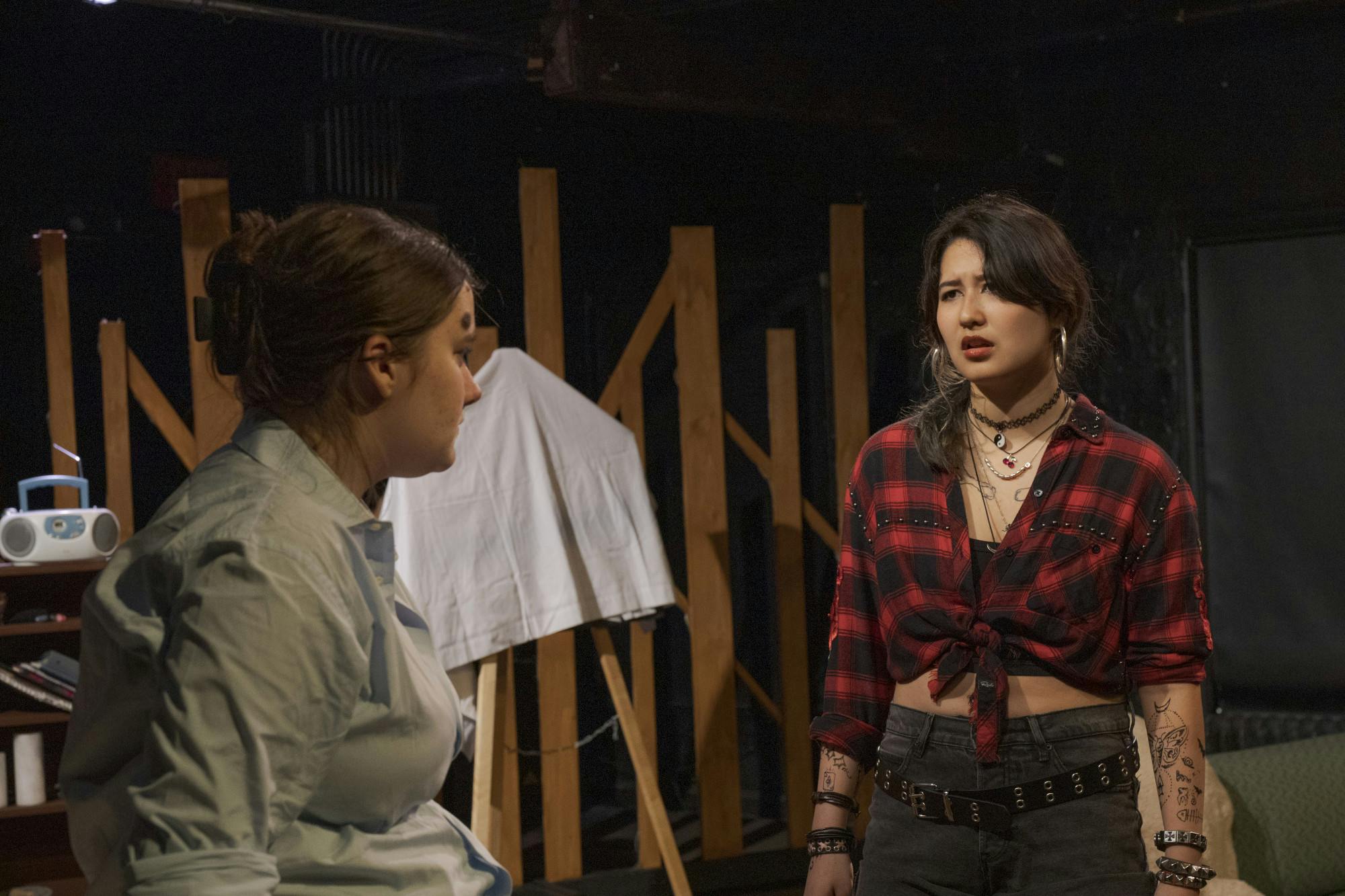
Photo from the play "Bigfoot," performed in the Hepburn Zoo Black Box Theater, with Celia Kadoi '26 and Hannah Alberti '26.
“Bigfoot” is just the latest in a series of works by Meghan Endres Brown that focus on tumultuous family relationships, the harmful effects of social media, and the development of belief systems and skepticism.
Ultimately, the play sheds light on the fractured state of information, belief, relationships and institutions. How do we decide whose opinions we value and trust? How can we prove something is real beyond belief?
“The plot has a focus on the social media bubbles we operate in and the effects that people with powerful voices have on audiences. That is so prevalent in today's world of parasocial relationships and influencer propaganda. I hope that, with shows telling stories like these, there's a deeper connection to real people and conversations, and that light is shed on the frightening truth of media like Alyssa's,” Alberti wrote.
At its core, “Bigfoot” is grounded by the relationship between the two sisters, a connection that becomes clear in the chemistry between Kadoi and Alberti onstage. Radically different, the sisters also understand each other like no one else, a connection that none of them can ever leave behind. For Alberti, this connection was the heart of the story and key to her performance.
“The sisters are such different people, but in the end, it’s being honest and vulnerable that allows them to navigate an incredibly frightening situation,” Alberti wrote.


