
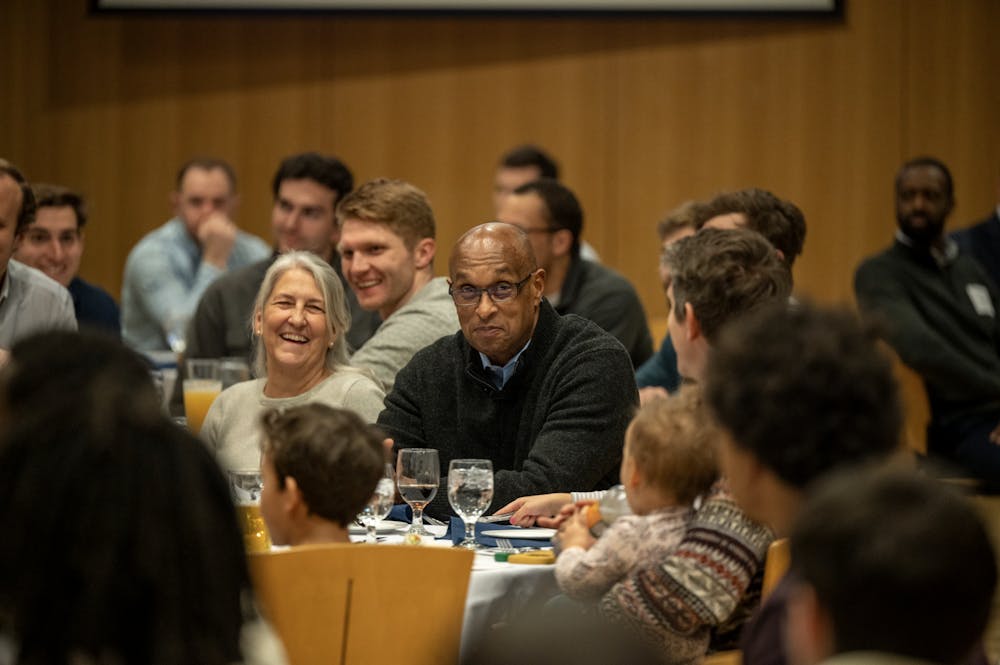
Who would you drive through a snowstorm for? For many Middlebury basketball alumni, the answer is Jeff Brown.
On Saturday, Jan. 24, amid winter storm warnings, a group of Middlebury’s most accomplished basketball alumni made the drive back to campus — some with their families and small children — to honor the man who built the program they once represented.
Jeff Brown, the former Russell L. Reilly Head Coach of Middlebury men’s basketball, retired after 28 seasons last year, and the Panther basketball family returned to celebrate this milestone. Brown’s retirement marked the end of a career that made him the winningest coach in Middlebury basketball history.
Well, not quite. Middlebury Director of Athletics Erin Quinn ’86 delivered the first of several speeches at Brown’s retirement party, briefly disrupting the room’s expectations.
“If you look at the records, he’s actually the second-winningest coach,” Quinn said. “His winning percentage is second. He’s behind the legendary Simeon Murch, who retired with a 7–0 record back in the 1917–1918 season. That’s going to be very hard to beat.”
It was a bold way to open a series of speeches, but Quinn’s delivery landed as a lighthearted joke — the perfect icebreaker for the night.
Quinn’s joke fit well, as Jeff Brown’s legacy was never about perfect records. In fact, for the first decade of his career, he was far closer to being the losingest coach in Middlebury history.
“I’m a slow learner, I guess,” Brown reflected on his journey. Yet he learned well: in Brown’s time at the helm, the Middlebury team was ranked as high as third in the nation in 2022, reached the NESCAC championship six times and won four since 2009, and reached the semifinals of the NCAA tournament in 2011.
As the night went on, each story added another tile to a growing mosaic — one that revealed not just these successes, but continuity, accountability and belief.
Still, what kind of coach was Jeff Brown beneath all the accolades? An answer can be found in comparing Brown to Middlebury’s current head coach, Matt Goldsmith.
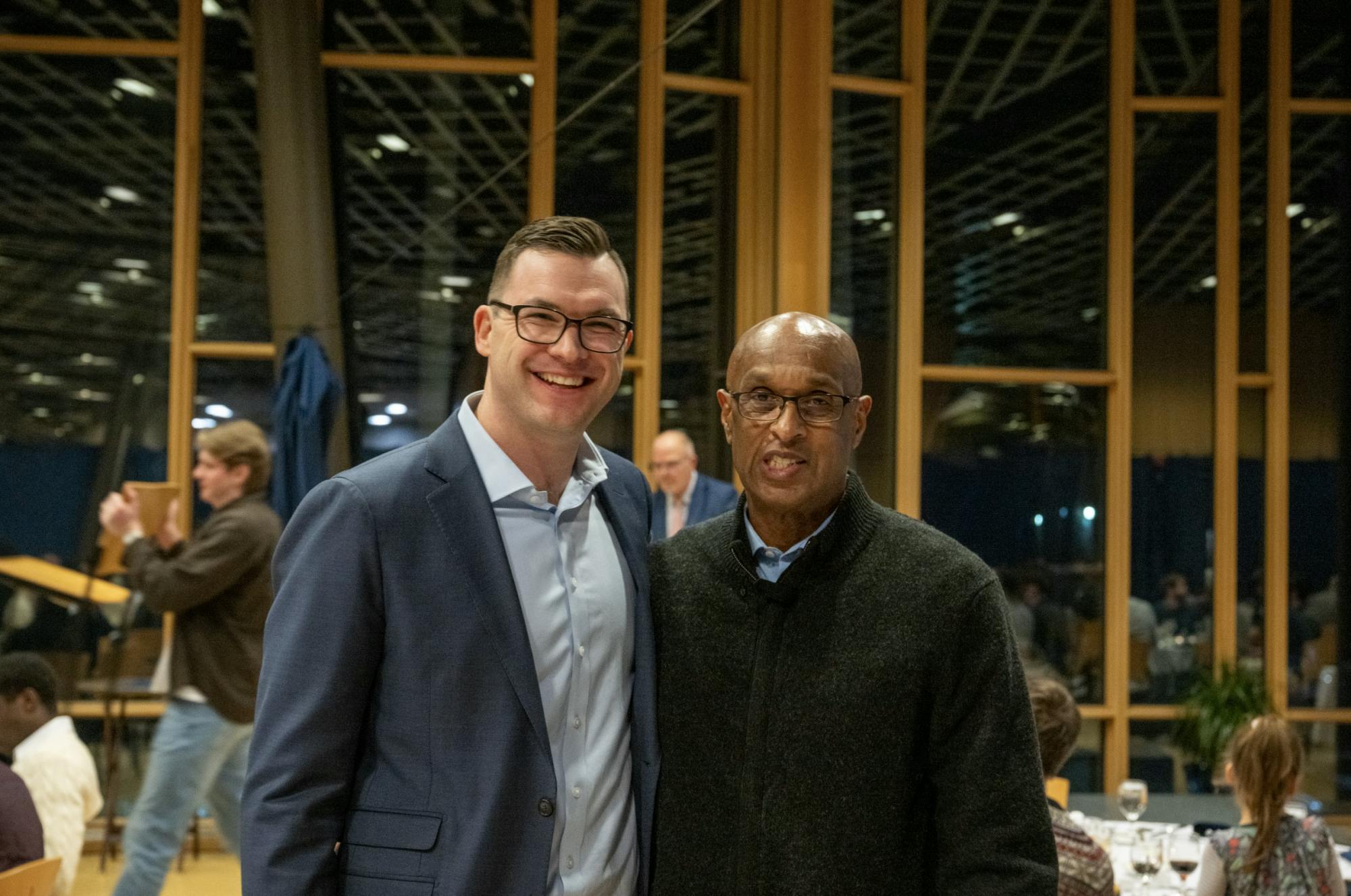
Goldsmith came to Middlebury from The College of New Jersey just before Brown retired last spring. Goldsmith is detail-oriented and relentless. Before every game, he hunts down a whiteboard — no matter the size — and carefully sketches out personnel breakdowns for his players. Before tip-off, he appears calm, almost detached, eyes locked on the opening jump as players go through their routines.
Once the ball is in the air, that calm suddenly vanishes.
Goldsmith coaches with a commanding presence. Whether his players are five feet away or on the opposite baseline, his voice cuts through the gym. If words fail, a blast from his whistle brings the team back to focus. He’s unafraid to challenge referees, especially because he demands physicality from his team — a style that occasionally results in sloppy execution, but more often forces officials to make difficult calls. Goldsmith never misses the chance to advocate for his players.
In the huddle, he grounds the team in belief. No game is ever too far out of reach. Even when they’re up, he expects them to set the tone, push the pace and dig deep defensively. Facing Keene State in early January, Goldsmith embraced that mindset before the game.
“They're over there thinking you’re the nerds of Middlebury. It’s your job to go out there and set the tone physically. Bruise them up, play our brand of basketball. Make them scared to come back here and play us.”
Former players paint a strikingly different image of Brown as a coach. Ryan Sharry ’12, a cornerstone of the historic 2010–11 team, described Brown as unwavering — especially in moments of chaos.
“Coach was always calm in the huddle,” Sharry said. “Things could be as high as possible or as low as possible. Coach stayed at the same level. He didn’t panic — so there was no excuse for us to panic either.”
That composure didn’t mean softness, however.
“He was phenomenally steady, but that doesn’t mean he didn’t give it to us when we needed it. And when he did, you knew you deserved it.”
Sharry recalled one story that perfectly captured what that looked like on a day-to-day basis. Having shown up to practice a mere 15 seconds before the start, Brown turned to him and said, “Thanks for coming, but we’ll see you tomorrow.” Brown ultimately let him stay — but that message was all Sharry needed to hear.
“That was the best practice I had all year,” Sharry reflected. “I apologized to Coach afterward, and he said, ‘you know, Ryan, I need you to show me. You can’t just go out there and play as a player. You can’t just talk it. You need to show it. Show your teammates that you are a leader to them.’”
That expectation — show it, don’t just say it — is where Brown and Goldsmith intersect.
Both believe leadership starts with the upperclassmen. Both believe players should be on the floor and ready to work at least 15 minutes early. Both believe team culture is built through daily habits, not speeches.
As long-time assistant coach Rob Alberts put it that night, “these two have completely different coaching styles — but it’s fascinating that you can build a winning culture in different ways.”
Jeff Brown’s career is a testament to the fact that good things take time. He became the winningest coach not through impatience or perfection, but through consistency — by holding up the standard long enough for everyone else to rise to it. And judging by who was willing to drive through a snowstorm to honor him, that culture hasn’t faded.
Editor’s Note: Dante Aguilar ’26 is the team manager for the men’s basketball team.


