
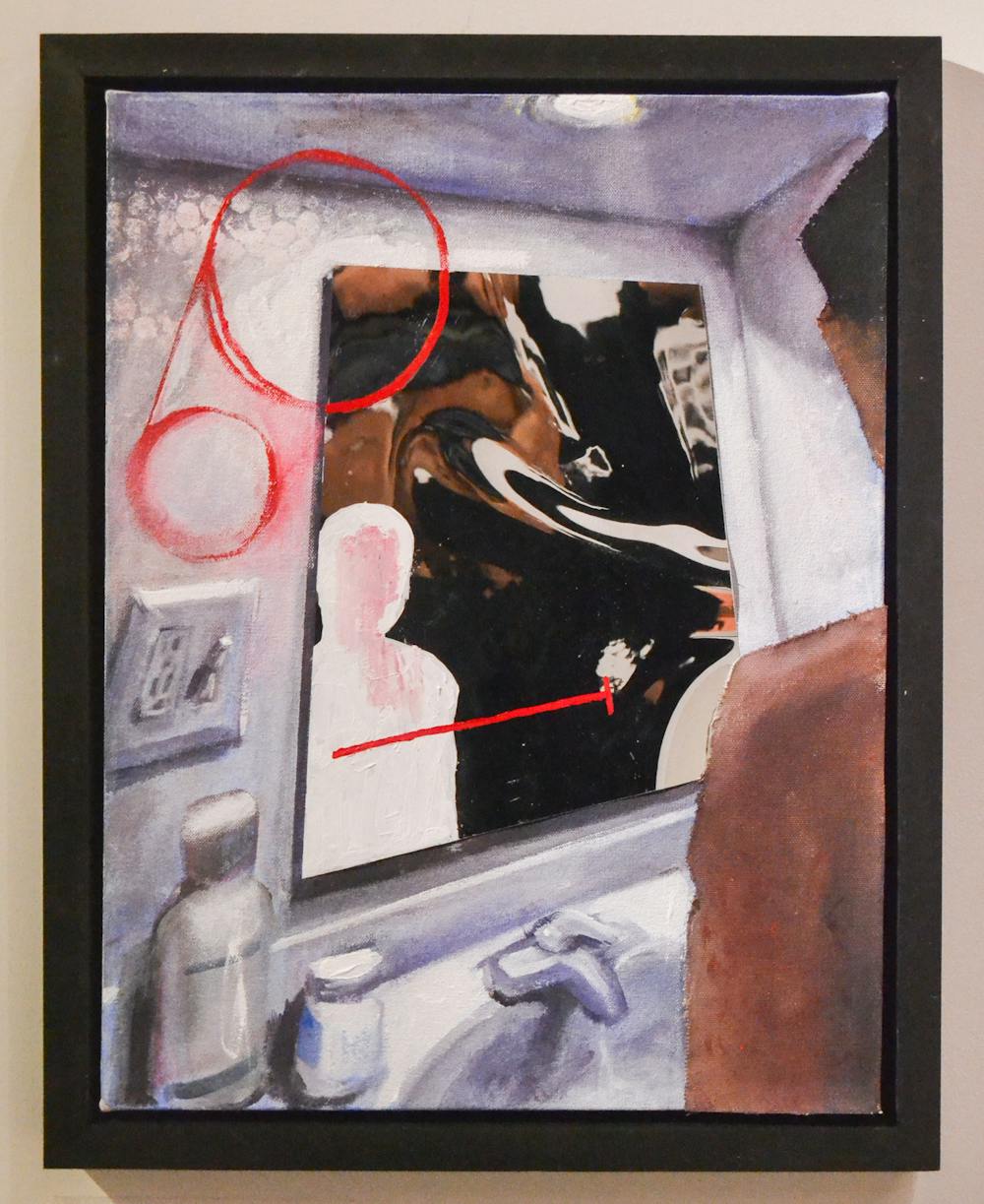
Conversational Art is a column of artist interviews (faculty & students alike) that foregrounds the personal voice, the creative process and moments of insight springing from the resonant space in between.
Christy Liang: Which medium did you first start with?
June Su: I first started with a mechanical pencil. I started drawing when I was in third grade. I joined a cartooning club, and after school, we learned how to draw cartoons together. And from then on, I started drawing a lot in pencil, like from third to sixth grade. And I think I also picked up watercolor. Both of these mediums were very easily accessible.
CL: Where do you draw your inspirations from?
JS: I'm a poli-sci major, so I get inspired by visual history a lot. I took International Politics my sophomore year with my advisor, Kemi Fuentes-George. He likes to put a lot of pictures in his presentations and I always found those to be really interesting - particularly pictures that depict something kind of absurd. I also take a lot of screenshots on my computer of random dumb [things] like absurd advertisements saying “this is one hack that will help you get rid of your Alzheimer's.” I always find the pictures for those advertisements so interesting. I collect them in a folder on my computer and paint them out sometimes. Some of my favorite artists are Francis Bacon and Leon Golub.
CL: When you paint, do you first have a compelling vision and then you are drawn to the canvas to fulfill that, or do you just start painting and let your impulse take you wherever?
JS: It's varied throughout the years. Right now, my practice has evolved into more so letting the picture develop itself. I've been really interested in composition as a force of its own. I also photograph for fun sometimes. For my recent thesis show the past semester, I went through my camera roll and took out photos of friends where somehow their expressions spoke to me. And I printed out a packet of these photos on papers. I would use that packet as a reference and then paint onto a canvas and treat it with different materials. For example, I used a lot of medical gauze for this past thesis.
CL: Do you think of yourself as like a channel, not exactly in control of what you're creating?
JS: That's a really interesting question. Also because we were talking about fate, and how you said that everything's predetermined in a way. I honestly have no stance on that. I don't know whether I think things are predetermined or not. I do prioritize having a strong political voice in my paintings and to a certain extent, that does feel like I'm a channel for something. But it feels fickle. I was talking to Matthew Schrader in the Studio Art department about ‘how much do I want this or that painting to be an objective analytical essay where I’m trying to create an argument of something linear and specific’ versus, ‘this is just who I am as a person and this is my experience of the world.’ I struggle between the two a lot.
CL: How have you evolved from Freshman to Junior year in terms of your artistic vision?
JS: I definitely evolved away from trying to always have something so significant to say in my paintings, at least like consciously planned out profound things to say. Studio art is my minor, whereas poli-sci is my major; trying to lessen my political naivete and also deepening my historical and moral knowledge in general has enriched my artistic practice and the ways that I formulate the abstract ideas that go into my paintings.
CL: How have your relationships shaped this evolution? Not just interpersonally, but also relationships with space and time, being in the web of all these things.
JS: It's also a very fitting question for me, because my previous artist statement for this semester was extremely abstract. It was about the Buddhist concept of interdependent origination. I'm 20 now, but I was 17 when I first came here. I think these ideas have definitely shown up in my art, like the way I now conceptualize time in a less black and white way. And that has definitely gone into my central idea for this past semester, which was about how interdependent origination means that there is no permanent truth or essence of all things. Everything is constantly bouncing off each other and arises in relationship with each other. But also, I want to make a disclaimer that I find it so hard to verbalize these things. It's not something I've worded in a way that has been super satisfying to me yet.
CL: This is about your column, I guess. What are some things that you learned from the painting professionals you interviewed?
JS: I immediately think of my interview with Brian Cirmo, who's a painter based in upstate New York. He taught the class that I took last J-term, Introduction to Oil Painting. And he definitely had a non-nepo way of becoming a very well-respected artist now. He came from a working-class background and worked several jobs at once to sustain his practice. It was illuminating because I often struggle with the question of how committed I am to making art my livelihood. And in an interview with Reverend Dr. François Scarborough Clemmon, I learned about how our artistic careers are very much shaped by the historical forces of his time. It makes me feel privileged to talk to these experienced artists with long lives behind them, not only to contextualize my professional career, but also where I am historically, like, what do my privileges or opportunities look like at this point, and how can I take advantage?
CL: Since you mentioned the historical moment, I’ve been feeling how there’s just a helplessness to being an artist in this era that we’re in. Like if we're in the 1960s, a piece of essay could engender a whole movement. But now it's hardly ever the case. I think art has lost a bit, if not much, of its potency.
JS: Well, I was immediately thinking of, and I want you to include that I'm talking out of my ass, this Zen Studies Podcast I’ve been listening to. One episode talked about how in the pre-modern world, there was a lot of community and faith. Then, modernity happened and scientific objectivity became this thing. But at this point, it’s okay to lose the religion part because we still have this collective idea that humankind is progressing towards some scientific ideal. And now in the “postmodern” world we don't have either, so we all have lost meaning in a big way, or at least in the way we used to conceptualize it. But honestly, I’m a huge fan of contemporary art from this era. I really don't feel like technique is that big of a deal and that having some sort of profound thing you're trying to say, like in most classical paintings, is all that necessary. I guess I find vibes more important at this point in my life. But I fucking hate those New York City galleries that sit on the most expensive properties and have just one painting in them that’s an empty mirror. I think material conditions must be addressed in art. But if you're trying to approach vibes from a genuine place, I would want to see that.
CL: How do you see yourself making art in Argentina, where you’re spending the Spring semester?
JS: That's a really good question. I think I'm mainly going to take a lot of photos there, because I don't really foresee myself having the space to paint. I'm also going to keep a sketchbook. I do a lot of drawing of random people in public spaces. Something that I've found out recently is that when I draw things, I remember them better and more vividly. So I hope to draw a lot of things in Argentina to crystallize those experiences.
CL: It's interesting that you used the word crystallize, which is what I'm trying to do with words. But it's hard to arrest something from a stream of experience. It's never quite what is.
JS: I guess that for me, I try to think about it as little as possible. That's my practice in general. I'm trying to think as little as possible, which I guess in live drawing means how you're sitting right here, for example, I'm gonna not look at the page and draw you looking at me exactly like this with your hand on your chin. It's like I took a picture of this moment and just slapped it onto the paper. I love that drawing has that immediacy.
CL: But words don't. Because writing is already a retrospective act. You're already sitting somewhere else and reflecting and remembering. And then you're trying to crystallize, it feels quite ironic.
JS: That's so true. But I mean, it's still your present experience of those past things. Very interesting.
Editor’s Note: This interview has been lightly edited for clarity.
Christy Liang '28 (she/her) is an Arts & Culture Editor.
She is an English & Religion major who loves long conversations, live music in underground bars, and films that are a little pensive. She's genuinely curious about what goes on in other people's minds. Her column, "Conversational Art," is a series of interviews with student and faculty artists across all mediums.


