
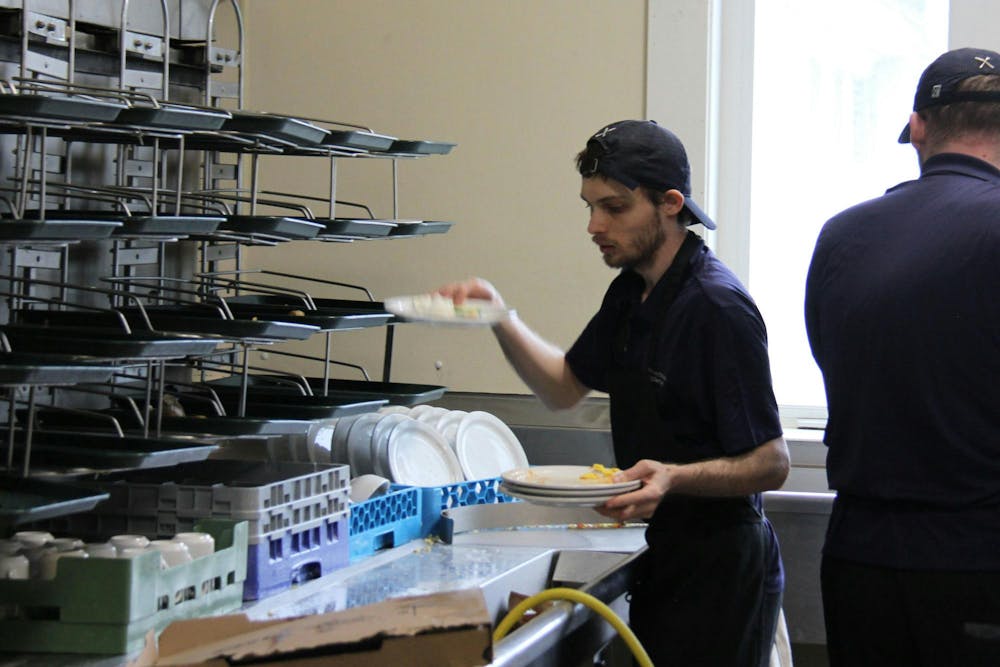
In the fall 2025 semester, residents of Coffrin Hall received an email from Residential Life informing them that the dorm’s only kitchen and lounge would be locked up for the remainder of the semester due to the excessive amount of broken dining hall dishes consistently found in the building’s lounge.
“This has been an ongoing issue for years and years,” Executive Director of Food Service Operations Dan Detora said in an interview with The Campus, referring to the issue of missing plates, bowls and cups from dining halls.
Latest reports from the custodial team show that students not only remove dishes from the dining hall but also have been throwing them directly into the trash, according to Detora.
“We spend roughly between $35,000 and $45,000 a year on replacing [dining hall dishes],” Detora said. The money is appropriated directly from the annual dining budget.
Shane Lawton, assistant manager of Atwater Dining, noted that the missing dishes have an impact on day-to-day operations.
“Our duty and responsibility, as well as what we want, is to provide students with the best service,” Lawton said. “If we don't have the dishes to provide food for them, that makes it kind of difficult.”
Lawton noted that last fall, the issue was the worst it had been in his 11 years working at Middlebury.
“We were down to a dozen bowls,” Lawton recalled. “I put a sign that said please bring dishes back, what we have is what we have, and we cannot restock the dining room.”
Students answered the call, returning with armfuls of dishes.
Another issue that Lawton pointed out was the tendency to take dishes out of one dining hall and return them to a different one.
“All those dishes that go out [of Atwater] end up at Proctor, and they are getting used, [but] we end up having to buy stuff to replace that,” Lawton said. "We need to replace approximately 600 units a month.” These purchases come only after dining halls exhaust their shared off-site storage.
According to Detora, the issue stems from the college’s abundance of outdoor dining spaces across its dining halls. All three dining halls have an outdoor patio accessible during warmer months. Additionally, Proctor has the Woodstove Lounge, while Ross has the Fireplace Lounge outside the main dining space.
At Union College and Siena College, where Detora previously worked, controlled entry and exit points, thanks to a confined dining space made it nearly impossible for dishes to leave the dining halls.
Alvaro Micocci ’28, a Residential Assistant (RA) at New Battell, pointed to the pace of campus life as a driving factor.
“We are always rushing places at [Middlebury] because of how intense and packed students’ schedules are; therefore, there’s a need to drink and eat while walking,” Micocci said. He added that the small college atmosphere creates a false sense of informality. “It seems as if you are only borrowing it and taking it ‘to your room’ from your house’s kitchen.”
To address the issue, multiple departments, including the student body, Dining Services and Residential Life and Facilities, are at work.
The to-go-box program, where students can buy a carabiner for $5 from Midd Xpress that can be exchanged for plastic reusable takeaway boxes, was initiated by students and implemented in 2019 to mitigate the issue.
“It’s a great program,” Detora said. “I have to assume that a lot of students don’t even know it exists.”
Last semester, only 162 carabiners were sold — a figure Detora called “shockingly low.”
“It needs better advertisement and marketing for students to know how easy and accessible it is to use,” Micocci commented on the matter.
Associate Dean of Students for Residential Life AJ Place said that ResLife has posted signs and tried to maintain active communication about keeping shared spaces clean through floor meetings and emails.
Residence Director (RD) Heather Sitkie noted that students usually receive warning emails from their RD and messages from their RA stating the problem and expected solution before a space is closed.
“Usually, before locking a space, there is a lot of warning given. We are making an ask for people to clean up. We are expressing the concerns about pests and the impact on the community and custodial staff, and we send a lot of prior communication,” Sitkie said. “When we are leaving dishes out, a lot of students aren't cleaning them out, so that adds to concerns about attracting pests and rodents.”
The Coffrin Lounge closure was a last resort response as the large number of broken dining dishes that were left behind caused excessive work for the custodial staff and made the space dangerous for student use, according to Place.
Also implemented is a dish collection program across campus, where every Monday the custodial staff clears out dishes and emails Dining Services, who sends out a crew to collect them, according to Detora.
Lawton said that the program was piloted at the Bread Loaf School of English over the summer with much success, but staffing issues pose a hurdle to fully implementing it here on the main campus.
At the end of each semester, Dining Services works with Facilities to sweep the campus for leftover dishes. What comes out of it is “boxes and boxes of dirty dishes”, where, after sitting in dorms for so long, only 75% of them are salvageable.
The program marks a shift in Dining Services' philosophy from prevention to damage control.
“I think our folks have given up a little bit,” Detora said “[We’ve] tried a lot of different things, and nothing seems to work. We have bigger fish to fry.”
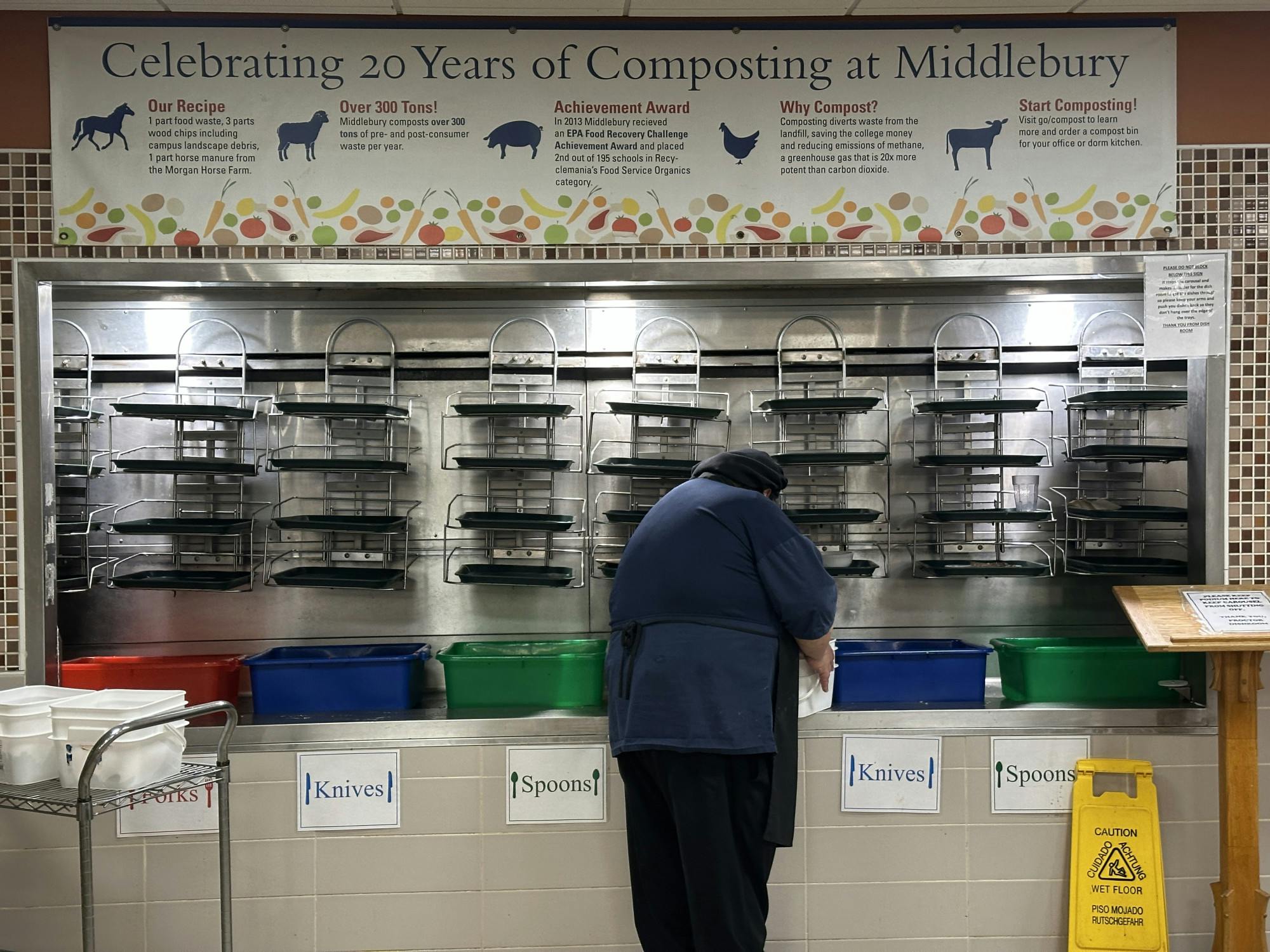
Editor's Note: Incoming Managing Editor/Senior Opinions Editor Yuvraj Shah ’26 contributed to reporting to this article.
Met Ly '28 (he/him) is a News Editor.
Met is a UWC Davis Scholar majoring in International Politics and Economics with a Creative Writing minor. He is also a fellow at the Rohatyn Center for Global Affairs. He hails from Siem Reap, Cambodia and spent his gap year there as a digital marketing manager and events coordinator. Outside the newsroom, he line dances in his cowboy boots and jams out to the Arctic Monkeys.


