
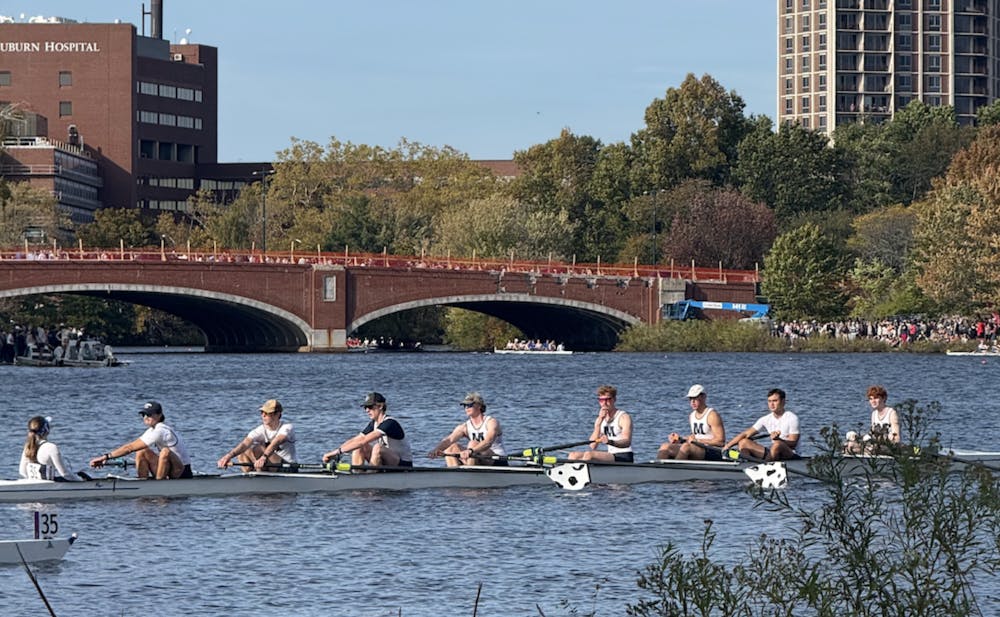
Three hundred thousand people, 12,000 athletes, 2,500 boats, 72 events, one river.
Last weekend, the Middlebury Crew team competed at the 60th Head of the Charles Regatta (HOCR) in Boston, the world’s largest two-day rowing event that annually attracts the top collegiate and club crews from across the country. Around 300,000 spectators lined the Charles River over the three day competition, watching 12,000 athletes row in nearly 2,500 boats. As spectators packed the grass and bridges along the Charles, rowers walked their boats along the river, each turn drawing laughter and “Pivot!” jokes from passing competitors.
Walking along the banks, the number of college rowing shirts was almost greater than oars being carried. The regatta brought people of all ages together to celebrate the sport, from a great grandfather who rowed at Yale in the 1950s supporting his grandson to a group of fresh college graduates from California watching their dads compete in the 60 plus men’s 8s event.
Bands and artists also performed, unexpectedly excellent tacos were served, and by Sunday afternoon, the number of people wearing HOCR merchandise had doubled (myself included).
On Sunday afternoon the Middlebury squad took to the water. The women’s four finished in 20:13.284 and finished 21st of 41, beating Bowdoin and Wesleyan while trailing Clemson by two seconds. The men’s four finished in 17.43.335, beating Washington College but fell short to most other NESCAC competition. The women’s eight finished in 19:48.590, while the Middlebury men’s eight finished in 15:49.948, besting Vassar, Bowdoin and Villanova, all programs to whom Middlebury lost last year.
Middlebury’s crew program is a club sport, whereas most of the other Division three colleges at the race have well-developed varsity programs that recruit many of its players. The main distinction between club and varsity rowing is the funding for boats, recruiting and reputation.
“Being a club isn’t really a disadvantage, it’s just a different way of doing a team sport,” Charlie de Ramel ’28 said. “There’s also more flexibility and less commitment compared to D3 or D1 programs, and it’s more fun.”
As Middlebury’s fans tracked the boats on their phones, they waited excitedly to see the familiar cow oars splash around the Eliot Bridge and the large M’s on the chests of Middlebury’s rowers come into view. Overall, rowing is not an ideal spectator sport. Onlookers are only able to watch the boats up close for 100 meters before they are too far. However, for those 100 meters, students, alumni, parents and fans cheered for every boat as loud as they could. Every 20 seconds at the regatta, a new school or name was cheered for, an endearing moment of community and shared enthusiasm for the same sport.
That sense of community runs not just through the crowd, but deep within every program and team.
“When you are in a boat full of your best friends rowing on a lake tucked in Middlebury’s mountains with a sunset illuminating the sky, you can’t imagine a world where you wouldn’t commit to these rowers every day,” Anna Morrissey ’28, a member of the women’s four, said. “This is a sport where you truly cannot succeed unless you have your teammates there with you, and that commitment to yourself and each other is what makes it so special.”
In a sport built on rhythm, trust and quiet endurance, the Head of the Charles stands as a rare moment when that world opens up, when the solitude of rowing becomes collective. Over three days, Olympians, club rowers, parents and alumni all shared the same pulse along the river. The regatta revealed what defines the sport at every level: connection between teammates, generations and the water itself.
For Middlebury, a club team competing among nationally-known varsity programs, that connection was especially visible — a reminder that spirit and cohesion can carry as much weight as status or funding. By the weekend’s end, the sea of HOCR sweatshirts lining the riverbanks seemed to symbolize not just participation, but belonging.


