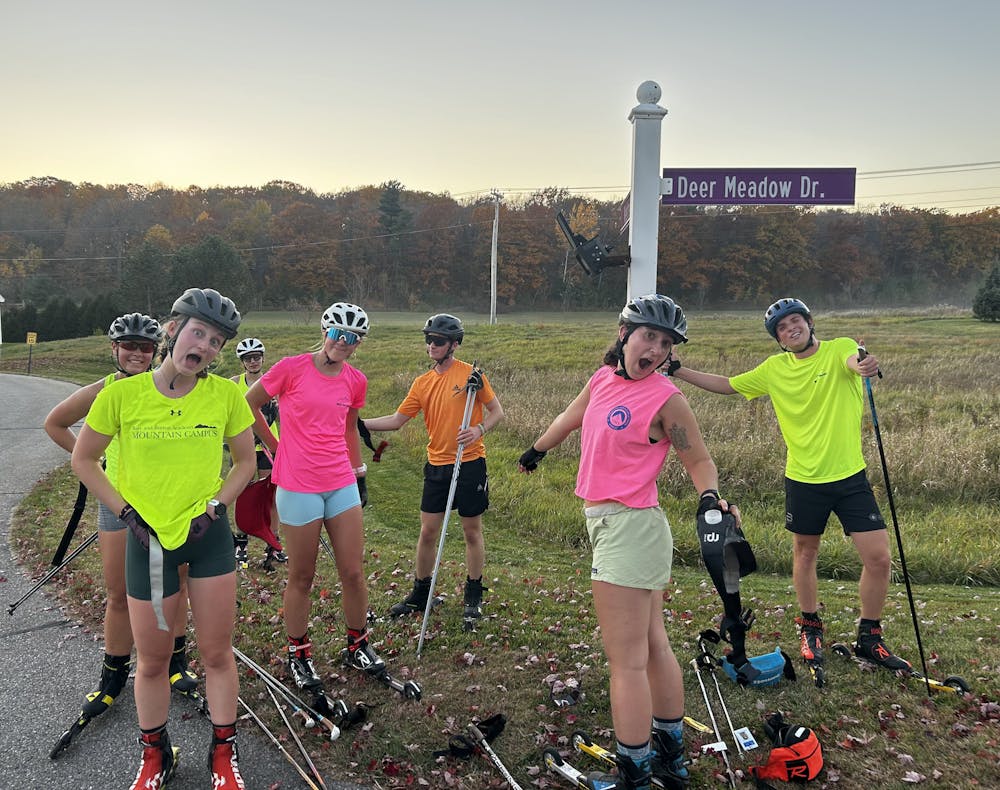
Foliage radiating across the mountains beyond the soccer pitch, large swaths of the football team squeezed into the film room, and packs of cross-country runners circling the grass fields into dusk are a few of the familiar fall sports sights at Middlebury. Yet none of these are as attention-grabbing, nor as fluorescent, as the college’s Nordic skiers zipping along the shoulder of South Main Street and through the town’s surrounding countryside in their neon gear. The bright garments, single-file procession, and rhythmic clacking of ski poles on pavement all comprise the ritual that is roller skiing.
In this inaugural issue of Tapped-in, I talked with a few of Middlebury’s Nordic athletes to get an insider’s perspective on what’s really going on.
At its core, roller skiing is an important form of off-season training for Middlebury’s varsity and club Nordic skiers. The training method, although not a perfect copy, sufficiently mimics the motions and demands of true Nordic skiing more closely than any other off-season workout.
“If you’re wanting to get better at cross country skiing, roller skiing in the offseason is the one thing that is the closest you can get to on-snow skiing in the movements and the muscle groups,” cross country skier for the college’s varsity team, Mason Wheeler ’26 said.
Athletes even use the same boots as they would on regular skis, an additional benefit that Club Nordic skier Halle Zuck ’26 pointed out. The relative shortness of roller skis allows for sharper turns and handling drills.
“Because the skis are so short, you can train really intense agility,” Co-President of Club Nordic Caio Brown ’26 said.
However, roller skiing has its downsides. First, the subtle differences in hip and knee alignment between pavement and snow can cause injuries when skiers adjust between surfaces. Classic roller skis also sport a ratcheted wheel design, meaning that any backwards force will help propel a skier forward. In contrast to the narrow wax pocket beneath true classic skis that grips the snow and creates the necessary friction for movement, this difference can encourage bad skiing form habits.
These drawbacks are minor, though, compared to the glaring question of safety.
Admittedly, watching people roller ski is nerve-wracking. Between the two slabs of metal gliding beneath each foot, two poles prancing on each flank, and up to a dozen athletes skiing in close succession, there are many moving parts that are apt to collide. The potentially fatal presence of cars only heightens the risk. All the skiers I spoke with confirmed these concerns.
“Even now after years of doing it, I probably have at least one good crash a year at the minimum,” Wheeler said.
Yet the visible dangers present in roller skiing may not even constitute the single biggest risk of the sport — that prize is likely won by pebbles.
“The gap between the wheel and the ski, especially on skate skis, is like a centimeter, and if your wheel sucks up a pebble that’s about a centimeter or a little bigger, it can actually just stop the entire wheel,” Wheeler said.
“I have the intrusive thought of if I hit a little rock, I’m cooked,” Brams said.
Cooked, indeed. A stray pebble could trigger full ejection, not ideal when you are flying down a paved road, reaching speeds of 40 miles per hour, wearing little more than a t-shirt and shorts. Road rash is common proof for such incidents; incidents of torn menisci and broken bones are some of the more serious results from the union of skin and asphalt.
Pebble anxiety aside, just stopping on roller skis is dangerous enough.
The skis rarely come with brakes, and if they are included, trying to tinker with speed reducing systems while moving may cause a crash of its own. The common method of slowing down, then, involves lots of planning ahead, knowledge of the terrain, and the classic “pizza” technique: An awkward pointing in of the toes combined with a series of inwards steps until you reach a gradual halt.
If an instant stop is necessary, there is always a last resort. “For us, the closest to an emergency brake is you bail into the grass on the side if that’s an option,” Brown said.
So, is it worth it? The skiers I spoke with gave a resounding “Yes.”
In light of the risks, both teams follow strict safety protocols and road etiquette: Always wearing high-visibility gear and helmets, skiing single-file and alerting fellow skiers when traffic is approaching. Further, local drivers tend to be accommodating of roller skiers according to Brams and Wheeler.
The dangers of the road can even be removed by trekking to one of the region’s two enclosed roller skiing tracks, or if you’re lucky enough to find one, using a giant treadmill specifically designed for roller skiing. Generally, though, Middlebury’s Nordic skiers stick to the roads. Given the exhilarating terrain and stunning surroundings of the college, you might do the same if you were in their boots.
Simon Schmieder '26 (he/him) is a Senior Sports Editor.
Simon is an avid runner and biker and enjoys spending time outdoors. He is a philosophy and political science joint major with a minor in German, in addition to being a Philly sports fan.