
When I last wrote an op-ed about artificial intelligence (AI) in 2024, submissions created with the technology had sneakily won several art and photography contests. Now, it is consistently deceiving hundreds of thousands of internet users every day. Its content creation capabilities have improved so drastically that AI has officially breached into mainstream media with its use in postproduction effects for Netflix’s show “The Eternaut.” It is safe to say that, up to this point, at least, AI progress has been exponential.
I’m writing now because if this continues the consequences are so seismic that to ignore them in earnest demonstrates a state of total obstinance, one that is so neglectful to the affairs of the human race it could be considered misanthropic. I can only forgive the monks, the surfers, and the children of the world for their ignorance; if you attend or teach at Middlebury College, you have long relinquished the privilege of being oblivious to that which so obviously and directly threatens not only academia but human activity as a whole.
It is not hard to imagine how far-reaching the consequences of a truly advanced Artificial Intelligence could be — for now, in true liberal arts flavor, let’s just talk about capitalism.
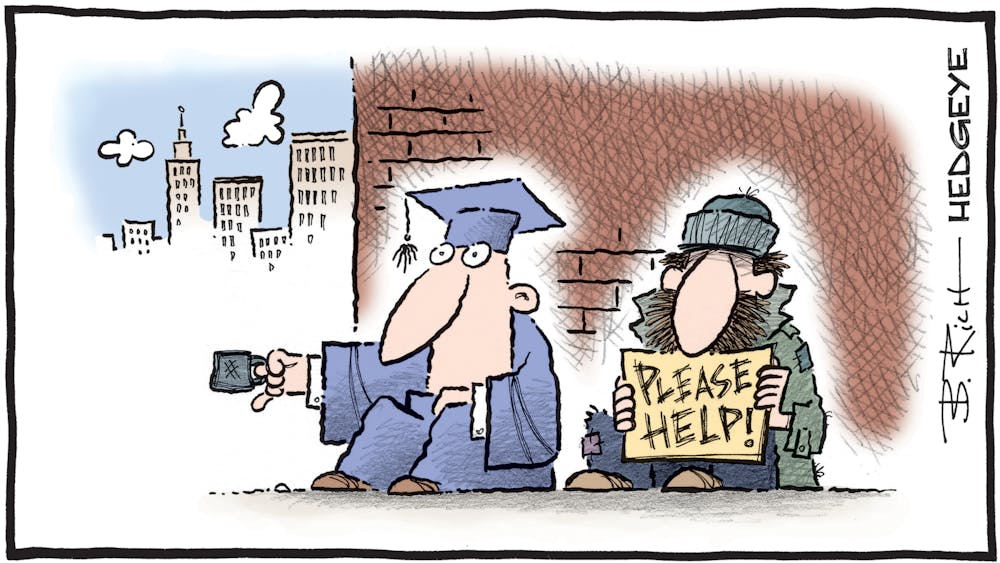
We all know that AI is replacing jobs. This is not the only reason that the job market is feeling impenetrable, but soon it may be the preeminent one. I will simply repeat what I said a year ago, that “within the next decade it is reasonable to expect that there will not be a problem a human could solve that a computer could not.” We should be preparing to face the reality that this may leave swathes of people with little to meaningfully contribute to society.
There appear to be two ways out of this. First, millions of Americans will have to swap collars from white to blue. This might be particularly traumatic for us liberal arts students who are paying exorbitant amounts to learn how to do exactly what is most in danger of substitution: Think. I hope we can all figure out how to hold a wrench.
The other option is a Universal Basic Income (UBI). How the U.S. will afford an acceptable UBI for hundreds of millions of Americans remains to be seen; If we print that money, we will violently debase our dollar, and as the de facto world reserve currency the consequences may be unforgiving. Furthermore, on its own, that stimulus would be immediately priced into consumer costs (meaning: it goes to the rich). One could make the point that the extent of federal price controls necessary to prevent this from happening would spell out the end of capitalism anyway.
But AI poses larger threats (or opportunities) to capitalism in how it will affect the marketplace. Consider this analogy
Imagine a local chess club. Once a month, chess enthusiasts get together to play each other in a tournament. There are some underdog wins, but in general, the better players usually prevail. One day, every member of the club comes to the tournament with a new app, a “pocket grandmaster”, that tells them the best move to make every time (mind you, there’s no rules against this, since nobody thought this would happen). Someone will still win the tournament, but it is fair to say that the players themselves no longer have an impact on that outcome.
To reduce capitalism to a chess match is highly reductive, ignoring the systemic forces at play that often dictate its winners and losers. But the point is that the “players” in capitalism are companies who will utilize their “pocket grandmaster” the moment it becomes possible for them to do so.
My view is that with the advent of universally accessible, super-intelligent AI systems, the resulting superabundance of intellectual capital will end meaningful market competition. Entrepreneurs will no longer be relevant in the competitive market because an “entrepreneurial AI” can simply take their place. Some have speculated about the first billion-dollar single-person company. Could there be one with no people at all?
With this, the twilight of capitalism may finally ebb into night. Could Marx have ever predicted that the end of the capitalist system would not be brought about by humans, but by their sudden obsolescence in it? Perhaps this was the purpose of capitalism all along — to progress to the point where we could finally invent the new gods. Now we only wait to see if they will worship us or destroy us.
I should note that just because AI progress has been exponential does not mean it will continue to be. In fact, there are many who believe that, like most technology, AI progress is slowing in the manner of an S-curve. I can comfortably speak for the human race when I say we would much prefer this assumption.
But I assume the opposite; that AI progress is and will continue to be exponential, and so should you. The warm winds are subtle: The Trump administration recently invested a 10% stake in Intel. Nvidia, Intel’s main competitor, bought an additional 5% stake. It’s clear we’re currently in an AI arms race, and we shouldn’t be surprised when we find out the next Manhattan project has been long underway.
Do I honestly think the world will end here? The human race has a tendency to pull through, so no, we’ll be fine. But given the nature of the technological advances that we are actively witnessing, we should expect some major corrections to our systems and institutions. In any case, this is certainly an exciting time to be alive.
I am always trying to refine my perspective: please email me with your thoughts at jdisorbo@middlebury.edu.

