
Three hundred million dollars.
Imagine this sum for Middlebury — a king’s ransom. With this sum, we could build forty-two Atwater Dining halls. With this sum we could have Beyoncé at every spring concert for the next three decades. With this sum we could give over 3,000 students full ride scholarships; we could double every faculty retirement plan; we could subsidize every staff vehicle. We could even buy 1.2 million Aritzia Puffer jackets, if it were up to MCAB.
But we cannot do any of these things. Not because we don’t have the money, but because we already spent it. Three hundred million dollars: the lifetime sunk cost of Monterey. Three hundred million dollars, not just gone, but invisible.
How is this possible? This is because our tuition money, plain and simple, does not appear to be meant for us, but for a mission much larger.
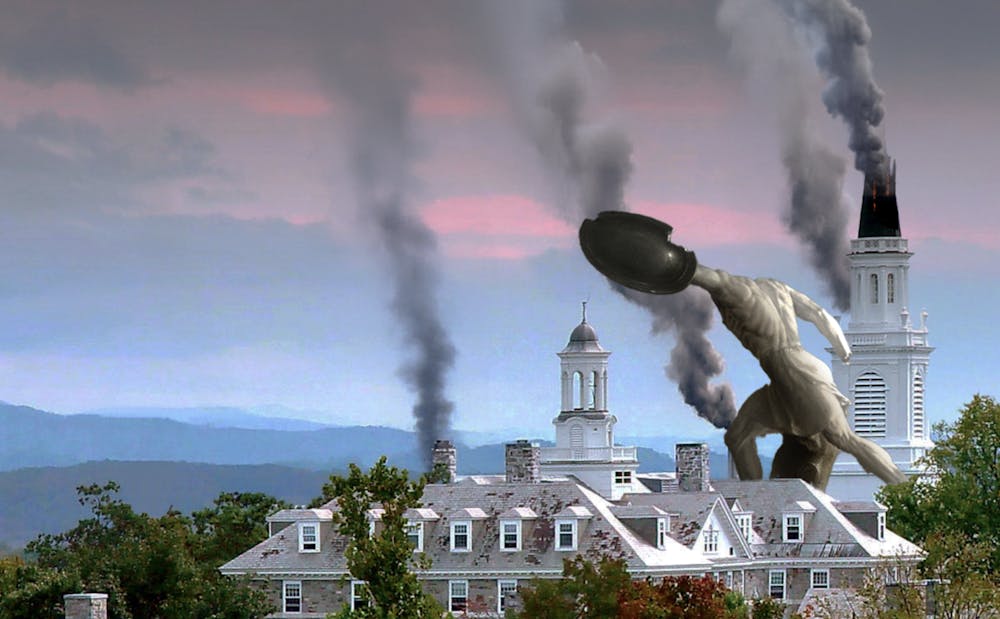
Once you see it, you can’t unsee it: Middlebury wants to be its own Roman Empire. The administration’s recent decision to deprioritize the main college in favor of its colonial project in Monterey demonstrates that its ambitions — and financial resources — were meant for bigger things than mere students. Much of what Middlebury has been and is doing now is the result of an agenda that is strikingly Imperial in its demands: To expand, in size and scope, indefinitely.
The college’s multigenerational ambitions are completely transparent. The most significant administrative decisions — its “arts agora,” for example — are made on timelines far beyond what could ever be relevant to current students. There is a Rube Goldberg sequence of new buildings scheduled for the next half-century whose architectural choices keep erring toward the behemoth. BiHall, the new Battell, and mega-Proctor are all militaristically super-scaled, all absolute affronts to the “Quaint Vermont” that Middlebury tries to sell.
Foresight is necessary. But our foresight has become Ozymandian. The administration has positioned its sights so far above the clouds that it can no longer understand or relate to its students, staff, or faculty. The effect is that they ask us to tighten our belts for the sake of a future that is completely removed from us.
It is one thing for neglect to creep as administrators spread themselves thin managing the colonies. But it is another when Middlebury, to preserve itself, sacrifices its employees. Or when it begins to hinder or even actively prohibit its students from doing the things they want in college.
Middlebury’s need to preserve itself at the cost of its subjects is painfully evident; Kafka’s nightmares come true as the Student Activities Office, ResLife and Events Management reach new levels of bureaucratic absurdity in their attempts to monitor student life while maintaining plausible deniability. We are in the dark ages — thou shalt not conveneth without thy Lord’s permission; thou shalt not playeth club lacrosse; thou shalt always keepeth a “trained crowd manager.” They would sooner banish fun altogether than risk a litigious controversy that would threaten their generational ambitions. Some of these offices may as well be in Aruba for how little they understand and relate to our student experience (or how little they can legally admit to).
Middlebury’s expansionist fervor has come at a price. It seems that Middlebury has gotten so excited about its mission to “prepare students to lead engaged, consequential, and creative lives” that it has cut out the middleman altogether. Students have a duty to enact change in the world, but administrative zeal has lifted that duty from the students and given it to itself instead. The only satisfaction that a small liberal arts college is allowed is a vicarious one: seeing its students succeed. If Middlebury cares about generating the movers and shakers of the world, it must let its ego die.
Whether or not our administration is seeing Caesar in the mirror, it seems they have forgotten that Rome fell from the inside. And our core — students, staff and faculty of the college — is in danger.
Ask any long-term tenured professor if they agree that the foundation is cracking. “Unauthorized use of A.I.” in academic work has doubled every year for the past three years, and despite its recent defanging, the Honor Code is still nothing but a limp scarecrow if professors do not have the spine to enforce it. And why would they? Would this institution sooner fire them to protect itself? This question is the root of grade inflation — fear of the entitled student. The only export that should matter to Middlebury is a high-quality education, and with academia on the rocks, if we are not firing on all cylinders to maintain the quality of a Middlebury Education, we are failing.
If Middlebury wants to remain true to its mission, my advice, now writ large, is for the timely withdrawal of its commitments from Monterey. Furthermore, the Middlebury Schools Abroad, Language Schools, and even Bread Loaf invite scrutiny given their status as satellite programs. If the integrity of Middlebury’s core institution, the original college, is threatened, damaged, or otherwise in any way diminished due to its external efforts, these efforts are antithetical to our mission, and their continuation must be reconsidered.
But allow me to speak in language that administrators might understand: You are alienating potential donors. In fact, I can personally guarantee that this institution won’t get so much as a charitable cent from me until it can demonstrate an actionable commitment to channeling its resources back into its core. Because if the core falters, everything falters. And I cannot in earnest support an institution that will not support those for whom its alleged mission is dedicated.

