
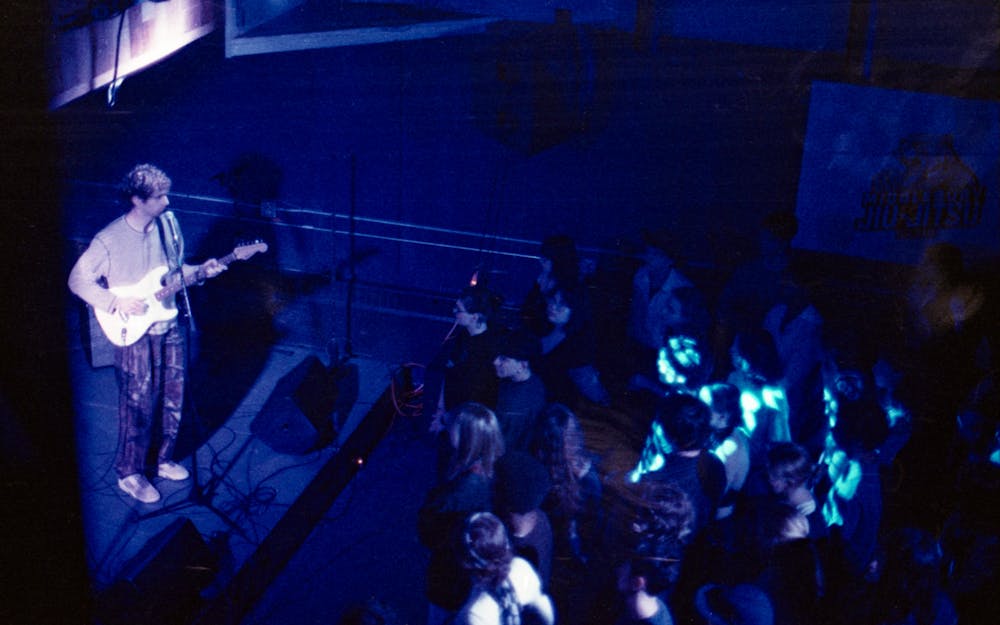
Middlebury College has long promoted its vibrant music culture, advertising Wednesday Open Mic Night (WOMP), the Nocturne Arts Festival and even its rock-star alums such as the band members of Dispatch. Despite all that, Middlebury's institutional structure makes it unnecessarily difficult for musicians to access equipment, practice spaces or venues. If musicians can’t access these resources, live music ceases and with it a unique opportunity for Middlebury to overcome its social divisions through open, on-campus live music events.
Currently, the college does not support or cultivate the most essential ingredient for a vibrant music culture: access to the resources that allow students to host informal live music events without facing institutional barriers.
Middlebury must reconsider its approach to live music and student-led events. First, the college should streamline access to music resources by improving transparency on how to access college-owned musical equipment and expanding the availability of practice spaces and that equipment. Second, the administration should designate additional on-campus spaces for live performances equipped to handle them without fear of noise complaints, which I’ve seen often preemptively shut-down both registered and unregistered events.
While the post-pandemic “music explosion” sparked a renewed enthusiasm for live music performance at Middlebury, our one weekly open mic night does not address the demand for more casual, music-centered social gatherings. WOMP attracts a musician-heavy audience already predisposed to seeking live music. For a campus as academically rigorous as Middlebury, a Wednesday evening that might conflict with academic and extracurricular events cannot be the cornerstone of its music scene. Instead, the college must address broader institutional barriers that stifle the creation of a dynamic, inclusive and student-led social culture independent from any one club, sports team or organization.
The root of the problem lies in access. Musical equipment is expensive, and most students depend on institutional resources to practice and perform, which is no small feat. Middlebury Music United (MMU) — the campus club responsible for managing the Freeman International Center (FIC) upstairs practice room and basement studio, access codes and equipment with Middlebury facilities — lacks a functional online presence. It often relies on periodically scheduled meetings via GroupMe, limiting access for students with busy schedules or competing commitments.
The college is trying to limit access to spaces such as the FIC by ensuring students know how to keep equipment damage-free when entering a space filled with fragile, expensive equipment. However, students should not be afraid to lose access to drum kits and XLR cables that may have already been damaged before we even stepped on campus. Perhaps the best example of this looming threat by the school system lives through the message written above the drum kit in the Mahaney Arts Center music practice room that announces: “If anyone breaks this, we will not replace it.” While there should be consequences for intentional and irresponsible mismanagement of equipment, something as trivial as one student accidentally breaking a snare drum should not mean the rest of the student body also loses access to the drum kit.
Another issue is that coordinating with Facilities Services to secure equipment for live performances often prompts objections from Events Management, who are often wary of unsanctioned events. Many students abandon their idea for an informal, spontaneous event entirely rather than deal with these bureaucratic complications. Students are hesitant to organize events outside institutional norms due to the potential for public safety interventions, noise complaints, and when hosting off-campus events, the possible ensuing fines that come with noise complaints.
“I feel super lucky that I have had the opportunity to play live shows at Middlebury and each one has been an absolute blast. But, I do wish that the process to rent out equipment and practice rooms was more streamlined and equitable for all who want access,” Levi Goldberg ’26.5 wrote in a message to The Campus, when asked about his experience playing live shows at Middlebury.
Another significant barrier is the scarcity of suitable spaces for live music. The town of Middlebury's off-campus noise ordinance, which begins at 11 p.m. on weekends, discourages outdoor performances. To prevent disturbances to the residents of Middlebury, students should be able to host on campus, however, only roughly seven indoor venues can technically host a band without generating noise complaints, and only the FIC Bunker and the Gamut Room are readily equipped for the typical rock-band with equipment such as a PA, amplifiers, microphones, cords and mixing boards. These limited options exacerbate logistical challenges, forcing students to compete for space and time slots while contending with public safety's strict enforcement of noise policies.
There is a glimmering bright spot for the future of Middlebury’s music scene. WRMC hosted a Student Battle of the Bands this past Saturday night in the FIC Bunker. The event last Saturday showed that Middlebury not only has a musically talented student body, but also has the capability to host inclusive and interesting events with the help of input from student organizations.
By empowering students to organize and perform without undue restrictions and easy-access to equipment and readily equipped venues, the college can transform its music culture into a genuinely inclusive and dynamic part of campus life: one where bands can play not just for themselves but for the enjoyment of the entire community. If Middlebury wants to attract and maintain an artistic and well-rounded student body, we need to provide an outlet for people to socialize through music. There is no better way to achieve the culture Middlebury claims to strive for than through live performances.
Curran Amster '26 (she/her) is an Editorial Board Director.
Curran Amster is an International and Global Studies major at Middlebury College, concentrating in Spanish with a minor in Religion. She is a Rohatyn Global Fellow at Middlebury’s Rohatyn Center for Global Affairs and is currently working on her senior year thesis. Outside of academics, and her work for the Campus, Curran is also a musician and a songwriter and loves performing with her bandmates, dancing with Middlebury’s RIDDIM World Dance Troupe, and singing with the Mischords A cappella group.
