
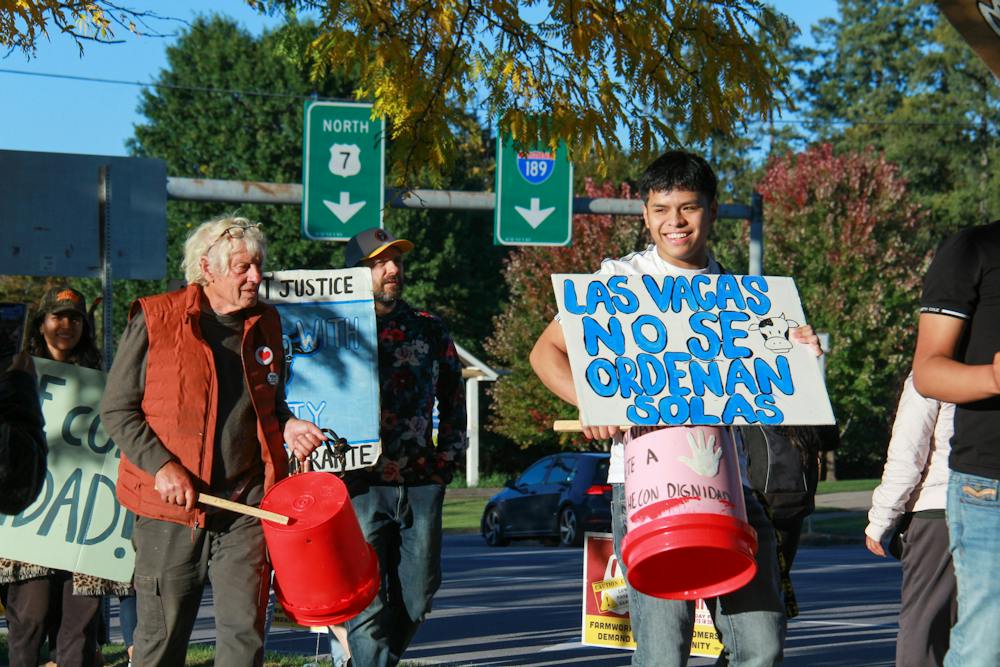
On Oct. 3, Migrant Justice celebrated the nine-year anniversary of Ben & Jerry’s joining the Milk with Dignity (MwD) Program through a picket at the South Burlington Hannaford on Shelburne Road. Through Spanish and English chants and handmade signage, dozens of protestors urged consumers to not cross the picket line and instead support farmworkers that are calling for an end to labor abuses by the Hannaford dairy supply chain.
“Today is essentially about demonstrating that Milk with Dignity exists and works, and showing that there is an opportunity for Hannaford to follow in the footsteps of companies like Ben & Jerry’s,” said Migrant Justice organizer Abel Luna.
Each anniversary not only marks MwD's success with Ben & Jerry’s, but also another year of struggle with Hannaford since the campaign began in Oct. 2019. Since then, Migrant Justice has compiled over 75 pages of documentation of abuses on dairy farms in the supermarket corporation’s supply chain. Luna explained to The Campus exactly how MwD works.
“We wanted a program where there would be genuine consequences and an enforcement mechanism. Milk with Dignity is a solution to these problems while also incorporating education. There is also a third-party monitor to oversee Ben & Jerry's farms and to ensure rights are respected. It has a code of conduct created by the workers themselves … and an economic distribution system that provides better income for the workers," Luna explained.
Ronaldo Carballo Hernández, a picketer and migrant farmworker who works for Allendale Farm in Vergennes, spoke to The Campus about how this broader Vermont social movement for fair labor rights has influenced his workplace.
“It’s important to picket because it puts pressure on companies [where we work]. If they mistreat and overwork us, Migrant Justice calls them out. And because we are many, the companies don’t have any other option than to give us more work, higher wages and better housing,” Carballo Hernández remarked.
Carballo Hernández also highlighted how undignified working conditions at his farm improved when Migrant Justice MwD stepped in.
“We were living among rats and bedbugs — it was awful. The ranch gave us a separate little house but it was in really bad shape and very neglected. Thanks to support from Migrant Justice [half a year ago], [the farm] has been providing us with food supplies, washing machines, work clothes, and the like,” Carballo Hernández explained.
A 2024 Migrant Justice survey of over 200 migrant dairy farmworkers in Vermont revealed that 95% work six to seven days a week; 87% receive less than Vermont’s minimum wage of $13.67/hour; 77% have suffered work-related health problems; 82% report issues with employer-provided housing; and 53% report discriminatory treatment.
Benjamín Lucas García, a participant at the picket and a New Haven chicken-farmworker, told The Campus that working conditions across the state vary, often by industry.
“We [at the chicken farm] have housing and jobs, so we’re fine. I do see that in some dairy farms, workers don't have dignified housing and the work is much harder … Many also work the night shift. I suppose night work is inevitable, since the cows still have to be milked,” Lucas Garcia said.
“They really need things to improve — that work is grueling,” Lucas Garcia added.
Rowan Cleary ’26.5, member of the student group Migrant Justice at Middlebury, told The Campus why physically showing up at the picket with other Middlebury students was important. Migrant Justice at Middlebury operates as a solidarity network that supports Migrant Justice Vermont.
“[Farmworkers] aren’t a workforce that's separated from us. They’re our neighbors,” Cleary said. “It benefits everybody to know that the products that you're buying aren't supporting abusive or exploitative practices — that your neighbor can be living in conditions that are the conditions you'd like to live in.”
Protestors approached Hannaford from their starting location on the corner of Shelburne Street and Route 7 and marched through the line of Hannaford private security to the store entrance. Police officers and Hannaford staff guarded the doors while police cars were stationed in the parking lot.
Lucas García summed up why he came out to the picket.
“I’m here to support the community, to keep on improving our housing and employment, so that we can be a little bit better off. There is still a lot to improve.”
The picket featured speeches by members of the Coordination Committee, ten farmworker leaders who organize and lead regional farmworker assemblies. Full-time Migrant Justice staff, like Abel Luna, and allied movements in Vermont also spoke. The night ended with more speeches, home-cooked tamales, hot chocolate and a birthday cake for MwD.
The American Federation of Teachers, AFT, highlighted cross-sectoral worker solidarity in Vermont and how they recently authorized a strike against the University of Vermont Medical Center (UVMMC). The Vermont Coalition for Palestinian Liberation, VCPL, highlighted boycotts of Israeli products and the Oct. 4-10 Shut Down ICE VT week of action.
Throughout the event, speeches and chants targeted Mike Vail, the president of Hannaford Supermarkets, who will be at the Spruce Peak Lodge in Stowe for an executive three-day retreat.
“We invite everyone, including Middlebury students, to come to Stowe on the 14th, 15th, and 16th… Students hold great power, and it would be wonderful to have them stand alongside the workers,” Luna said.
June Su '27 (he/him) is the Senior Multimedia Editor.
June is studying Political Science and Studio Art. He recently returned from studying abroad in Buenos Aires, Argentina, where he also interned at FM La Tribu 88.7. He spent the rest of the summer working as a Environmental Studies research assistant studying Theories of Change in social movements. In his free time, he is growing white hair over Spanish and Mandarin Chinese, painting and photographing his friends, and fumigating his apartment with stir fry fumes.


