
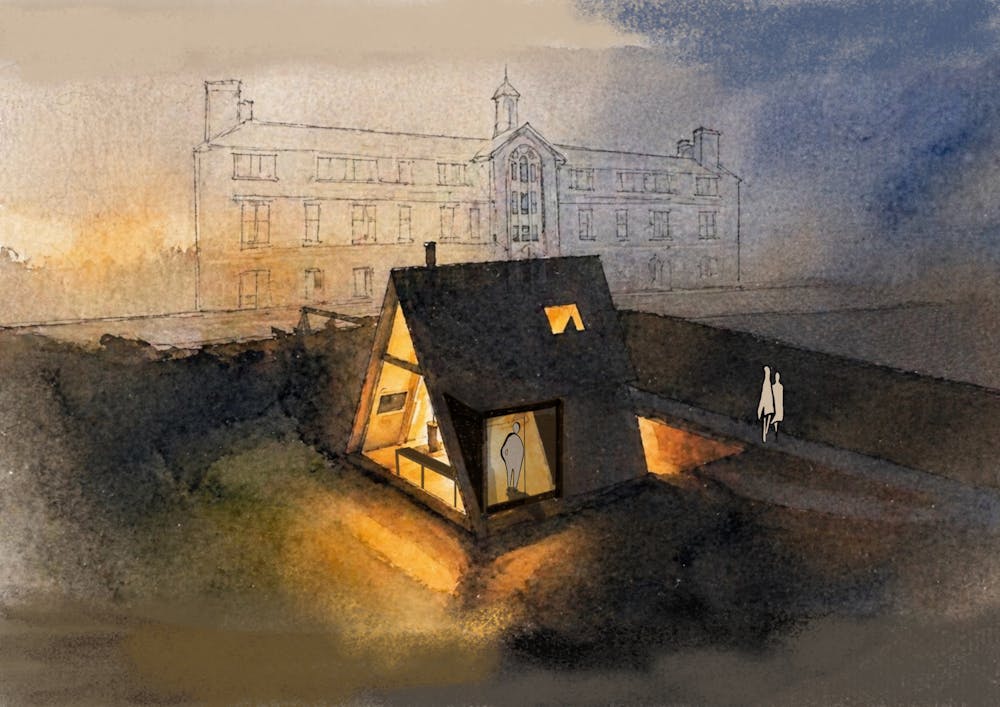
On Monday, April 27, the project to construct a pavilion on Battell Beach received the go-ahead from administrators to enter the next phase of design development and construction documentation. It marks a milestone in the development of Battell Park.
The pavilion was designed by students Benji Sindell ’26, West Currier ’26.5 and Henry Heilman ’26 with the support of Makerspace Manager Daniel Houghton ’06 over the course of this spring semester.
“This winter, I was presented with an awesome opportunity in the form of a question: ‘Hey, would you and some students consider designing a pavilion for Battell Beach?’” Houghton said in an interview with The Campus.
The interested group was Middlebury’s Center for Health and Wellness (CHW), which received a donated endowment of $4.9 million, designated by former President Laurie Patton for student mental health. On top of current developments at Battell Park, interest generated from the endowment has allowed the CHW to host wellness days with guest facilitators, hire an additional counselor and expand financial support for its internship program.
“We hosted several sessions for students to come in and give input on what they'd like to see,” Director of Counseling Tammy Austin said in an interview. “What students kept coming back to was ‘space to be.’”
“One of the resounding things we heard from students is that community mental health, to them, was not about more counselors or more clinical services. It was about spaces to gather — organically and in planned ways — and to be outside,” Barbara McCall, associate vice president for student health and well-being, added.
In its current design concept — still subject to change — the pavilion features a sheltered space with seating, a fireplace, and a sunrise-facing deck that could serve as a performance space.
Project leaders used words such as “gathering,” “playful,” “refuge” and “prospect” to describe themes that went into designing the pavilion.
“It’s just somewhere I’d want to be,” Heilman said. “I just think it’d be a nice hangout spot.”
The design was informed by student opinions gathered from a survey that yielded over 100 responses, posted on different campus bulletin boards.
Additionally, “The Beacon,” a student-built installation, was exhibited at the campus arts festival Nocturne, where visitors could provide feedback on pavilion designs in person or via a separate QR code.
Generally, student responses favored a space for hangouts and studying, a fireplace and a performance space in a post-and-beam style structure.
Student involvement will follow the process through its actual construction.
“Students are going to construct this,” Houghton said. “I think it will be a thousand times more meaningful to see it built with the work of students rather than mysterious professionals that helicopter in and get the job done.”
Incorporating hands-on building into a liberal arts education is central to the philosophy of the Makerspace.
“I think the mindset here at Middlebury has traditionally been that building and doing things … is not an intellectual endeavor,” Sindell said. “The Makerspace is an attempt to really emphasize what learning is with your hands.”
“There’s something extremely satisfying about having an idea and bringing it to life in the real world,” Currier added.
Designers also hope to pay tribute to Old Battell, which is set to be replaced by a new museum, by repurposing elements of the building in the pavilion’s design, such as its slate roof and marble.
The project is part of a broader development on Battell Beach, building off of an independent study by architecture student Mica Bodkins ’26, which drafted a plan for Battell Park. The next phase of the plan, featuring permanent hammocks and a “serpentine” table, is set to be completed soon and will add to the existing swing set and lounge chairs installed in the park’s first phase.
As the warm weather sets in, the park has already seen much traffic from students.
“We literally saw students coming down off the hill, getting on the swing, doing a few swings, and then going upon their day,” Austin remarked. “[It’s] super fun to kind of see the park live in action being utilized but also know that it doesn't take organizing an event. It doesn't take kind of the structure of ‘I have to set aside a full hour.’ That literally can be as you're passing through."
The CHW is also exploring the possibility of incorporating pocket playgrounds like Battell Park around campus, albeit on a smaller scale, according to McCall.
“What if one of those serpentine tables showed up, or there was just a cluster of three hammocks outside Stew," McCall said. “All of a sudden there are really varying size and shaped places where people could gather year-round.”
Student designers expressed appreciation for the support they had received from the administration regarding the project being greenlit and taken to the next stage.
“I think it's kind of special as a student to be taken seriously by [administration] at the end of the term,” Heilman said. “I certainly had my fears deep down that the response would be, like, ‘this is ridiculous’... But it was the complete opposite of that.”
“I think [the greenlight] is a reflection of the work that we put into it. I think we were taken seriously, but also we took this endeavor seriously,” Sindell added. “We made our project legitimate through that work and that effort.”
“It's been satisfying seeing how much the administration responds to student interest to act on something I think, though it might not always seem that way, if you are a Middlebury student who wants something to happen and is willing to work for it, there are people here who will support you with that vision,” Currier remarked. “It's just about going out there, getting your hands dirty and giving it a shot."
The project is now moving into the design development and construction planning phase before entering an 18-month permitting process covering fire safety, Act 250, and groundwater approvals.
“I’m looking forward to when new students arrive and [Battell Park] is just part of Middlebury,” McCall said. “It’s exciting to talk about the actual implementation phase … but soon it’ll just be like it’s always been there.”
Met Ly '28 (he/him) is a News Editor.
Met is a UWC Davis Scholar majoring in International Politics and Economics with a Creative Writing minor. He is also a fellow at the Rohatyn Center for Global Affairs. He hails from Siem Reap, Cambodia and spent his gap year there as a digital marketing manager and events coordinator. Outside the newsroom, he line dances in his cowboy boots and jams out to the Arctic Monkeys.


