
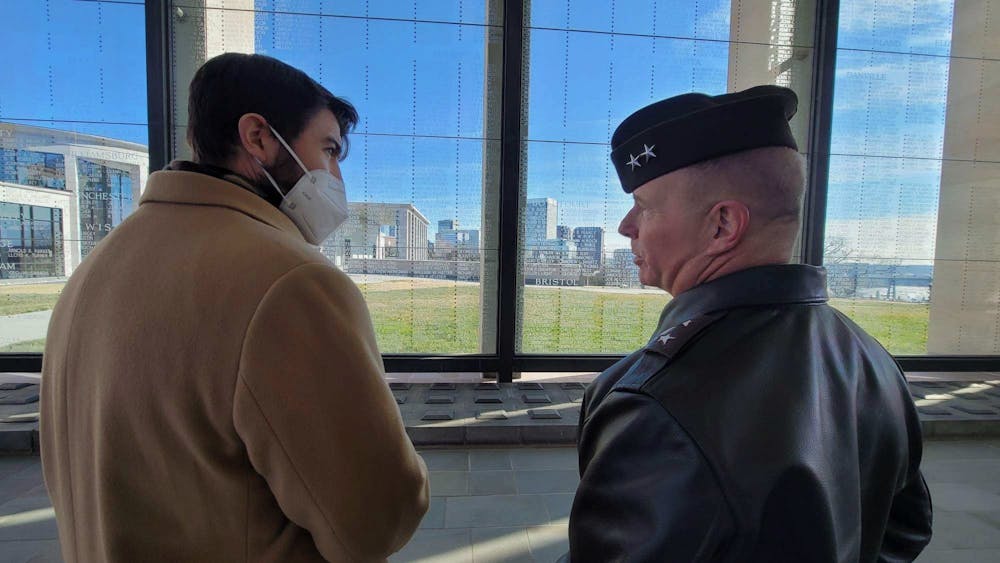
Connor Williams ’08.5, a current lecturer and first-year seminar instructor at the college, has taken a roundabout path back to Middlebury. Before returning to his alma mater to teach during the 2025 J-Term, Williams served as lead historian for Congress’ Naming Commission. In that role, he spent 2021 and 2022 researching American military figures as the commission worked to rename nine U.S. military bases that had previously commemorated Confederate soldiers.
Congress established the Naming Commission in 2020 following nationwide protests after the murder of George Floyd. The decision was bipartisan, though the renaming initiative was partially reversed by President Donald Trump in 2025. As lead historian, Williams spent 20 months traveling across the country, meeting with military personnel and community members to help compile a list of potential new names.
“The seminar experience [at Middlebury] where we had to read different viewpoints, where we had to read dissenting views and find our way through them, that prepared me really well both for grad school and working for Congress,” Williams said in an interview with The Campus. “I was aware that there wasn’t going to be any right answer.”
Williams has since published two books on his experience with the commission, one of which was released earlier this year. He has taught the J-Term course Catastrophic Memories for two years and began offering it this spring as a first-year seminar for Febs.
Williams arrived at Middlebury with a strong interest in history and eventually majored in the discipline. However, he said the most impactful part of his Middlebury education was not simply the knowledge he gained, but learning how to apply it.
“I never knew what to do with that knowledge until professors showed me and my peers how to think critically and how to use knowledge for the betterment of the world,” Williams said.
Rehnquist Professor of American History and Culture Jim Ralph taught Williams’ first-year seminar, Domination and Resistance, and continued to advise him during his sophomore year. In 2006, Williams joined Ralph as a research assistant on a project commemorating the 40th anniversary of the 1965–66 Chicago Freedom Movement.
“When I have an opportunity to engage undergraduates with that kind of work, I like to, because that’s part of the Middlebury experience,” Ralph said in an interview with The Campus.
During his time as a student, Williams wrote extensively on American history. As a first-year student, he researched the status of Native Americans, and he later wrote his senior thesis on the assassination of President James Garfield. Although Williams initially planned to go directly to graduate school and pursue a professorship, Ralph encouraged him to gain teaching experience first.
“You might have to be creative with what you learned and accomplished through your training to be a professional historian,” Ralph said. “I think back to Connor, it’s been interesting because that advice actually played out.”
Williams graduated in Feb. 2009 and went on to teach high school history before enrolling in Yale’s graduate program, where he earned a Ph.D. in 19th-century American history. He said the extensive writing he completed at Middlebury, including his junior and senior theses, prepared him well for careers in Congress and trade presses.
“One of the two naming chairs had an expression that ‘Whoever writes first wins, and that only works if you write well,’” Williams said. “Middlebury really taught me how to write effectively across many different genres.”
Williams said his work with the Naming Commission also required a high degree of bipartisanship. The commission met with military personnel, local officials and groups such as the Sons of Confederate Veterans while researching possible base names. In conversations with community members, commissioners often asked a simple question: “What do you think a hero is?”
For Williams, the experience reinforced a skill he first developed at Middlebury — listening.
“I knew how to be patient during these conversations,” Williams said.
Ralph commended Williams’ ability to communicate well to the average American, a skill that allowed him to relay key facts to those he met with during his time as lead historian for the Naming Commission.
“It’s so important in our democratic republic that we have people who are drawing on their expertise, but then can distill it in a way that is accessible to ordinary citizens,” Ralph said.
During the renaming process, Williams and other commission members visited each base, spending entire days meeting with commanders, officers, enlisted soldiers and local leaders. The commission also launched a website that allowed members of the public to submit potential names for the installations.
At one point, Williams attended a lunch with reenactors of the 54th Massachusetts Regiment, one of the first officially Black regiments in the U.S. Army during the Civil War.
“Although they all had different views, they were speaking from a place of optimism on what America should be, and how it could be that,” Williams said.
Williams ultimately presented the commission with a list of 87 potential names. Commissioners unanimously selected a diverse group of honorees, including the only woman ever to receive the Medal of Honor and a Black soldier who served during World War I.
Since completing his work with the commission, Williams has returned to the college to teach during J-Term and as a first-year seminar instructor. He also continues to serve as the Naming Commission’s historian of record and works in public history as staff historian at Great Camp Sagamore and with The Nantucket Project.
“Here in the history department, we’re very proud of Connor, of his success and accomplishments, and we’re glad he’s able to enrich our community and teach our students,” Ralph said.
Williams’ first book about his experience on the naming commission, which came out Nov. 2025, received acclaim from accomplished war documentarian Ken Burns. He is delivering a lecture about his second book on March 17.
Kai Arrowood '29 (he/him) is a News Editor.
Kai previously served as a staff writer. He is a prospective English and Sociology joint major. Aside from The Campus, Kai is a copy editor for Middlebury Geographic and an avid participant in National Novel Writing Month.


