
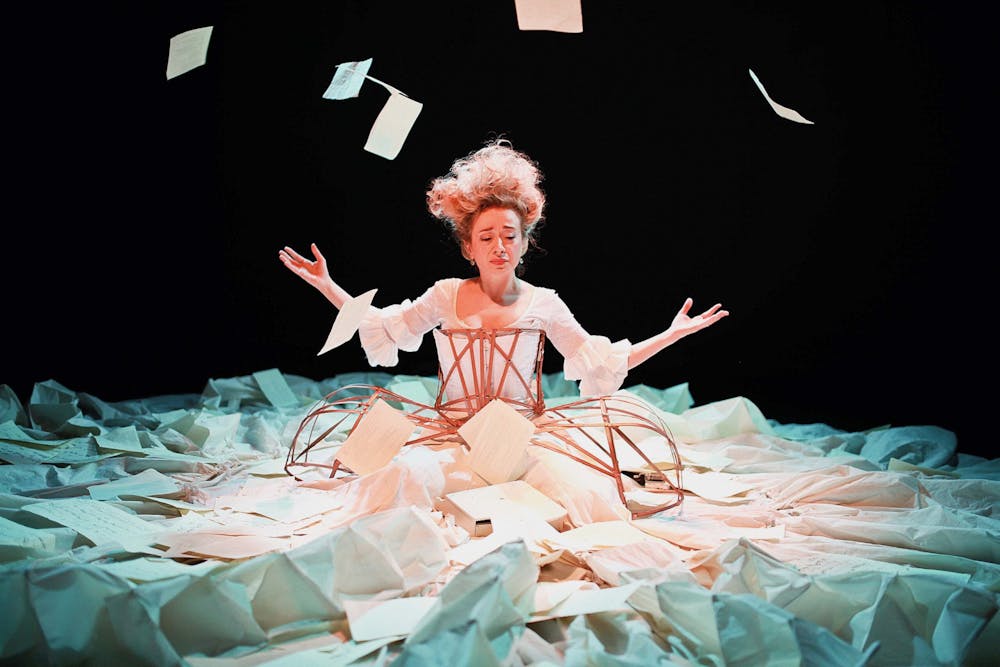
A vast white gown spilled across the stage of Wright Memorial Theater this past Friday, introducing audiences to the forgotten prodigy of the Mozart family with“The Other Mozart.” The play, written and performed by Sylvia Milo and directed by Isaac Byrne, features a striking 18-foot dress by Magdalena Dabrowska and an evocative soundscape by Nathan Davis and Phyllis Chen. It is a one-woman show reclaiming the life of Maria Anna (Nannerl) Mozart, Wolfgang’s gifted elder sister.
An off-Broadway success at HERE Arts Center in New York and London’s St. James Theatre, the production continues to tour nationally and abroad. As the program detailed, it has been staged in Austria by the Mozarteum Foundation inside Mozart’s own apartment and in Vienna at the Mozarthaus on Domgasse — venues steeped in the composer’s history.
The play unfolds as an extended conversation between Nannerl and the audience. It is composed of only one scene, one character and one set: a monumental dress.
Within the circumference of the dress, Nannerl (Sylvia Milo) recounts to us her story ever since her first encounter with the harpsichord: her love and talent for music, the end of her musical career due to her adulthood, her unfortunate late marriage, and her intertwined fate with her little brother Wolfgang Mozart. The abrupt end to her music career began her life-long melancholy, where she could no longer perform in the public and had to rely on Wolfgang’s potential career success in Vienna.
“She could not lose her reputation by being paid to play. God forbid it,” Sylvia Milo said at a theater department lunch before the show on Friday. “It would be prostitution for women to be paid by playing music.”
The play keeps its focus squarely on Nannerl: she is both the only character and the sole storyteller. Milo recalled how that choice evolved.
“At first I wanted it to be Mother and Nannerl, but then I really wanted her to talk directly to the audience — without the fourth wall, without going back in time — to have her come here and speak,” she said.
Performing the role herself, Milo felt an almost urgent need to deliver Nannerl’s voice.
“I realized she really wants to talk. I had so many words that needed to come out. It was an incredible experience. It seems Nannerl was like this too — she just needed to say it all,” Milo said.
This urgency drove Milo’s research; She worked with different primary sources and letters, trying to piece together a full picture of Nannerl’s life. However, this process proved challenging due to the scarcity of sources documenting Nannerl.
“I could barely find any words about her in Wolfgang’s biography,” Milo said.
In the production, much of the script is lifted from the Mozarts’ family letters — yet strikingly, few of the women’s letters survived. Even worse, although Nannerl has composed several pieces of music herself, none of these manuscripts endured.
“Our job was to write original music into this silence,” sound designer Nathan Davis said. “The composer’s own work was lost.”
A lot of efforts were made to create Nannerl’s musical world. Davis and Chen built a soundscape meant to spark Nannerl’s imagination without imitating it.
“We want to be sure we won’t compose anything that would be mistaken for Nannerl’s music,” Davis said. “Instead, we use instruments like music boxes — we know the Mozart family had one — along with clock chimes, bells, teacups and hand fans, all objects that might have captured her imagination as a young musician. Sylvia tries to write music of potential, imagination and wonder — to start the conversation.”
The set itself carries symbolic weight. The 18-foot dress serves as young Nannerl’s playground in the first half of the show, where she leaps and twirls like a ballerina within the vast hemline; after her marriage, she becomes confined inside it, transforming the gown from a stage into a cage.
“It was her world,” Milo said about her design behind the prop. “It has to cover the stage, to take space, and be ‘the dress’ — which is the beautiful thing and also the restraining thing. At the time, the fashion was so marvelous, grand, and luxurious, but it was so restrictive for women.”
For many in the audience, “The Other Mozart” is their first encounter with Nannerl. We saw her curiosity, her dreams, her disparity and resilience.
“I think it’s pretty authentic, especially in the way it reveals Nannerl’s negative emotions instead of portraying her as a perfect protagonist or a victim,” Yuzhuo Wang ’28 said. “We can see her strong obsession with music, praise and fame — all are natural human desires that we could emphasize."
In this transcendence of time, Wang was deeply touched by the relationship between Milo and Nannerl.
“A female artist of today steps into the silence of another from centuries past — and in that space between time, the story unfolds in tension, introspection, and empathy,” Wang contemplated, “I’m left with so many questions for Sylvia: How does she understand her relationship with Nannerl? At what point does she become Nannerl, and when does she feel as though she’s in conversation with her?”
As the music and lights faded, Nannerl stepped back, her 18-foot dress trailing behind her as if carrying the suffering, prejudice and restrictions of her time. Her genius and compositions may remain a mystery, but her story is finally told. The audiences will remember Nannerl — the other Mozart.


