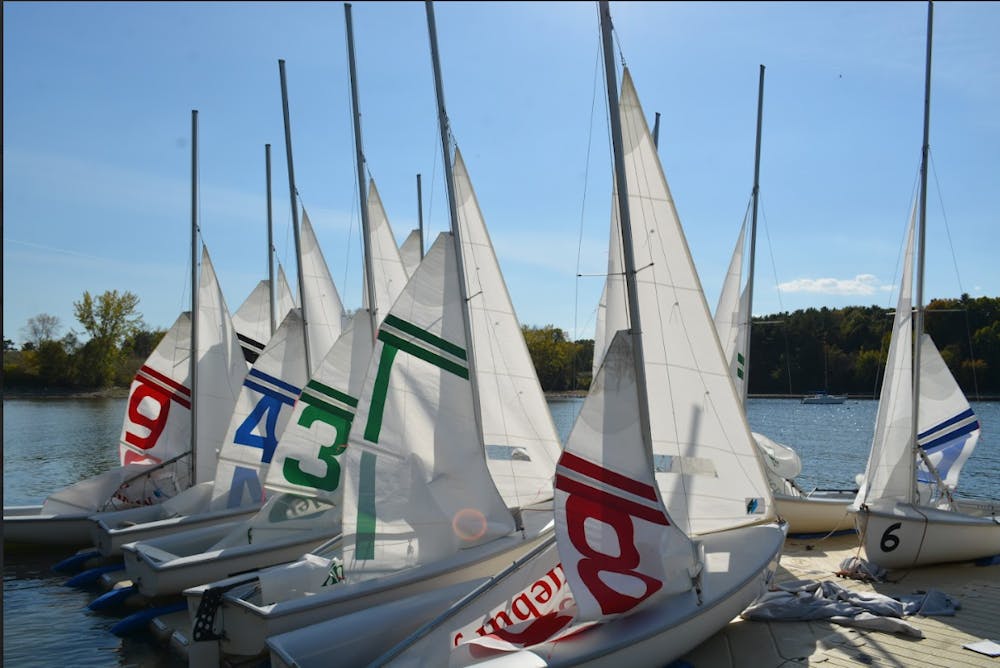
Swing left off Vermont Route 22A just shy of Vergennes, zigzag between old homesteads and silos along dirt roads and soon you will be tumbling towards Lake Champlain. Drive a little further and you will find a brown boathouse adorned with a blue pennant: the home of the Middlebury College Sailing Club.
On Saturday, Oct. 4, Middlebury hosted the 10th edition of the Stuart Walker Trophy, the college’s annual home regatta. This year’s event saw UMass Amherst, the University of New Hampshire, Williams College and Middlebury’s team competing on the lake.
Eight knots of wind blew across Lake Champlain on Saturday morning, an adequate breeze for racing. In ideal conditions the A and B fleets of each team compete separately, with each respective fleet of boats sailing three times. Crucially, three full races are required for the results of the regatta to count for conference standing. Knowing that the wind was likely to weaken later in the day, the race organizers combined the fleets for the first two races.
Middlebury entered three teams, each with their own A and B fleets — six boats in total. Middlebury’s first team A fleet, led by skipper Benson Chiles ’26.5 and crew Isabelle Vagell ’26.5, won the first two races among the 12-boat field.
A winning partnership of this sort demands strong chemistry and communication between sailors. The skipper, responsible for steering and trimming the mainsail, must work in tandem with the crew, the sailor at the front of the boat who handles the jib, dictates speed and controls boat balance. What’s also special about the boat pairings is that they are co-ed, making sailing one of the few collegiate sports in which athletes of different genders compete together.
By the third race, though, there was little to no competition. As forecasted, the wind had died down and the sails of each boat now draped undisturbed. While towing the boat of Middlebury’s earlier winning duo back to the dock, Vagell explained the team’s next steps.
“We’re gonna go back in and wait for about an hour and see what happens,” Vagell said. “Here we either have a lot of wind or no wind, and not very often in between.”
A frustrated wait ensued. The crucial third race was put on hold, resting at the mercy of the waning wind. Back on shore, though, the atmosphere did not reflect that of a regatta facing a premature end and voided results. Smoke billowed from a grill; hamburgers, chips, vegetables, cider donuts and homemade Middlebury sailboat-shaped sugar cookies sat spread out on a table; and sailors from each team treated themselves to the feast.
The cookout was more than a nice gesture by Middlebury parents and alumni, though. It was symbolic of the broader ethos of Middlebury’s sailing team.
“None of the other teams really do a big barbecue like this, so we try to stand out and be the friendliest regatta,” Toby Jennings ’28 said.
Vagell echoed that.
“We try and be one of the friendliest teams in our league, if not the friendliest… we have more team friends than team rivals,” she said.
The friendliness extends to the water, where Middlebury emphasizes fair sailing. Jennings explained that “the main rule is no contact between boats,” but if a collision does occur, the offending team must acknowledge the incident and do two penalty spins before proceeding. However, if the sailors believe the contact was not their boat’s fault, they can file a protest after the race.
“I think there’s a balance between resolving things on the water and being a good sport … but also if someone does foul you, you should call them out for it,” Aric Duncan ’27.5 said, alluding to the hearings that can occur after a race to address boat contact. Resembling a court trial, sailors protest to a committee boat immediately after the race. Both teams involved submit documents describing the incident, witnesses are called and the coaches from all teams ultimately reach a verdict.
Competitors generally avoid escalating to a hearing, especially at a friendlier regatta like the Stuart Walker Trophy. Resolving disputes on the water is the preferred means of justice, and opposing sailors trust each other to follow an implicit honor code while racing.
After all, who would want to be that guy at a venue like Middlebury’s? The tranquility of the Arnold Bay entrance to Lake Champlain coupled with the pensive Adirondack Mountains spanning across the horizon tends to discourage disagreement.
“What we like to say, and I think a lot of people agree, is that we have one of the prettiest venues in college sailing,” Duncan said.
Middlebury is lucky to have such a venue given the spectrum of sailing conditions it can offer: high and low winds, choppy and still water, and a range of sailing routes. Lake Champlain is a prized location, and still has enough water to sail amid the current drought, a privilege some colleges lack.
Possibly most meaningful, though, are the personal and athletic connections that form out on Lake Champlain.
“I think [sailing] is probably one of the sports where you’re most in tune with the natural world. You’re just harnessing the water, harnessing the wind, and using that to help you make decisions to win,” Duncan said.
This reality of the sport also means that sailors are particularly at the whim of nature, and on Saturday, the regatta officials eventually called the competition early after the wind ceased to cooperate. Far from expressing regret, though, the sailors, parents and regatta committee did not mind. It seems most days at Middlebury’s Panton, Vermont sailing pavilion are days well spent.
Simon Schmieder '26 (he/him) is a Senior Sports Editor.
Simon is an avid runner and biker and enjoys spending time outdoors. He is a philosophy and political science joint major with a minor in German, in addition to being a Philly sports fan.