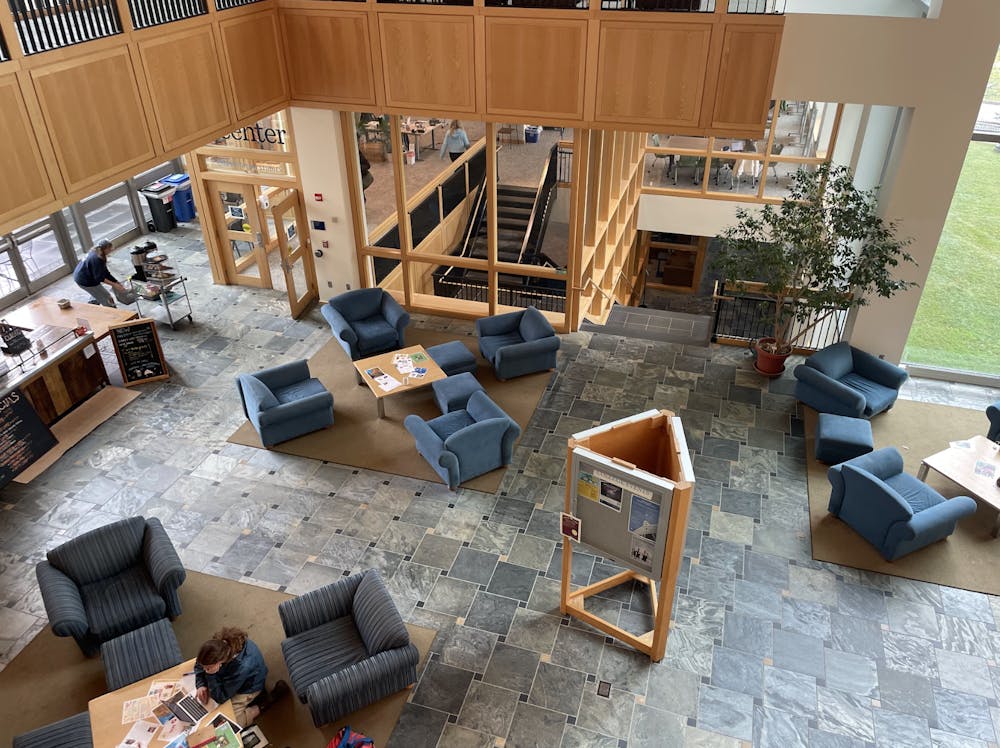
As the Armstrong Science Library in BiHall closed last fall, the Quantitative Center (Q-Center) was implemented in its former space, welcoming STEM students to a collaborative study spot. Meanwhile, the project of relocating Armstrong’s collections presented difficulties for librarians, a challenge that may resurface when items from the Middlebury Institute of International Studies at Monterey (MIIS) will have move to Middlebury’s campus after its closure.
The renovation was a heavy lift for library staff, according to Special Collections Outreach Specialist Mikaela Taylor, who wrote an article about Armstrong’s legacy. Armstrong originally housed 100,000 volumes, including maps and government documents, though that number had been reduced to 40,000 by the start of renovations. From fall 2024 to Jan. 2025, librarians weighed what to keep and what to get rid of while facing staff shortages.
With the help of faculty, they reviewed how many times and how recently each item had circulated. If a book in the library had held for over 10 years had only been checked out once or twice in the past decade, it went under consideration for the chopping block. Most books that had been acquired in the past decade were kept regardless of circulation numbers. By the end of the delegation, only 20,000 books remained. Others were donated, recycled or sold to Better World Books, a third-party vendor and nonprofit.
Librarians had to take careful measures when it came to Armstrong’s collection of government documents and maps. Strictly following government policies, government documents were either deaccessioned or moved to the Davis Family Library.
Preservation Manager Joseph Watson coordinated the sale of flat map cases to historical societies, libraries and nonprofits. Outdated topographical maps, many already digitized, were offered to academic departments, antique stores and the public. Those that could not be reused were recycled.
By Oct. 2024, circulation specialists determined that Davis’ lower stacks could house much of the collection, and over two months, thousands of books were shifted to create space. The college hired a moving company to transport the collection, while Circulation Specialist Todd Sturtevant polished up the stacks, establishing a temporary holding place in the Davis lower level. Over the next year or two, Sturtevant will manage the integration of items in the Armstrong collection into Davis’ main stacks.
The closure of MIIS and the transition of the Arabic, Italian and Portuguese Language Schools from Bennington to Middlebury’s campus in summer 2027 will soon add more pressure to Davis’ already limited capacity. The Armstrong transition came just as Davis had deaccessioned enough material to make space for new acquisitions, but accommodating additional collections will test a staff that numbers only 35.
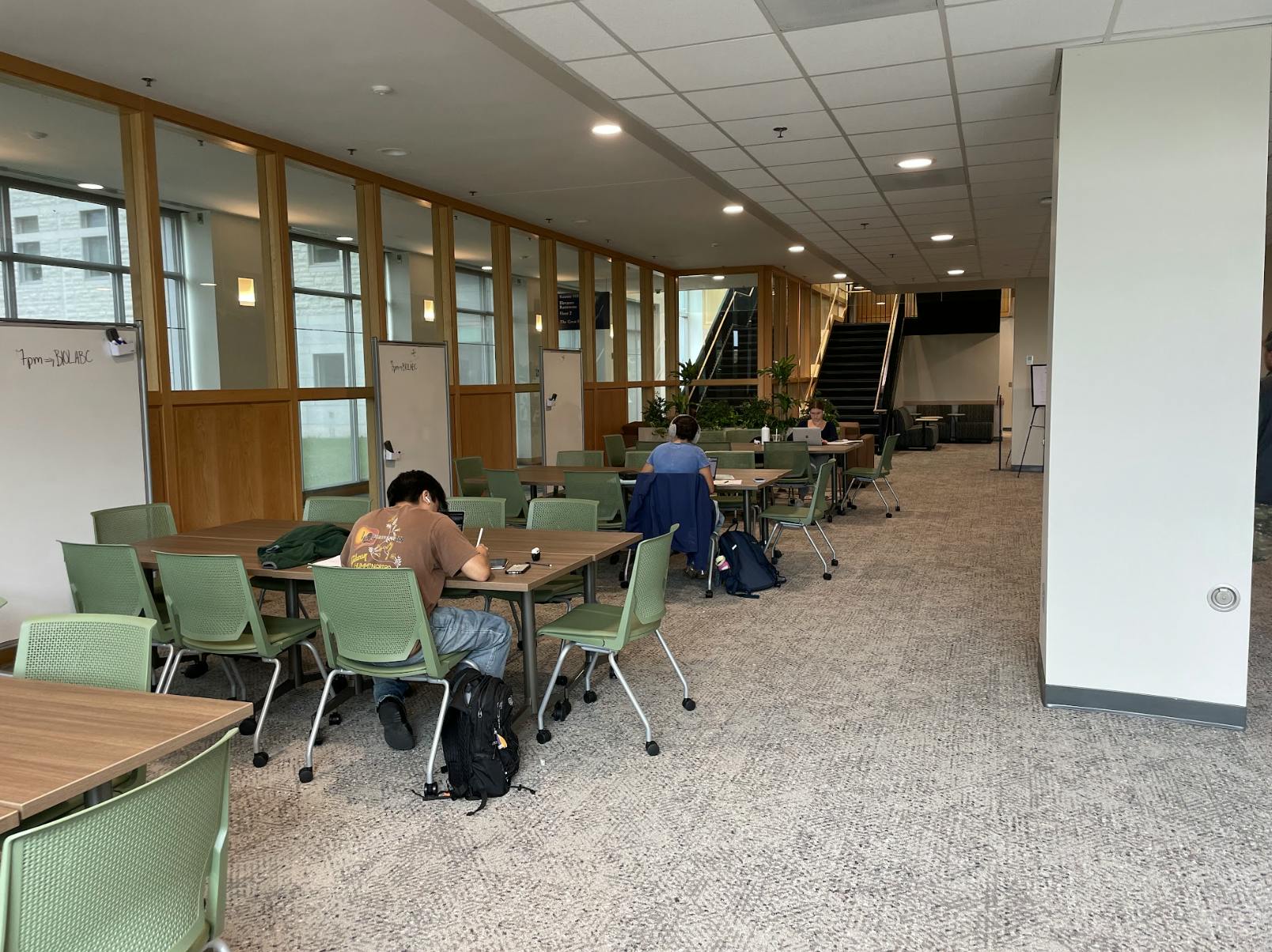
The basement floor of BiHall formerly housed the Armstrong Science Library collections. Renovations over the summer transformed it into a study and tutoring space.
The new Q-Center reflects a broader shift in STEM transitioning to digital research. Over the past decade, students and faculty have increasingly turned to databases for current journal articles instead of browsing Armstrong’s physical collections.
“Science is more of a current-journal-article-type discipline,” Director of Discovery and Access Services Terry Simpkins said. “Books that are 10, 15, 20 years or older have a limited use in a program like ours.”
Libraries have been adapting to the digital age for decades. According to Simpkins, the majority of the library budget at Middlebury goes towards various paid journal subscriptions and databases, outnumbering spending on physical volumes by 10:1.
However, Watson believes that physical objects, especially those in Special Collections, will only increase in value as the world becomes digital.
“The idea of books as an object, not just something you can read, is almost like a work of art in itself,” Watson said. “The way the book is bound, the way it was printed, those things will become more interesting to people.”
The Q-Center now anchors the transition to increasing digital resources, supporting data-driven learning in place of Armstrong’s shelves. They have 80 student tutors, five full-time general quantitative tutors and 10 assistants. Every day students fill the seats at its tables, attending faculty office hours, receiving academic support from their peers or finding time to focus in the former Armstrong reading room, which has remained a silent study space.
“Our faculty and staff benefit from help-seeking, and so do our students,” Q-Center director Lauren Kodonowy wrote in an email to The Campus. “We aim to make the Q-Center ‘the place to be’ if you want to thrive as a learner, user, and teacher of quantitative skills.”
Data librarians work with students on-site, while those in Davis work hard to ensure access to the latest research online. As the question of further digitization looms large, Middlebury’s libraries will have to continue to adapt.
Correction 9/26/25: A previous version of this article stated that if books had not been checked out in over a decade, they were deaccessioned. It has been updated to better reflect that if a book the library owned for more than a decade had been checked out once or no times in over a decade, it went under consideration for deaccession.
Kai Arrowood '29 (he/him) is a News Editor.
Kai previously served as a staff writer. He is a prospective English and Sociology joint major. Aside from The Campus, Kai is a copy editor for Middlebury Geographic and an avid participant in National Novel Writing Month.