
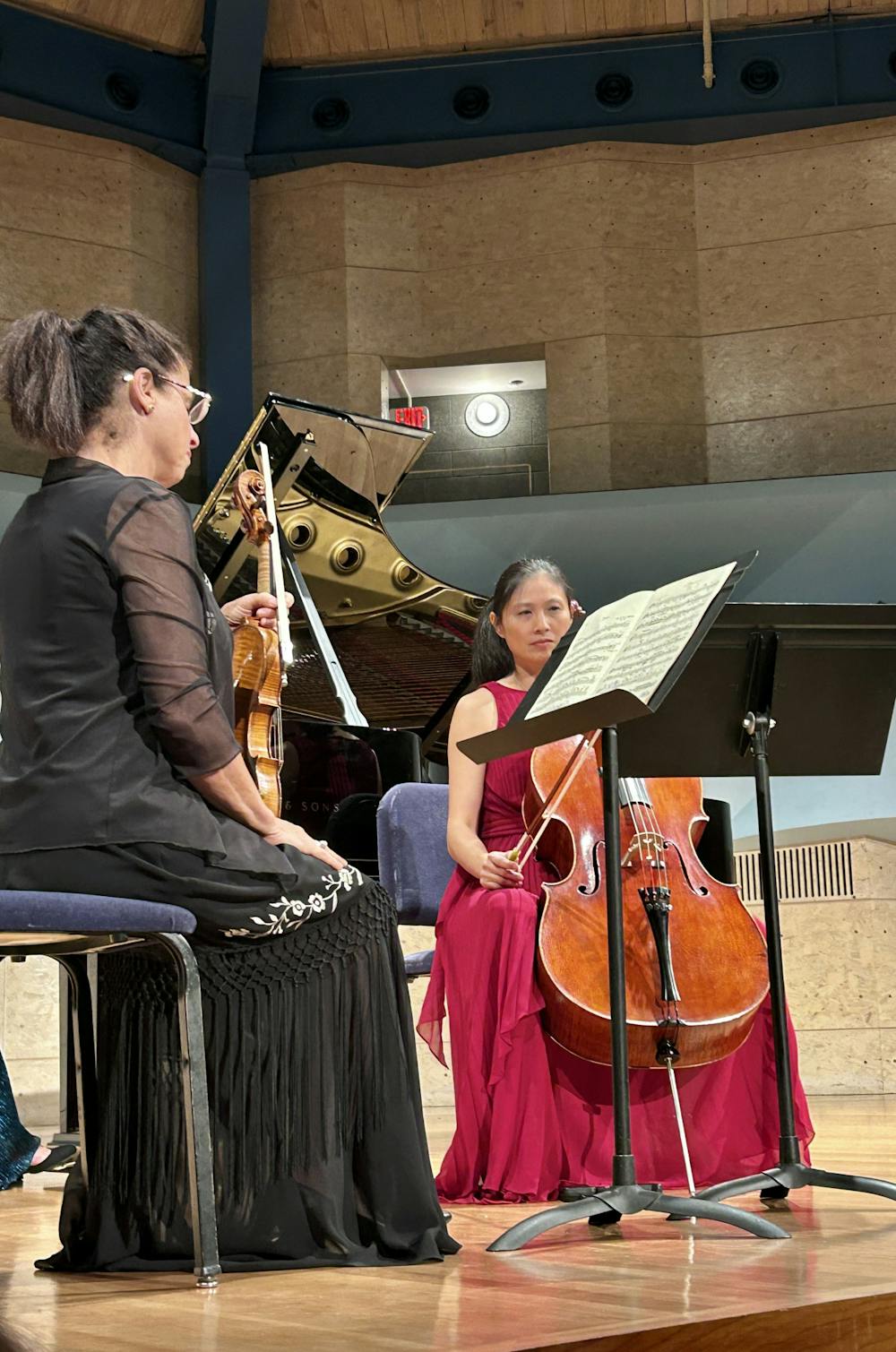
The opening notes of the trio Sophie Shao & Friends pulsed through Robinson Hall, the air charged with anticipation. The three women — cellist Shao, violinist Carmit Zori, and pianist Ieva Jokubaviciute — launched into an evening of intimacy and intensity, the kind of performance where silence carried as much weight as the music itself. This balance of poise and focus reflects why Shao’s presence in Middlebury’s Performing Arts Series has come to mark the start of each semester, and her performance this past Saturday was no exception.
For the 106th season, she designed a program that honored the college’s recently opened “Le Petit Salon” exhibit, weaving together French baroque elegance, pioneering American composition, contemporary innovation, and the sweeping emotion of nineteenth-century Romanticism. This impressive repertoire reflects more than just curatorial skill; it grows from a career marked by international acclaim.
At 19, she received the Avery Fisher Career Grant, one of classical music’s most prestigious awards, and went on to earn top prizes at the Rostropovich and Tchaikovsky competitions while performing at major halls worldwide. Critics praise her expressive range and the dynamism she brings to even the most familiar repertoire. This international reputation made her annual return to Middlebury all the more special: The chance to experience a world-class musician not on a distant stage, but in the intimate setting chamber music was designed for.
The evening opened with Amy Beach’s “Piano Trio in A minor, Op. 150”, beginning the concert with elegance and intensity. The “Allegro” carried a restless energy that surged through the hall, its urgency heightened by the knowledge that Beach composed it at a time when women were expected to perform rather than create. This awareness lent the music an added depth, as if each phrase bore the weight of her determination to claim space within the canon.
The “Lento espressivo” followed with a lyrical tenderness that was contemplative yet unafraid of dissonance. The trio then launched into the “Presto, Allegro con brio” with clarity and vigor that was both exhilarating and exacting. Shao, Zori, and Jokubaviciute each captured the full range of the piece with remarkable sensitivity, giving the quieter moments a luminous stillness and the surging passages a brilliance that seemed to lift the music beyond the page. Their interpretation revealed not only the refinement of Beach’s writing, but also the daring ambition that once startled nineteenth-century audiences and still commands attention today.
From there, the program shifted to François Couperin’s “Concerts Royaux” (1722), a deliberate homage to the French salon culture echoed in the museum’s exhibit. On paper, Couperin’s ornamented miniatures can seem like delicate curiosities; in performance, they became something far more alive. Each phrase shimmered with nuance, the ensemble breathing as though they shared a single set of lungs. Their restraint was its own kind of eloquence, and the hall seemed briefly transformed into a salon of another century, a space where music was less of a performance and more of a conversation.
For me, the centerpiece of the night came from Elena Ruehr’s “Cello Sonata No. 2”, composed specifically for Shao, her close friend. The work created a wholly different landscape, less polished, but wrestling with fragility and resilience. As Ruehr detailed in the performance’s program, her compositions seek to bring narrative and emotion to audible life, an impulse that seemed to resonate in every measure of the sonata.
At times, the cello’s voice plunged downward, heavy with shadow, before rising with a kind of defiance; at others, the piano pressed against it, offering both resistance and consolation. This dissonance between the two instruments felt deliberate; it underscored the unease of holding both destruction and hope, turning the music into a meditation on a world shaped by beauty and decay.
That sense of struggle became even more vivid in pianist Jokubaviciute’s performance. She leaned into each note as though her body could press the sound further into being, bending toward the keys with a physical intensity that mirrored the score’s emotional demands. Her playing at times swelled against Shao’s cello, at other times flowed seamlessly into it, the two instruments sometimes indistinguishable. Their dialogue carried an imperfect harmony, a reminder that music, like nature, is not about erasing tension but about finding meaning within it.
The concert closed with Dvořák, a composer whose music often exists in a realm of in-between. His work, perfectly selected for the finale, felt like a gentle, liberating exhale. For many, it provided the catharsis that only comes at week’s end; for me, it resonated with the breathless start of the semester. After days that already felt like a sprint, the work’s surging rhythms and sweeping lines captured both exhaustion and exhilaration, as if the music itself were negotiating the shift from summer’s stillness to autumn’s urgency. The final notes rang out with both culmination and renewal.
What gave the evening its power was not only the repertoire but the ensemble’s synergy. Shao’s playing is celebrated for its rich, resonant tone, but what stood out was her capacity to listen. Every glance, every held breath, every pause signaled attunement among the musicians, making this chamber music in its truest form: not a collection of solos, but a dialogue woven from trust and time.
As the audience filtered into the night, there lingered a sense of having been taken somewhere both beyond campus and intimately close. The concert honored the salon tradition while stretching far past it, spanning centuries and continents to tell a story rooted in the present moment. For those at the threshold of another demanding semester, it offered more than beauty; it offered orientation. Through a sound that was at once grounding and transcendent, Shao, Zori, and Jokubaviciute gave us not just a concert but a compass, to steady ourselves as we step into the season ahead.


